
• Chair in Mobility and the Politics of Difference supports Gender and Geography

    This opinion piece was originally published by Wits University under the same title, along with the featured images, on 18 May 2023.  The 18th international architectural exhibition in Venice showcases urban spaces in the Global South - with African cities front and centre. La Biennale Architettura runs from 20 May to 26 November2023. You Will Find Your People Here is part of exhibition curator Lesley Lokko’s special project, Gender and Geography. This special project features the book by sociologist Caroline Wanjiku Kihato, Migrant Women of Johannesburg: Everyday Life in an in-between City, published by Wits Press. A migrant to Johannesburg herself, Kihato was previously in Urban Planning in the School of Architecture and Planning at Wits and is now associated with the University’s African Centre for Migration & Society (ACMS).   ‘A new language to speak about mobility and African cities’ The Mellon Foundation Mobility, temporality, and Africa’s future politics project at Wits provided support for the exhibition, as did the ACMS, and the Migration Governance Lab at Wits and Oxford University. Dr Kabiri Bule, a postdoctoral Research Associate at ACMS, provided technical support. The project is aligned to the general goal of Professor Loren B. Landau’s SARChI Research Chair in Mobility and the Politics of Difference in the ACMS. “What […]

  • Third Global Consultation on the Health of Refugees and Migrants

    The 3rd Global Consultation on the Health of Refugees and Migrants opened in Rabat (Morocco) yesterday. The 3-day consultation, 13-15 June 2023, aims to assess progress and good practices in promoting the health and well-being of refugee and migrant populations; consider emerging and persistent challenges; foster implementation of key priorities; and build further political commitment on the way forward. Its purpose is to inform policy decisions and the implementation of appropriate interventions to improve, protect and preserve the health and well-being of refugees and migrants, as well as host communities. This consultation builds upon previous forums and commitments, such as the WHO Global Action Plan on Promoting the Health of Refugees and Migrants 2019-2023, the Global Compact for Safe, Orderly and Regular Migration (GCM) and its first revision process, the International Migration Review Forum, and the Global Compact on Refugees (GCR). It is hosted by the World Health Organization (WHO), the International Organization for Migration (IOM), the Office of the United Nations High Commissioner for Refugees (UNHCR), and the Kingdom of Morocco. Speaking at the opening event WHO Director-General, Tedros Adhanom Ghebreyesus, reported that over 100 million people worldwide are forced to move for a variety of reasons, including conflict, […]

  • ‘Atlas of Uncertainty’ exhibit coming to Jozi

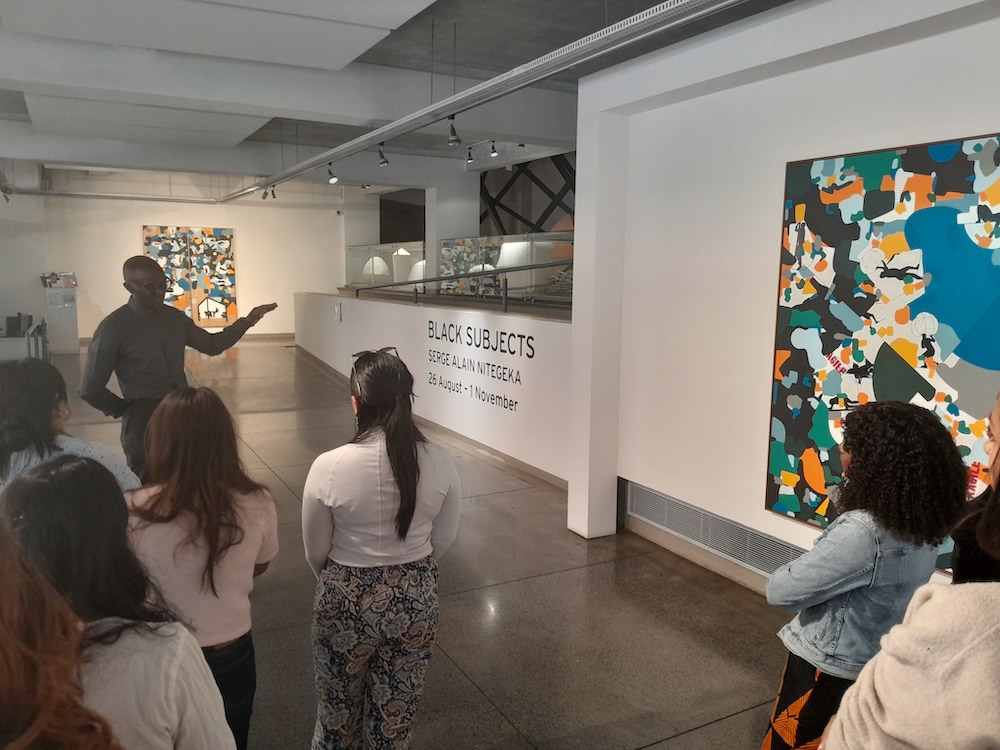
    Human mobility is the defining feature of an era marked by political instability, economic precarity, and environmental insecurity. These movements are reshaping urban landscapes and Africa’s cities stand at the forefront of this transformation. They are now among the world’s largest and most diverse urban centres, serving as focal points for a youthful, rapidly growing population. Yet, this is occurring without the traditional pathways of industrialization, job creation, and service provision. Urban life now blurs the line between lottery and life-making. It is a life of uncertainty. The complexities of material marginalization and mobile place-making demand novel ways of understanding community, politics, and the city itself. It requires novel forms of analysis that avoid oversimplified narratives and instead embrace the ambiguities characterising African urban life.   Atlas of Uncertainty: Transforming African Cityscapes is a multi-media research project by the African Centre for Migration and Society (ACMS) at the University of the Witwatersrand, and the Mobility Governance Lab at the University of Oxford. The Atlas of Uncertainty unsettles the racialised tropes of danger, desperation, and deprivation informing the manic mapping of contemporary migration and urbanisation in Africa. Where such classic cartography typically projects scientific certainty, the Atlas elevates emotion, ambiguity, and contributors’ […]

  • ACMS Seminar: ‘From Deprivation to Mobilisation: Towards a Multideterminant Model of Xenophobic Violence in South Africa’

    ACMS Seminar Room 2163, South East Wing, Second Floor, Solomon Mahlangu House, University of the Witwatersrand East Campus

    Presenter: Dr Jean Pierre Misago Date: 12 March 2025 Time: 12.20 – 13.30 Venue: ACMS Seminar Room: Room 2163, Solomon Mahlangu House (2nd floor), East Campus, Wits University (directions) Zoom: link Please register: here Abstract: Drawing on extensive and comparative qualitative data from a nearly two-decade long and ongoing research, this paper responds to inadequacies and limitations of current causal explanations for xenophobic violence in South Africa. It argues that existing explanations are inadequate as many lack empirical backing and others are incomplete due to their reductionist approach. To address these shortcomings, this paper proposes an empirically based and theoretically informed multideterminant (explanatory) model, which identifies and analyses the roles of - and interconnections between - six key determinants namely: i) socio-economic and political deprivation, ii) xenophobic beliefs, iii) collective discontent, iv) political economy, v) mobilization, and vi) governance. The paper argues that i) these determinants and their interconnections in a value-added process constitute the necessary and sufficient conditions for the occurrence of xenophobic violence, and ii) this multideterminant model consequently provides an adequate and comprehensive explanation of the xenophobic violence in South Africa. Bio: Dr Jean Pierre Misago is a Senior Researcher at the Africa Centre for Migration & […]

  • ACMS Seminar: The ‘Oil and Water’ Dynamics of Migration Governance in West Africa: A Bottom-up Perspective in Niger

    ACMS Seminar Room 2163, South East Wing, Second Floor, Solomon Mahlangu House, University of the Witwatersrand East Campus

    Presenter: Dr Balkissa Daouda Diallo Date: Wednesday, 23 July 2025 Time: 12:30 – 13:45 Venue: ACMS Seminar Room: Room 2163, Solomon Mahlangu House (2nd floor), East Campus, Wits University (directions) Zoom link: https://wits-za.zoom.us/j/95441930593 Register: https://tinyurl.com/4zxkc7s8 Abstract: Studies on migration governance in the context of African so-called migrants sending countries are often influenced by European narratives. While this discourse informs migration policy in these countries, it overshadows existing local mechanisms that condition actors’ practices. Debates on this issue either point to the influence of the European Union (EU) on migration governance in Africa, or to the agency of African states in aligning or ‘bargaining’ their policy goals with global agendas on migration. The present discussion uses a multi-level governance lens to examine the case of Niger’s management of ‘transit’ migration to Europe from 2015–2020. Its objective is to explore the influences multi-level actors had on this governance and its outcomes. In doing so, it shows how higher-level processes seldom reflect lower-level realities where informality prevails often at the expense of migrants. These dynamics critically challenge conventional ideas of what is considered ‘legal’ or ‘illegal’ crossings in a context where borders are negotiated informally. About the researcher: Dr Balkissa Daouda Diallo is […]

  • ACMS Seminar: Queering Sex work and Mobility in South Africa

    ACMS Seminar Room 2163, South East Wing, Second Floor, Solomon Mahlangu House, University of the Witwatersrand East Campus

    Presenter: Ntokozo Yingwana Date: Wednesday, 6 August 2025 Time: 12:30 – 13:45 Venue: ACMS Seminar Room: Room 2163, Solomon Mahlangu House (2nd floor), East Campus, Wits University (directions) Zoom link: https://wits-za.zoom.us/j/95786624514?pwd=53Oi1h6gHcWY2Q43O0p8ZqzOsOLZXp.1 Register: https://tinyurl.com/4zxkc7s8 Abstract: Drawing from a doctoral thesis with a similar title, this paper explores the intersections of sex work, mobility, migration and gendered sexualities through a queer lens. The study informing it made use of digital storytelling and WhatsApp to engage 17 migrant and mobile sex workers in South Africa, during 2019 and 2020. Through a queering of sex work, migration and mobility analysis we learn that because sex work is essentially about using one’s body to perform varying sexual acts with different types of people for financial gain, a migrant/mobile sex worker is exposed to different ways of experiencing sexual (dis)pleasure. According to the research participants this can then broaden the body’s erotic vocabulary and expand one’s range of sexual desires, along with their expressions; to the point whereby it can also have an influence on one’s gendered sexuality and choice of intimate partner. However, the respondents also stressed the integral role movement plays in this evolution of one’s gendered sexuality. Hence, this paper argues for the recognition […]


  • ACMS Seminar: Managing the Transition – Adjusting Migration Policies to Respond to a World Undergoing Demographic Change

    ACMS Seminar Room 2163, South East Wing, Second Floor, Solomon Mahlangu House, University of the Witwatersrand East Campus

    Presenter: Dr Andrew Selee Date: Wednesday, 20 August 2025 Time: 12:30 – 13:45 Venue: ACMS Seminar Room: Room 2163, Solomon Mahlangu House (2nd floor), East Campus, Wits University (directions) Zoom link: https://wits-za.zoom.us/j/95786624514?pwd=53Oi1h6gHcWY2Q43O0p8ZqzOsOLZXp.1 Register: https://tinyurl.com/4zxkc7s8 Abstract: The world is undergoing rapid demographic change, with most upper and upper-middle-income countries dropping below replacement level fertility and many middle-income countries following close behind. As populations shrink in these countries, immigration will become one of the few ways that countries maintain a robust labor force and ensure fiscal solvency, even taking into account productivity gains and changes in workforce needs brought about by technological innovation. And African countries will almost certainly be the source of most of the migrants that are willing to move to these rapidly aging societies. However, this transition is likely to be less than smooth, with increased migration also leading to significant push-back within destination countries and to calls both for greater border controls. As a result, managing this transition effectively will require building legal pathways proactively, adjusting the pace of change thoughtfully, and ensuring the credibility of immigration systems to facilitate mobility. It will also require rethinking narratives of national identity in destination societies, while ensuring that emigration from source […]

  • ACMS seminar: On the move — where does wellbeing fit?

    ACMS Seminar Room 2163, South East Wing, Second Floor, Solomon Mahlangu House, University of the Witwatersrand East Campus

    Date: Monday, 25 August 2025 Time: 10:00 – 11:30 Venue: ACMS Seminar Room: Room 2163, Solomon Mahlangu House (2nd floor), East Campus, Wits University (directions) Zoom link: https://wits-za.zoom.us/j/99337631783?pwd=gvLi3k7R74aLv3N9R2t4IY2NtMa4RP.1 Migration and mobility shape multiple dimensions of wellbeing, from physical and mental health to social inclusion, identity, and access to rights. Yet, wellbeing often remains a secondary consideration in policy and research on migration. This webinar explores how wellbeing fits into the lived realities of those on the move — highlighting the challenges they face, the resilience they show, and the policies and practices needed to support them. SPEAKERS Ms Margaret Zulu – Project Manager, Save the Children, South Africa Dr Mwelwa Phiri – Researcher, Zambart, Zambia Dr Glynis Clacherty – Research Associate, ACMS, Wits University and Independent Consultant MODERATOR Dr Langelihle Mlotshwa- Researcher, ACMS, Wits University

  • WiP Seminar: The Securitisation of Migration: Consequences of EU Externalisation Policies on Conflict Resolution and Peacebuilding in Africa

    ACMS Seminar Room 2163, South East Wing, Second Floor, Solomon Mahlangu House, University of the Witwatersrand East Campus

    The featured image behind the title on the header was created using ChatGPT. Presenter: Dr Silindile Mlilo Date: Wednesday, 27 August 2025 Time: 12:30 – 13:45 Venue: ACMS Seminar Room: Room 2163, Solomon Mahlangu House (2nd floor), East Campus, Wits University (directions) Zoom link: https://wits-za.zoom.us/j/95786624514?pwd=53Oi1h6gHcWY2Q43O0p8ZqzOsOLZXp.1 Register: https://tinyurl.com/4zxkc7s8 Abstract: This work-in-progress (WiP) paper examines the impact of global migration governance, particularly the European Union’s (EU) externalisation policies, on conflict resolution and peacebuilding in Africa. Following the 2015 so-called “migration crisis,” the EU increasingly framed migration as a security threat, prioritising border militarisation, containment strategies, and partnerships with African states such as Niger, Libya, Egypt, and Tunisia. These policies sought to curtail irregular migration while neglecting root causes, including conflict, poverty, and governance failures, and often exacerbated local tensions between migrants and host communities. Drawing on a critique of Eurocentric narratives, the paper foregrounds African perspectives to highlight the unintended consequences of these policies. It explores how the securitisation of migration governance has contributed to human rights violations, corruption, and the destabilisation of regional mobility frameworks like the Economic Community of West African States (ECOWAS). Furthermore, the externalisation of migration policies has empowered non-state actors, such as smugglers and traffickers, while deepening economic […]

  • ‘The Borders of Transformation: The Continent and the South African University’ colloquium

    Ground Floor, Wartenweiler Library, Wits University

    This colloquium asks how universities in South Africa, and the scholars and activists housed within them, can respond to stormy political waters and to potentially competing visions of justice and transformation. Date: Thursday, 4 September 2025 Time: 13:00-17:00 (SAST) In-person venue: Ground Floor, Wartenweiler Library, Wits University Online: Link to be shared once RSVPed. RSVP: Lenore.Longwe@wits.ac.za, stating whether you will attend in-person or online. Description: This colloquium considers competing and complementary approaches to race and nationality in South African higher education, at a moment that marks ten years since the RhodesMustFall and FeesMustFall protests as well as being characterised by the increasing visibility and weaponisation of national and international xenophobia. It poses this question as a reflection not just on the Fallist movements, but on a three-decade long history of contentious post-Apartheid efforts to align the country’s universities with broader commitments to equity and progressive social change. Current attacks on academic institutions represent them as sites of illicit patronage of apparently unqualified foreigners, while foreign academics themselves navigate bureaucratic mazes and hostile atmospheres. What can these contradictions tell us about the processes of transformation and change that were meant to be invigorated by #RMF? The colloquium also considers future institutional […]