• ACMS Seminar: ‘From Deprivation to Mobilisation: Towards a Multideterminant Model of Xenophobic Violence in South Africa’

    ACMS Seminar Room 2163, South East Wing, Second Floor, Solomon Mahlangu House, University of the Witwatersrand East Campus

    Presenter: Dr Jean Pierre Misago Date: 12 March 2025 Time: 12.20 – 13.30 Venue: ACMS Seminar Room: Room 2163, Solomon Mahlangu House (2nd floor), East Campus, Wits University (directions) Zoom: link Please register: here Abstract: Drawing on extensive and comparative qualitative data from a nearly two-decade long and ongoing research, this paper responds to inadequacies and limitations of current causal explanations for xenophobic violence in South Africa. It argues that existing explanations are inadequate as many lack empirical backing and others are incomplete due to their reductionist approach. To address these shortcomings, this paper proposes an empirically based and theoretically informed multideterminant (explanatory) model, which identifies and analyses the roles of - and interconnections between - six key determinants namely: i) socio-economic and political deprivation, ii) xenophobic beliefs, iii) collective discontent, iv) political economy, v) mobilization, and vi) governance. The paper argues that i) these determinants and their interconnections in a value-added process constitute the necessary and sufficient conditions for the occurrence of xenophobic violence, and ii) this multideterminant model consequently provides an adequate and comprehensive explanation of the xenophobic violence in South Africa. Bio: Dr Jean Pierre Misago is a Senior Researcher at the Africa Centre for Migration & […]

  • ACMS Seminar: The ‘Oil and Water’ Dynamics of Migration Governance in West Africa: A Bottom-up Perspective in Niger

    ACMS Seminar Room 2163, South East Wing, Second Floor, Solomon Mahlangu House, University of the Witwatersrand East Campus

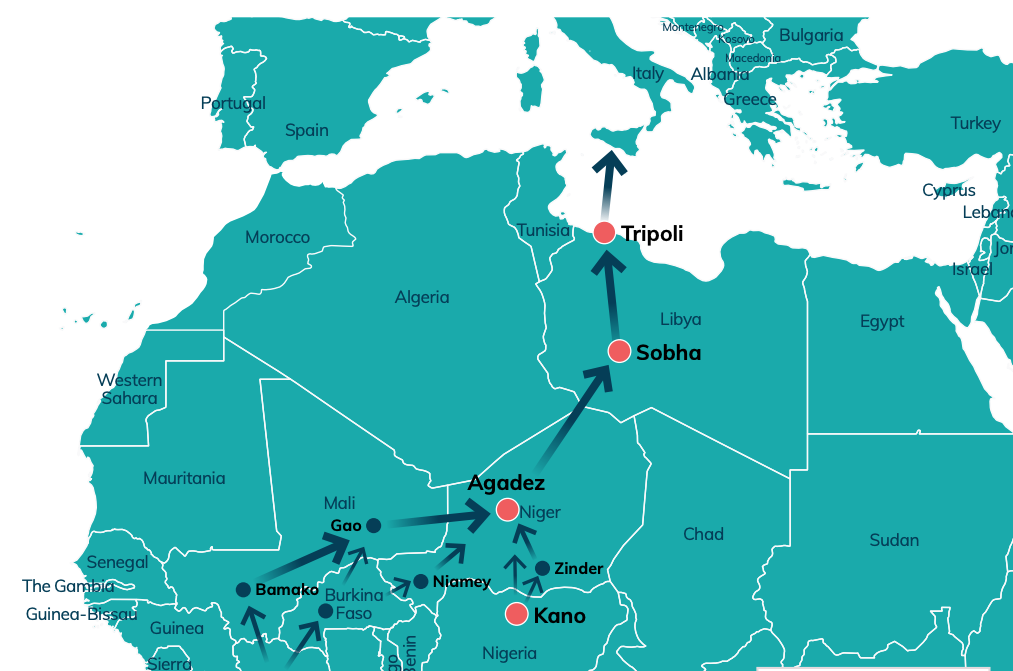
    Presenter: Dr Balkissa Daouda Diallo Date: Wednesday, 23 July 2025 Time: 12:30 – 13:45 Venue: ACMS Seminar Room: Room 2163, Solomon Mahlangu House (2nd floor), East Campus, Wits University (directions) Zoom link: https://wits-za.zoom.us/j/95441930593 Register: https://tinyurl.com/4zxkc7s8 Abstract: Studies on migration governance in the context of African so-called migrants sending countries are often influenced by European narratives. While this discourse informs migration policy in these countries, it overshadows existing local mechanisms that condition actors’ practices. Debates on this issue either point to the influence of the European Union (EU) on migration governance in Africa, or to the agency of African states in aligning or ‘bargaining’ their policy goals with global agendas on migration. The present discussion uses a multi-level governance lens to examine the case of Niger’s management of ‘transit’ migration to Europe from 2015–2020. Its objective is to explore the influences multi-level actors had on this governance and its outcomes. In doing so, it shows how higher-level processes seldom reflect lower-level realities where informality prevails often at the expense of migrants. These dynamics critically challenge conventional ideas of what is considered ‘legal’ or ‘illegal’ crossings in a context where borders are negotiated informally. About the researcher: Dr Balkissa Daouda Diallo is […]

  • ACMS Seminar: Queering Sex work and Mobility in South Africa

    ACMS Seminar Room 2163, South East Wing, Second Floor, Solomon Mahlangu House, University of the Witwatersrand East Campus

    Presenter: Ntokozo Yingwana Date: Wednesday, 6 August 2025 Time: 12:30 – 13:45 Venue: ACMS Seminar Room: Room 2163, Solomon Mahlangu House (2nd floor), East Campus, Wits University (directions) Zoom link: https://wits-za.zoom.us/j/95786624514?pwd=53Oi1h6gHcWY2Q43O0p8ZqzOsOLZXp.1 Register: https://tinyurl.com/4zxkc7s8 Abstract: Drawing from a doctoral thesis with a similar title, this paper explores the intersections of sex work, mobility, migration and gendered sexualities through a queer lens. The study informing it made use of digital storytelling and WhatsApp to engage 17 migrant and mobile sex workers in South Africa, during 2019 and 2020. Through a queering of sex work, migration and mobility analysis we learn that because sex work is essentially about using one’s body to perform varying sexual acts with different types of people for financial gain, a migrant/mobile sex worker is exposed to different ways of experiencing sexual (dis)pleasure. According to the research participants this can then broaden the body’s erotic vocabulary and expand one’s range of sexual desires, along with their expressions; to the point whereby it can also have an influence on one’s gendered sexuality and choice of intimate partner. However, the respondents also stressed the integral role movement plays in this evolution of one’s gendered sexuality. Hence, this paper argues for the recognition […]

  • ACMS Seminar: Managing the Transition – Adjusting Migration Policies to Respond to a World Undergoing Demographic Change

    ACMS Seminar Room 2163, South East Wing, Second Floor, Solomon Mahlangu House, University of the Witwatersrand East Campus

    Presenter: Dr Andrew Selee Date: Wednesday, 20 August 2025 Time: 12:30 – 13:45 Venue: ACMS Seminar Room: Room 2163, Solomon Mahlangu House (2nd floor), East Campus, Wits University (directions) Zoom link: https://wits-za.zoom.us/j/95786624514?pwd=53Oi1h6gHcWY2Q43O0p8ZqzOsOLZXp.1 Register: https://tinyurl.com/4zxkc7s8 Abstract: The world is undergoing rapid demographic change, with most upper and upper-middle-income countries dropping below replacement level fertility and many middle-income countries following close behind. As populations shrink in these countries, immigration will become one of the few ways that countries maintain a robust labor force and ensure fiscal solvency, even taking into account productivity gains and changes in workforce needs brought about by technological innovation. And African countries will almost certainly be the source of most of the migrants that are willing to move to these rapidly aging societies. However, this transition is likely to be less than smooth, with increased migration also leading to significant push-back within destination countries and to calls both for greater border controls. As a result, managing this transition effectively will require building legal pathways proactively, adjusting the pace of change thoughtfully, and ensuring the credibility of immigration systems to facilitate mobility. It will also require rethinking narratives of national identity in destination societies, while ensuring that emigration from source […]

  • ACMS seminar: On the move — where does wellbeing fit?

    ACMS Seminar Room 2163, South East Wing, Second Floor, Solomon Mahlangu House, University of the Witwatersrand East Campus

    Date: Monday, 25 August 2025 Time: 10:00 – 11:30 Venue: ACMS Seminar Room: Room 2163, Solomon Mahlangu House (2nd floor), East Campus, Wits University (directions) Zoom link: https://wits-za.zoom.us/j/99337631783?pwd=gvLi3k7R74aLv3N9R2t4IY2NtMa4RP.1 Migration and mobility shape multiple dimensions of wellbeing, from physical and mental health to social inclusion, identity, and access to rights. Yet, wellbeing often remains a secondary consideration in policy and research on migration. This webinar explores how wellbeing fits into the lived realities of those on the move — highlighting the challenges they face, the resilience they show, and the policies and practices needed to support them. SPEAKERS Ms Margaret Zulu – Project Manager, Save the Children, South Africa Dr Mwelwa Phiri – Researcher, Zambart, Zambia Dr Glynis Clacherty – Research Associate, ACMS, Wits University and Independent Consultant MODERATOR Dr Langelihle Mlotshwa- Researcher, ACMS, Wits University

  • ACMS Seminar: Home and Away – An Analysis of Out of Country Voting in South African Elections

    ACMS Seminar Room 2163, South East Wing, Second Floor, Solomon Mahlangu House, University of the Witwatersrand East Campus

    Presenter: Dr Catherine Musuva Date: Wednesday, 17 September 2025 Time: 12:30 – 13:45 Venue: ACMS Seminar Room: Room 2163, Solomon Mahlangu House (2nd floor), East Campus, Wits University (directions) Zoom link: https://wits-za.zoom.us/j/95786624514?pwd=53Oi1h6gHcWY2Q43O0p8ZqzOsOLZXp.1 Register: https://tinyurl.com/4zxkc7s8 Abstract: This research examines the extent to which South Africans living abroad are interested in participating in homeland elections. South Africa has a relatively large emigrant population, and non-resident citizens enjoy the right to vote in national elections. Yet, electoral behaviour is largely studied through a domestic voter lens, and the factors that influence emigrant political behaviour are not fully understood despite the growing interest of migration scholars and political scientists in external voting globally. A historical analysis of external voting data from the electoral commission of South Africa reveals that uptake is very low and opposition parties are the main beneficiaries of external votes. The research theorises on explanations for the data and contributes to broader debates on migrant agency, citizenship and transnational political participation. About the researcher/presenter: Dr Catherine Musuva is a senior researcher and postgraduate coordinator at the African Centre for Migration and Society (ACMS) at Wits. She is also a research fellow at the Centre for Research on Democracy (CREDO) at Stellenbosch University. […]

  • ACMS SEMINAR: Exclusionary Cohesion? Rethinking the Nexus between Social Cohesion and Xenophobic Violence in South Africa

    ACMS Seminar Room 2163, South East Wing, Second Floor, Solomon Mahlangu House, University of the Witwatersrand East Campus

    Presenter: Dr Jean Pierre Misago Date: Wednesday, 25 March 2026 Time: 12:30 – 13:45 Venue: ACMS Seminar Room (2163), Solomon Mahlangu House (2nd floor), East Campus, Wits University (directions) Zoom link: https://tinyurl.com/3dwkccpp, Meeting ID: 957 8662 4514, Passcode: 012731 RSVP: Email ntokozo.yingwana@wits.ac.za Abstract: Drawing on nearly two decades of multi-case and comparative qualitative research, this article examines the relationship between social cohesion and xenophobic violence in South Africa. Echoing emerging scholarship, it challenges the conventional wisdom that social cohesion is inherently a solution to violence. It demonstrates that under certain conditions, social cohesion is linked to xenophobic violence, not as a solution but as a driver. It indeed argues that intersections between i) migration-induced diversity; ii) severe socio-economic deprivation; and iii) local governance deficits turn already pervasive bonding cohesion into ‘exclusionary cohesion’, thereby rendering aspects of social cohesion (i.e. social cohesion itself) a driver of xenophobic violence. The article makes three scholarly contributions. First, it introduces two concepts – ‘exclusionary cohesion’ and ‘deprivation-induced cohesion’ (an extension of social closure) - that capture the essence of aspects of social cohesion making it a driver of xenophobic violence in South Africa. Second, it lends voice to calls for reconceptualising social cohesion by […]

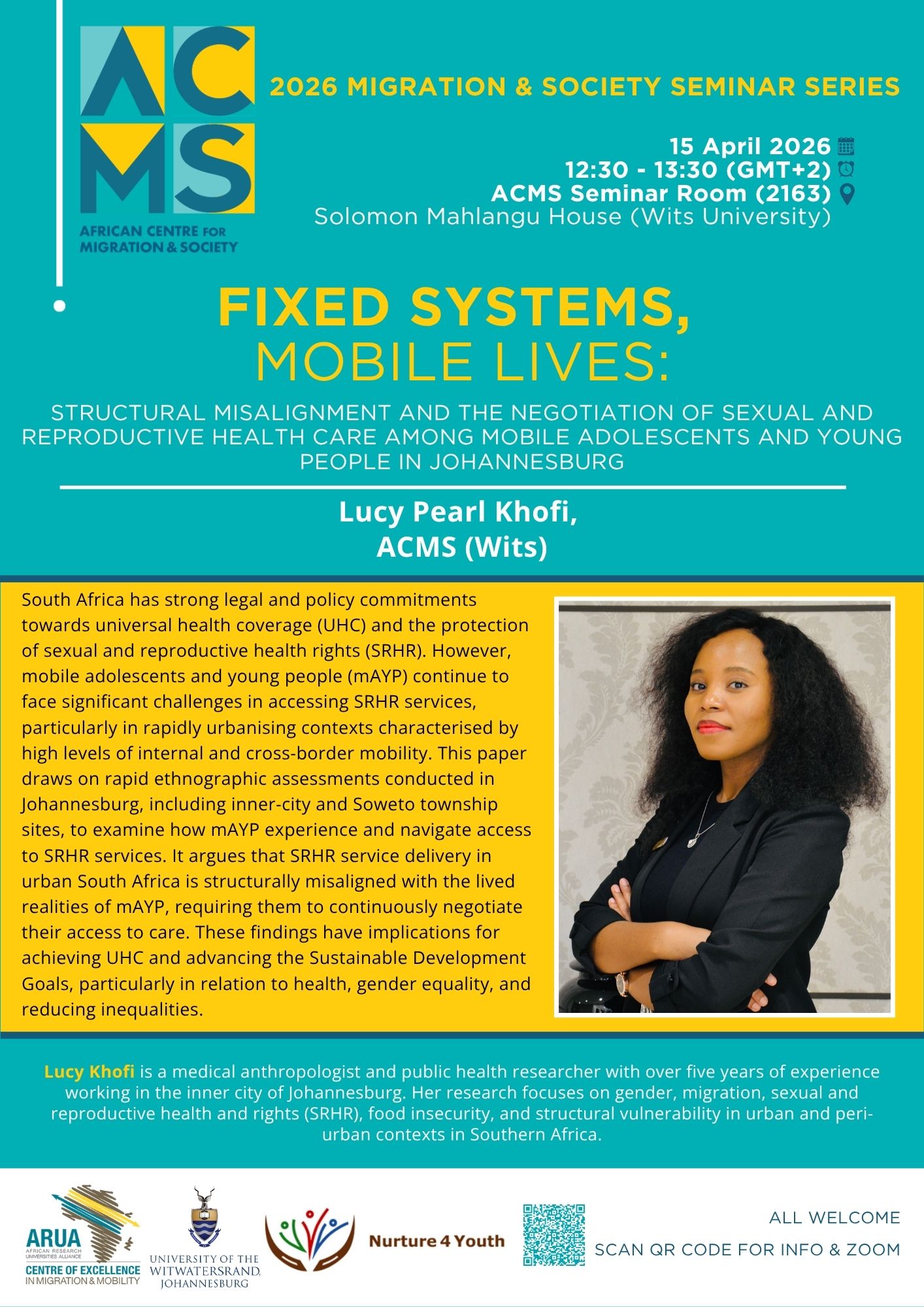
  • ACMS SEMINAR: Fixed Systems, Mobile Lives

    ACMS Seminar Room 2163, South East Wing, Second Floor, Solomon Mahlangu House, University of the Witwatersrand East Campus

    Presenter: Dr Lucy Pearl Khofi Discussant: Professor Busisiwe Nkala-Dlamini (Wits University, Department of Social Work) Title: Fixed Systems, Mobile Lives: Structural Misalignment and the Negotiation of Sexual and Reproductive Health Care among Mobile Adolescents and Young People in Johannesburg Date: Wednesday, 15 April 2026 Time: 12:30 – 13:30 Venue: ACMS Seminar Room (2163), Solomon Mahlangu House (2nd floor), East Campus, Wits University (directions) Zoom link: https://tinyurl.com/3dwkccpp, Meeting ID: 957 8662 4514, Passcode: 012731 RSVP: Email ntokozo.yingwana@wits.ac.za Abstract: South Africa has strong legal and policy commitments towards universal health coverage (UHC) and the protection of sexual and reproductive health rights (SRHR). However, mobile adolescents and young people (mAYP) continue to face significant challenges in accessing SRHR services, particularly in rapidly urbanising contexts characterised by high levels of internal and cross-border mobility. Nurture4Youth aims to support mAYP’s health and wellbeing by strengthening their capacity to navigate access to SRHR services in new and often precarious environments. This paper draws on rapid ethnographic assessments conducted in Johannesburg, including inner-city and Soweto township sites, to examine how mAYP experience and navigate access to SRHR services. The rapid ethnographic assessment approach included participatory methods such as transect walks, structured observations of key spaces, community engagements, and in-depth […]

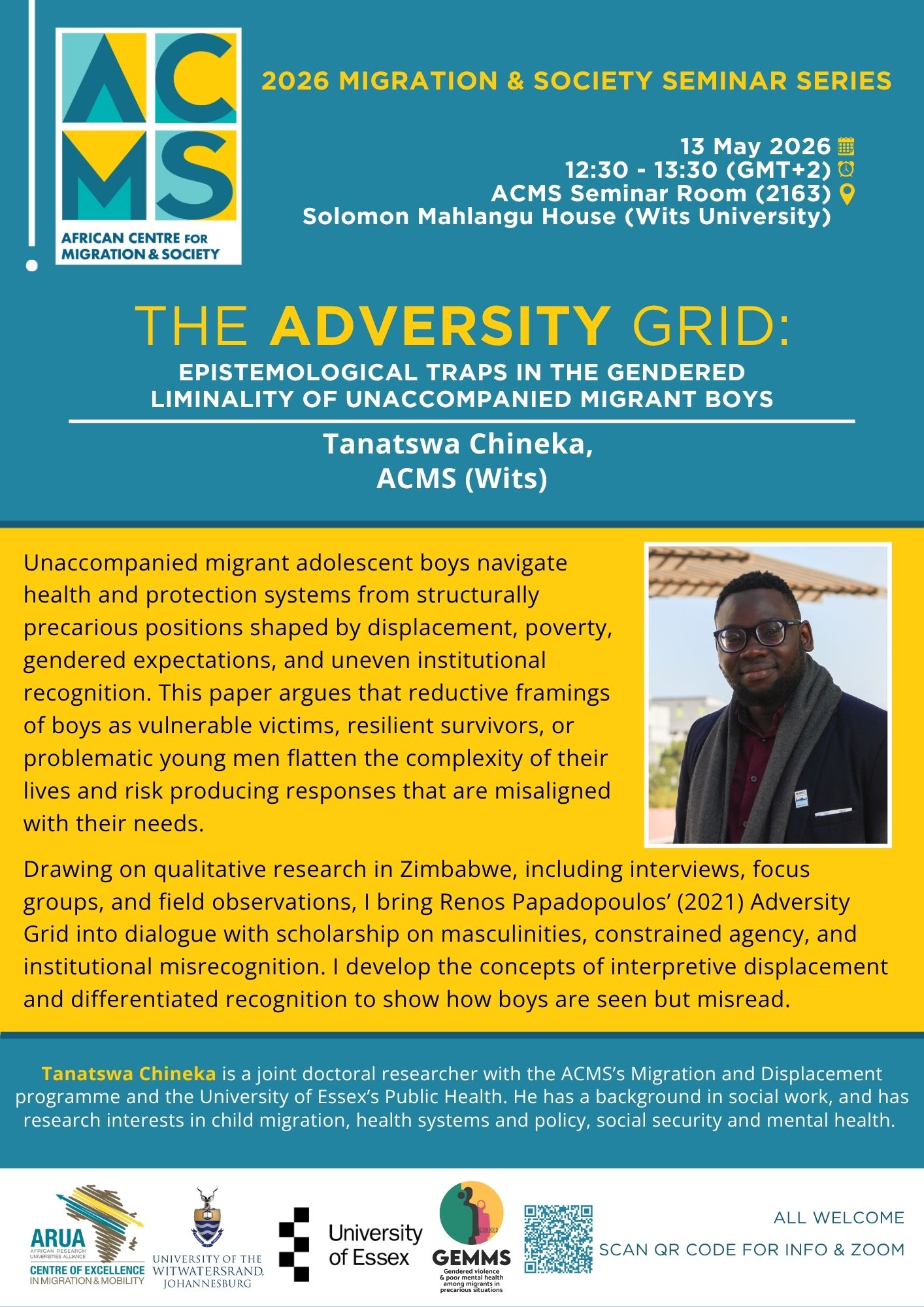
  • ACMS SEMINAR: The Adversity Grid – Beyond Epistemological Traps

    ACMS Seminar Room 2163, South East Wing, Second Floor, Solomon Mahlangu House, University of the Witwatersrand East Campus

    Presenter: Tanatswa Chineka Title: The Adversity Grid: Beyond Epistemological Traps in the Gendered Liminality of Unaccompanied Migrant Boys Respondent: Prof. Edmos Mtetwa (Department of Social Work, University of Zimbabwe)  Date: Wednesday, 13 May 2026 Time: 12:30 – 13:30 Venue: ACMS Seminar Room (2163), Solomon Mahlangu House (2nd floor), East Campus, Wits University (directions) Zoom link: https://tinyurl.com/3dwkccpp, Meeting ID: 957 8662 4514, Passcode: 012731 RSVP: Email ntokozo.yingwana@wits.ac.za Abstract: Unaccompanied migrant adolescent boys navigate health and protection systems from structurally precarious positions shaped by displacement, poverty, gendered expectations, and uneven institutional recognition. This paper argues that reductive framings of boys as vulnerable victims, resilient survivors, or problematic young men flatten the complexity of their lives and risk producing responses that are misaligned with their needs. Drawing on qualitative research in Zimbabwe, including interviews, focus groups, and field observations, I bring Renos Papadopoulos’ (2021) Adversity Grid into dialogue with scholarship on masculinities, constrained agency, and institutional misrecognition. Findings show that boys occupy a condition of gendered liminality and are subject to a girl-centred triage, achieving only partial recognition through the figure of the “good migrant boy.” I develop the concepts of interpretive displacement and differentiated recognition to show how boys are seen but […]

  • ACMS SEMINAR: Growing Up Across Borders

    ACMS Seminar Room 2163, South East Wing, Second Floor, Solomon Mahlangu House, University of the Witwatersrand East Campus

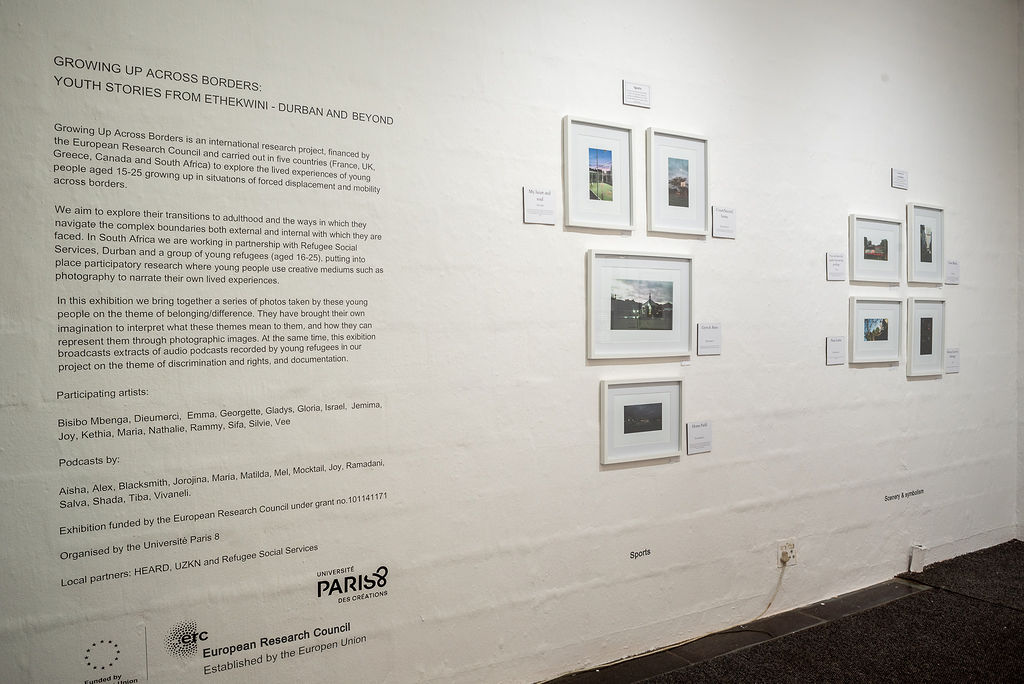
    Presenters: Prof. Jane Freedman and Dr Aron Hagos Tesfai Title: Growing Up Across Borders Date: Wednesday, 20 May 2026 Time: 12:30 – 13:30 Venue: ACMS Seminar Room (2163), Solomon Mahlangu House (2nd floor), East Campus, Wits University (directions) Zoom link: https://tinyurl.com/3dwkccpp, Meeting ID: 957 8662 4514, Passcode: 012731 RSVP: Email ntokozo.yingwana@wits.ac.za Abstract: Growing Up Across Borders (GRABS) is a project at the Université Paris 8 that explores how migration, mobility, and urban life shape the health, wellbeing, and everyday experiences of young people across Southern Africa. Bringing together research, dialogue, and community engagement, the project focuses particularly on the ways mobile and migrant youth navigate access to healthcare, social support, education, and opportunities within contexts of inequality and precarity. By centring young people’s lived experiences across borders, the project aims to generate evidence that informs more inclusive policies, responsive health systems, and youth-centred approaches to social justice and development. About the presenters: Prof. Jane Freedman is the leader of the European Research Council (ERC) funded Growing Up Across Borders (GRABS) project. She is a professor at the Université Paris 8 and a member of the Paris Centre for Social and Political Research (CRESPPA). Her research has focused for many years […]