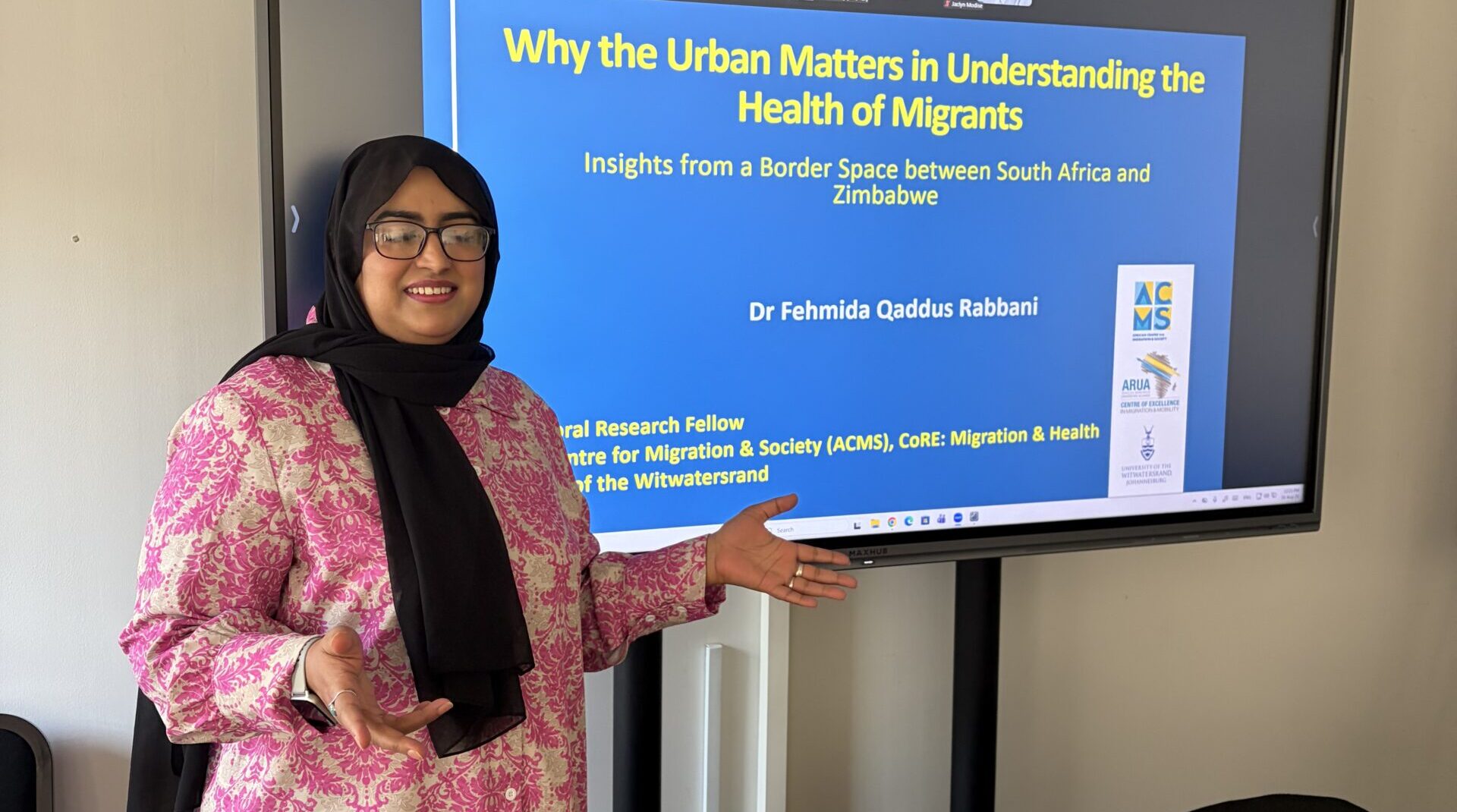
On 26 August, Dr. Fehmida Qaddus Rabbani (Postdoctoral Research Fellow, African Centre for Migration & Society) presented her research on how everyday urban conditions shape the health and well-being of South Asian migrants in Musina, a busy South African town on the border with Zimbabwe.
Drawing on qualitative fieldwork and interviews with South Asian migrants, her paper highlighted the critical role of daily urban conditions, access to secure housing, work, safety, and social services, in shaping health outcomes. Rather than focusing solely on healthcare systems and policies, she argued that the health of migrants is deeply shaped by how they experience life in an urban border area, where many remain for extended periods rather than simply passing through.
Dr. Langelihle Mlotshwa (Senior Research, ACMS) responded, offering reflections:
- Migrants are active agents, they navigate and reshape the spaces they occupy.
- There is a missing link in understanding the discrimination migrants face.
- Do migrants respond naturally to urban structures, or are they transformed by them?
- Who is actually a migrant? How does everyday life shape health and wellbeing?
- Urban inequality and power are central: how do migrants navigate deeply unequal spaces?
- Dr. Langa also requested a detailed profile of participants to better understand how they experience life in these spaces, and posed a broader question: What does this work tell us about how cities themselves produce health inequalities?
Thank you to Dr. Rabbani for a thought-provoking seminar and to Dr. Langa for pushing the conversation further.
0 Comments