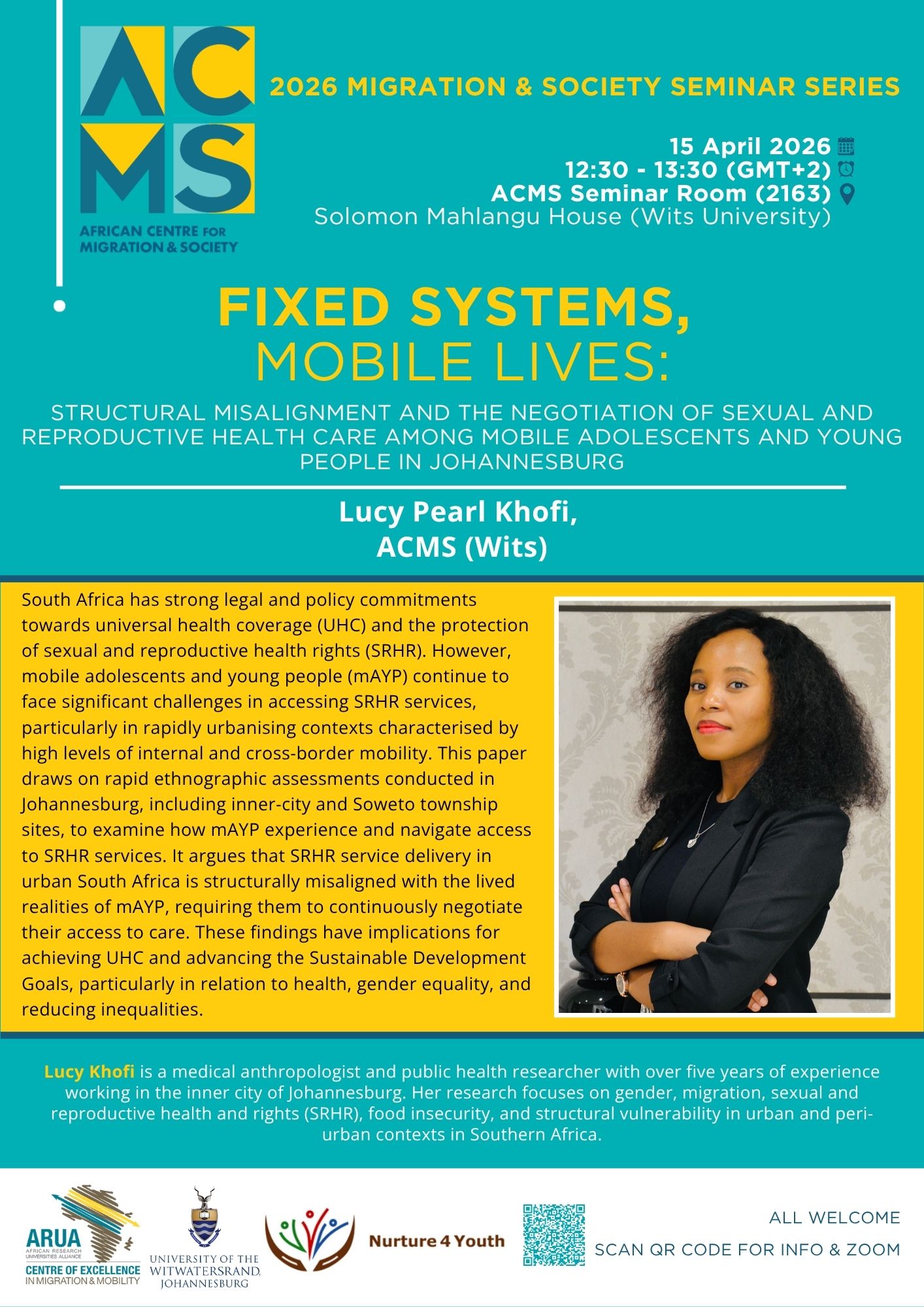
 Presenter: Dr Lucy Pearl Khofi
Discussant: Professor Busisiwe Nkala-Dlamini (Wits University, Department of Social Work)
Title: Fixed Systems, Mobile Lives: Structural Misalignment and the Negotiation of Sexual and Reproductive Health Care among Mobile Adolescents and Young People in Johannesburg
Date: Wednesday, 15 April 2026
Time: 12:30 – 13:30
Venue: ACMS Seminar Room (2163), Solomon Mahlangu House (2nd floor), East Campus, Wits University (directions)
Zoom link: https://tinyurl.com/3dwkccpp, Meeting ID: 957 8662 4514, Passcode: 012731
RSVP: Email ntokozo.yingwana@wits.ac.za
Abstract:
South Africa has strong legal and policy commitments towards universal health coverage (UHC) and the protection of sexual and reproductive health rights (SRHR). However, mobile adolescents and young people (mAYP) continue to face significant challenges in accessing SRHR services, particularly in rapidly urbanising contexts characterised by high levels of internal and cross-border mobility. Nurture4Youth aims to support mAYP’s health and wellbeing by strengthening their capacity to navigate access to SRHR services in new and often precarious environments.
This paper draws on rapid ethnographic assessments conducted in Johannesburg, including inner-city and Soweto township sites, to examine how mAYP experience and navigate access to SRHR services. The rapid ethnographic assessment approach included participatory methods such as transect walks, structured observations of key spaces, community engagements, and in-depth interviews and discussions with mAYP, healthcare providers, and community stakeholders.
A thematic analysis of the data highlights the structural misalignment between mobile populations and territorially fixed health systems. Findings show that access to SRHR services is not determined solely by availability, but is actively negotiated through temporal, spatial, and social processes. Young people described waking before sunrise to secure a place in clinic queues, often facing long waiting times and the risk of being turned away. Frequent mobility across neighbourhoods, provinces, and national borders disrupts continuity of care, while health systems remain spatially fixed and administratively fragmented. Informal networks and community-based organisations mediated access by directing young people to specific clinics, sharing information about service availability, and, in some cases, facilitating entry into services where formal access pathways were limited. These forms of mediation were uneven, with access shaped by young people’s social connections, gendered experiences, and familiarity with local support structures.
This paper argues that SRHR service delivery in urban South Africa is structurally misaligned with the lived realities of mAYP, requiring them to continuously negotiate their access to care. These findings have implications for achieving UHC and advancing the Sustainable Development Goals, particularly in relation to health, gender equality, and reducing inequalities.
About the researcher/presenter:
Lucy Pearl Khofi is a medical anthropologist and public health researcher with interdisciplinary expertise in gender, migration, sexual and reproductive health and rights (SRHR), food insecurity, and structural vulnerability in urban and peri-urban contexts in Southern Africa. She is a Postdoctoral Researcher at ACMS, University of the Witwatersrand, where she is part of the NIHR-funded Nurture4Youth project focusing on mobility, youth wellbeing, and access to SRHR services.

0 Comments