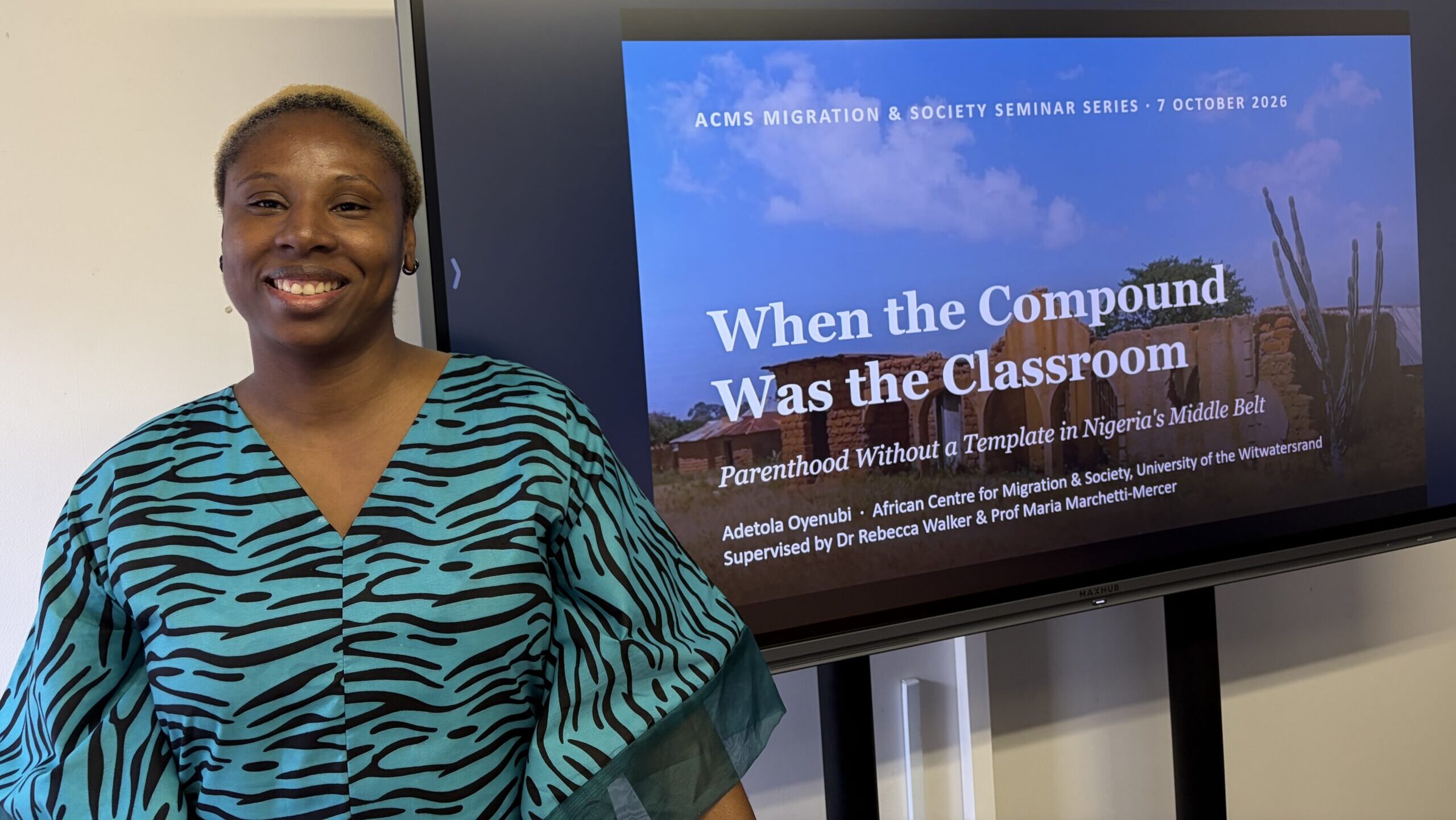
Adetola Oyenubi (PhD Candidate, ACMS) opened her seminar with a simple but profound question: What happens to caregiving when the usual people who teach are gone?
Drawing on six months of embedded fieldwork in Bokkos, Plateau State, Adetola shared how the December 2023 attacks killed hundreds and displaced thousands, leaving many caregivers to rebuild family life without the people who once taught them how. Her research introduces the concept of “transmission breach” to describe how displacement severs the everyday apprenticeship through which caregiving knowledge passes between generations.
She draws on situated learning theory, feminist care theory, and the anthropology of African childhood. Notably, she argued that this study matters beyond migration studies, pointing to how caregiving is unpaid, often uncosted work, and how caregivers themselves can lose their lives in the process.
Respondent: Dr. Turnwait Otu Michael (Senior Postdoctoral Research Fellow, Department of Sociology, University of Johannesburg) offered a rigorous and generous response. His work spans population and health, migration and displacement, family and reproductive health, gender, and social change in Africa, with over a decade of experience in mixed-methods research.
His key reflections:
- The central intellectual contribution is the transmission breach concept itself.
- The paper must specify the defining conditions that identify the breach, so other researchers can take it further beyond Bokkos.
- What must we observe empirically to understand the transmission breach? What are its elements in relation to the evidence?
- The paper powerfully highlights gender, associating women with caregiving and men with economic activity. Could we be observing new caregiving knowledge and identities that reshape gender norms?
- Conventional humanitarian interventions may not be sufficient, as they do not respond to the inter-generational process through which caregiving was taught.
From the floor:
- What has changed over the years regarding caregiving norms?
- What were parenting styles during displacement?
- How did Adetola’s positionality shape her interpretation and analysis?
- The paper should move beyond intervention strategies to articulate its academic contribution.
- Why does caregiving matter, and who is responsible for it?
- Is caregiving presented as linked only to nuclear families and gender?
Adetola’s response:
The transmission breach is a temporary disruption, confidence may be rebuilt over time. There is a need for frameworks that support current caregivers who have no templates. Children born into violence often turn to substances. Displacement in Plateau initially placed people in camps, but many remain scattered and invisible. Women are now participating in the economy, and men can be taught to caregive. She defines care as “the performance of raising someone regardless of age”, for her study, the daily work of tending to a child’s needs.
Thank you to Adetola for a deeply human and rigorous presentation, Dr Brian Murahwa for chairing the seminar and to Dr. Michael for an incisive response, and to all who contributed to the discussion.
Applications to study at the ACMS are still open. Learn more here.
0 Comments