
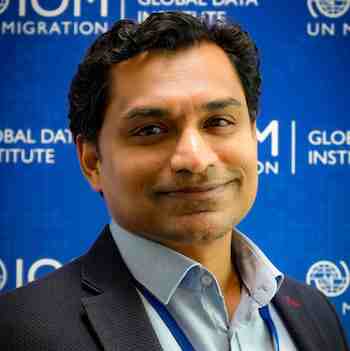
Dr. Wickramage is a Public Health Specialist and Migration Health Scholar with over 22 years of experience with the World Health Organization (WHO) and the UN migration agency. He has led health sector responses to humanitarian emergencies and advanced technical cooperation, health policy and diplomacy at the intersection of migration, health, and development with governments, academia, and UN across Asia, the Middle East, Africa, and Europe.
As the former Head of IOM’s Global Migration Health Research and Epidemiology Unit (2016-2025), Dr. Wickramage provided technical guidance to member states and country/regional offices while leading evidence generation, synthesis, and knowledge management across IOM’s health and migration portfolios. He supported research and evidence generation to UN missions across three program domains: health assessment, technical cooperation, and humanitarian emergencies.
He worked with WHO’s Health Action in Crisis team from 2004, coordinating frontline humanitarian interventions in context of civil war, the Indian Ocean tsunami, and post-conflict health system recovery. Since joining IOM in 2009 as head of health programs, and later as advisor to Migration Health Director in Geneva from 2014, he implemented health projects at national, regional, and global levels, including strengthening migration health data systems, cross-border malaria elimination, building state capacities in border health for global health security, advancing social and health protection for migrant workers and their families, and evaluating responses to disease outbreaks such as Ebola in West Africa.
Dr. Wickramage as of 2025 has authored over 93 peer-reviewed publications (h-index 30; i10-index 50), books, and book chapters. He serves on the advisory board of BMJ and as has served as editor for PLoS Medicine, BMJ, and The Lancet. His book on evidence-based policy and practice in migration health, launched at the 2nd Global Consultation on Migration Health, is a key reference in the field. He has led the formulation of technical guidance for member states and the UN, including intersectoral approaches to advance migration health data in 2025.
He has supported governments in advancing national migration health policies through evidence-based approaches and received Presidential honors in Sri Lanka for his contributions to migration research. He served on numerous WHO expert advisory committees, including the inaugural WHO Director General Technical Advisory Group on migrant and refugee health in 2019. Driven by a passion to advance migration health scholarship in the Global South, he co-founded the MHADRI Network in 2017—the world’s largest network of migration health research scholars—fostering global collaboration and knowledge exchange especially in Global South. He currently serves as its Executive Director and continues to provide expert advisory to Governments, UN, academia, civil society and private sector stakeholders.
He serves as affiliate/visiting scholar for the following institutions: Johns Hopkins University, USA; Imperial College London, UK; and University of the Witwatersrand, South Africa.