• A hustle for profit and protection: What informal mining reveals about governance in South Africa

    ACMS Seminar Room 2163, South East Wing, Second Floor, Solomon Mahlangu House, University of the Witwatersrand East Campus

    As part of the Lunchtime Seminar Series, the African Centre for Migration & Society invites you to a seminar titled A hustle for profit and protection: What informal mining reveals about governance in South Africa by Zaheera Jinnah (African Centre for Migration & Society, University of the Witwatersrand). This lecture builds on an in-progress book proposal which explores the lives and livelihoods of an informal community in Johannesburg, South Africa. In doing so it raises questions that cut to the core of post-apartheid South Africa’s economy, society, and politics. It dismantles a rights-based, rainbow coalition in which men and women embrace independence from colonial and apartheid oppression, living freely as democratic and equal citizens of a proud land. Rather it points to pervasive informality, inequality, and risks to rights and democracy. But mostly the book attempts to paint a portrait of the everyday struggles of survival for the urban poor. What happens when the poor remain poor? What happens when they are ignored and mistreated, especially by the authorities meant to protect them? How do people work in an economy strained by slow growth, jobless growth, and a labour market marked by patronage? How do we explain the relationship between land, and its riches and the poor who […]
  • Transnational motherhood and economic failure: Latina immigrant domestic workers and the children they left behind

    ACMS Seminar Room 2163, South East Wing, Second Floor, Solomon Mahlangu House, University of the Witwatersrand East Campus

    As part of the Lunchtime Seminar Series, the African Centre for Migration & Society invites you to a seminar titled Transnational motherhood and economic failure: Latina immigrant domestic workers and the children they left behind by Lorena Munoz (Gender, Women and Sexuality Studies, University of Minnesota). This presentation explores the experiences regarding family separations—a contemporary condition of transnational motherhood of Latina immigrant domestic workers as well as the children they left behind. Through well-established narratives of separation, female immigrant domestic work is understood through multiple contradicting transnational meanings of motherhood. These discourses of transnational motherhood often frame immigrant mothers as heroic; these mothers have to leave their homes to sustain their families and communities, while also negotiating the emotions of being ‘bad’ mothers for leaving their children behind. This study adds to these gender and immigration transnational motherhood processes by analyzing how emotions tied to economic failures at different scales, shape the lived experiences of transnational mothers. To elaborate, for some immigrant domestic workers and transnational mothers, the poverty wages they receive in host countries are not sufficient to economically sustain their families and communities in sending countries. The ‘failure’ to sustain their families economically often leads to resentment among their children and extended family left behind, that […]

  • Basic Income: The Potential for Gendered Empowerment?

    ACMS Seminar Room 2163, South East Wing, Second Floor, Solomon Mahlangu House, University of the Witwatersrand East Campus

    The African Centre for Migration & Society invites you to a special public lecture titled Basic income: The potential for gendered empowerment? by Professor Alison Koslowski (School of Social and Political Science, University of Edinburgh). Basic income is likely to gain momentum as the next social welfare trend to sweep over the world with ideas of how to improve the fairness and efficiency of distributing money. Other earlier movements with similar ambitions to transform societies, ranging across the political spectrum from socialism to neo-liberalism, have led to very different consequences for strata of citizens, but have in common that they have de-prioritised gender equality in favour of other interests. Advocates of basic income suggest that in addition to pragmatic gains, such as a more efficient state administration, primarily a basic income will empower citizens, leading to the potential for greater human flourishing. The question is whether this empowerment will be gendered and if so, how? So far, the basic income debate addresses gender only in so far as it would raise the income of the poorest, of whom a larger proportion are women. However, it is less clear how it might contribute to a transformation of gendered behaviour, making possible divergent shapes of […]

  • Using pre-existing data for your own research

    ACMS Seminar Room 2163, South East Wing, Second Floor, Solomon Mahlangu House, University of the Witwatersrand East Campus

    The African Centre for Migration & Society invites you to a Methods Workshop on Using pre-existing data for your own research, a guest session by Professor Alison Koslowski (School of Social and Political Science, University of Edinburgh). Collecting your own data to do a research project is not always the best option. When using semi-structured interviews, or fixed choice questionnaires, the small number of respondents you can get ready access to and the time you have available to process the information you gather, means that your data may tell you very little. However, with a few basic skills that are easily picked up, you can access high-quality data, professionally assembled at substantial expense by expert organisations, and based on genuinely random samples that allow you to generalize to the population from which they have been drawn. Such data are very interesting to work with! In this session, we consider the skills you need to search for, locate, access, download, manage, process, analyse and present data as empirical research evidence, respecting the confidentiality or other obligations set by data providers and maintaining the security and integrity of the data you use. We will see if we can find you alternative sources of data that you might consider for […]

  • I Want to Go Home Forever: Stories of Becoming and Belonging in South Africa’s Great Metropolis

    Constitution Hill, 11 Kotze Street Braamfontein, Johannesburg

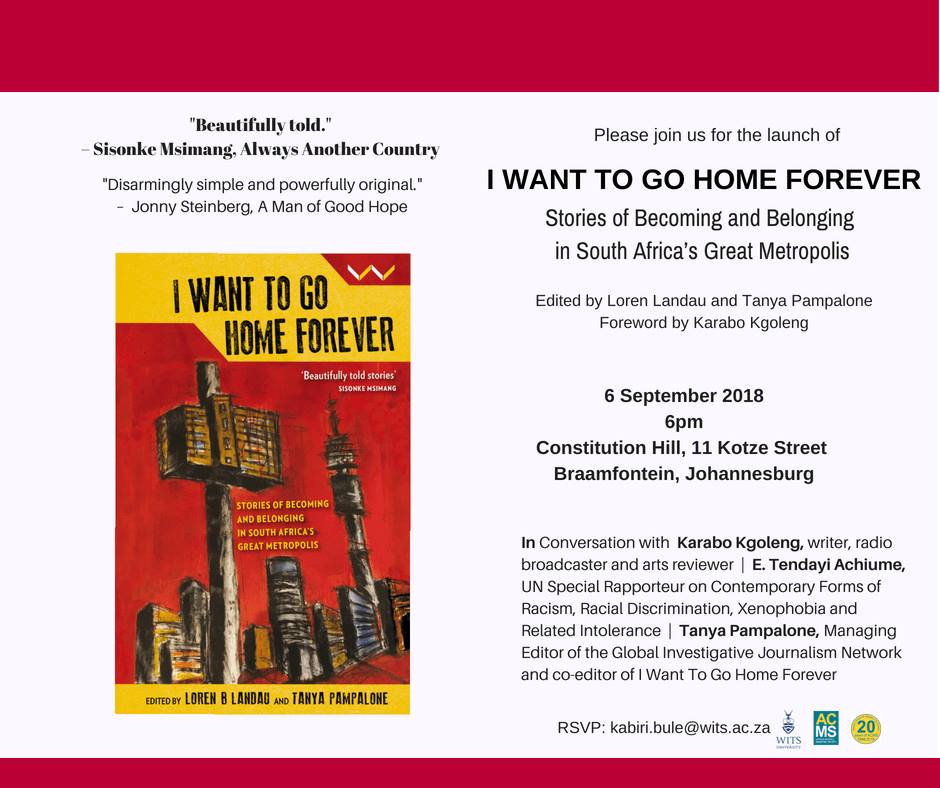
    Please join us for the launch of I Want to Go Home Forever: Stories of Becoming and Belonging in South Africa's Great Metropolis edited by Loren Landau and Tanya Pampalone in conversation with Karabo Kgoleng (writer, radio broadcaster and arts reviewer), E. Tendayi Achiume (UN Special Rapporteur on Contemporary forms of Racism, Racial discrimination, Xenophobia and Related Intolerance) and Tanya Pampalone, (managing editor for the Global Investigative Journalism Network and co-editor of I Want to Go Home Forever) Date: 6 September 2018 Time: 18.00 Venue: Constitution Hill, 11 Kotze Street Braamfontein, Johannesburg

  • Gathering stories from migrants and the women left behind: A methods perspective

    ACMS Seminar Room 2163, South East Wing, Second Floor, Solomon Mahlangu House, University of the Witwatersrand East Campus

    As part of the Lunchtime Seminar Series, the African Centre for Migration & Society invites you to a seminar titled Gathering family histories from migrants and the women left behind: A methods perspective by Grascious Ncube (Department of Development Studies, University of the Witwatersrand). Within the growing scholarship on transnational migration, the methodological approaches and time perspective employed in these studies have received some criticism. One of the major critiques is that research tends to focus more on the transmigrants (those who move) and neglects those who remain behind. In addition, studies have failed to trace processes of intergenerational flows in migrant families over multiple generations, thus failing to incorporate family migration trajectories from a historical perspective. Indeed, relatively few migration studies are anchored on tracing the historical interactions and dynamics of migrant families and some criticisms have been levelled against the methodological approaches used by these studies. For example, these have been criticised for proffering situational realities based on individuals’ narratives whose standpoints are fluid and shaped by the continual changes in their context. This issue questions the adequacy, authenticity and epistemological validity of the reality presented in these family history accounts. In this presentation, Grascious addresses some of these criticisms through the use of multi-sited ethnography […]

  • Places of Promise or Poverty? Urban informal Settlements in South Africa

    ACMS Seminar Room 2163, South East Wing, Second Floor, Solomon Mahlangu House, University of the Witwatersrand East Campus

    As part of the Lunchtime Seminar Series, the African Centre for Migration & Society invites you to a seminar titled Places of promise or poverty? Urban informal settlements in South Africa by Eldridge Moses (Department of Economics, Stellenbosch University).   Since the 1970s informal settlements or slums have grown dramatically in number and size on the outskirts of South Africa’s economic centres in order to satisfy urban unskilled and semi-skilled labour demand. However,provision of basic services has not kept pace with the rapid growth of the urban slum population. In addition, school resources are constrained by the settlement of internal migrants on the outskirts of, and within cities and large towns. The mismatch between urban population growth and service delivery has manifested itself in protests, which are often violent and damaging to political stability. The South African experience, and indeed that of developing countries in general, suggests that while migration to urban informal areas may serve a necessary labour market function of reducing search costs for both the firm and worker, it by no means guarantees that individual rural-urban migrants and their family are better off than their rural counterparts who decide not to migrate in terms of education and health outcomes. It is also unclear whether […]

  • The spectacle versus the ordinary: Urban change and narratives of difference along a ‘Chinese’ street in suburban Johannesburg

    ACMS Seminar Room 2163, South East Wing, Second Floor, Solomon Mahlangu House, University of the Witwatersrand East Campus

    As part of the Lunchtime Seminar Series hosted jointly with the French Institute of South Africa (IFAS), the African Centre for Migration & Society invites you to a seminar titled The spectacle versus the ordinary: Urban change and narratives of difference along a 'Chinese' street in suburban Johannesburg by Romain Dittgen (African Centre for Migration & Society, University of the Witwatersrand) and Gerald Chungu (School of Architecture and Planning, University of the Witwatersrand). Derrick Avenue in Cyrildene, a suburb in the eastern parts of the city, is the closest one can get to a clichéd Chinese (street life) atmosphere in Johannesburg. With its wide array of restaurants, businesses and significant numbers of Chinese residents, customers and shopkeepers, this activity node sparks imaginaries of a spatialised elsewhere while standing in sharp contrast to the surrounding, mostly residential, neighbourhood. Owing to the prevalence of visible Chinese markers and its demographics, this street has mainly been viewed as exceptional and different, contributing to divorcing Derrick Avenue from the rest of the city. Yet, at the same time and irrespective of its Chinese qualities, it also points to a number of urban dynamics that characterise Johannesburg as a whole, whether in terms of challenges or opportunities. If Derrick Avenue conveys the image of a disorderly strip with its over-crowding, […]

  • Migration in North and Central America: Myths and Realities

    ACMS Seminar Room 2163, South East Wing, Second Floor, Solomon Mahlangu House, University of the Witwatersrand East Campus

    As part of the Lunchtime Seminar Series hosted jointly with the Mexican Studies Centre, the African Centre for Migration & Society invites you to a seminar titled Migration in North and Central America: Myths and realities by Jorge Schiavon (International Studies Department, Centro de Investigación y Docencia Económicas). This presentation will analyze the migration phenomenon in North and Central America, stressing how myths and misconceptions have prevailed over serious analysis of the real flows. It will argue that the study of migration should emphasize its effects on development and on the four different components of the process: emigration, immigration, transit, and return. The central challenge of analyzing migration in North and Central America is to avoid analyzing today’s realities with yesterday’s lenses and tools. The more attractive and high impact migration studies will be those that evolve to studying migration in North and Central America analyzing regional migratory systems from a comprehensive (emigration, immigration, transit and return migration), inclusive (all relevant actors), comparative (in time and space), and interdisciplinary perspective, placing special emphasis on its effects on development and human rights. Historically, Mexican and Central American policy-makers and academics were mostly obsessed with the emigration component of the equation, while the U.S. scholars and policy-makers have only been interested in the immigration part. The […]

  • Barriers to Asylum Seekers Claiming Their Rights in South Africa’s Asylum Management System

    ACMS Seminar Room 2163, South East Wing, Second Floor, Solomon Mahlangu House, University of the Witwatersrand East Campus

    As part of the Lunchtime Seminar Series, the African Centre for Migration & Society invites you to a seminar titled Barriers to asylum seekers claiming their rights in South Africa's asylum management system by Susan Tolmay (Amnesty International South Africa). South Africa’s failed asylum management process has been well documented over the years. While a strong legal and human rights framework exists, the implementation of existing laws and policies, and even court orders is starkly lacking.  Amnesty International South Africa (AISA) embarked on research to gather its own data on the experiences of asylum seekers attempting to exercise their rights to get and remain documented in South Africa. The research set out to examine the status of Refugee Reception Offices (RROs) in South Africa, but inability to gain access to the three open RROs meant we shifted the focus to the effects of the closures of three of the urban RROs (Cape Town, Port Elizabeth and Crown Mines) on the lives of asylum seekers.  Aside from being in contempt of court orders, for years, to reopen the Cape Town and Port Elizabeth RROs (recently reopened), a range of factors make it extremely difficult for asylum seekers to claim and receive refugee status. Major issues include a lack of understanding or explanation of the […]