• “What futures were they ‘waiting’ for anyway?”: Addis Ababan youth in cultural dissent in the years leading up to the Ethiopian revolution, c.1950s-1974

    ACMS Seminar Room 2163, South East Wing, Second Floor, Solomon Mahlangu House, University of the Witwatersrand East Campus

    As part of the Lunchtime Seminar Series, the African Centre for Migration & Society invites you to a seminar titled “What futures were they ‘waiting’ for anyway?”: Addis Ababan youth in cultural dissent in the years leading up to the Ethiopian revolution, c.1950s-1974 by Semeneh Ayalew Asfaw (Institute of Ethiopian Studies, Addis Ababa University). In this seminar Asfaw shows how everyday social and cultural performative practices have been formative of political subjecthood for Addis Ababan youth prior to the Ethiopian revolution of 1974. Asfaw attempts to show the linkage between cultural dissent and the making of the Ethiopian revolution through an examination of social and cultural changes in urban space (particularly, Addis Ababa) among the youth between 1950 and 1974. Biography Semeneh Ayalew Asfaw is a researcher at the Institute of Ethiopian Studies at Addis Ababa University. He is currently a PhD candidate at University of Cape Town in Political Studies at the Faculty of Humanities Research. He is currently researching for his dissertation project the relationship between urban space, rural-urban migration and social and cultural change among the young and urban in pre-revolution Ethiopia (c.1950s-1974). His research interest includes revolutions, social movements, popular culture and revolutionary terminology. He published and researched on areas ranging from music and […]
  • “The Personal is Political”: Engaging in arts-based teaching and research methods to center wellness in classroom and community spaces

    ACMS Seminar Room 2163, South East Wing, Second Floor, Solomon Mahlangu House, University of the Witwatersrand East Campus

    As part of the Lunchtime Seminar Series, the African Centre for Migration & Society invites you to a seminar titled “The Personal is Political”: Engaging in arts-based teaching and research methods to center wellness in classroom and community spaces by LeConté Dill (New York University College of Global Public Health). This seminar is framed by the popular saying from the U.S. Student Movement and Second-Wave Feminist Movement of the late1960s—“the personal is political”—to explore the connections between personal experiences and larger socio-political structures. Informed by the personal experiences of stress and trauma among students and research participants, this seminar will delve into how scholars can engage with literature, music, and visual art to not only deconstruct such trauma but also to map out multiple practices of wellness. Such arts-based knowledges serve as rich examples, particularly for public health practitioners and migration scholars, to critically examine our own analyses and role in engendering personal and collective healing, health, and wellness. Participants in the seminar will be invited to use their own experiential knowledges and seminar discussion topics to create a brief poem, song, or femifesto to generate new insights regarding teaching and research collaboration and dissemination strategies. Biography Dr. LeConté Dill is the Director of Public Health […]

  • Political economy of informalisation

    ACMS Seminar Room 2163, South East Wing, Second Floor, Solomon Mahlangu House, University of the Witwatersrand East Campus

    As part of the Lunchtime Seminar Series, the African Centre for Migration & Society invites you to a seminar titled Political economy of informalisation by Zoran Slavnić (Institute for Research on Migration, Ethnicity and Society, Linkoping University). The concept of informal economy in Western economies is traditionally understood as denoting a sort of marginal, ‘separate’ economy, related to the survival strategies of marginal social groups, as distinct from the so-called formal economy that comprises mainly big companies as well as the state, which together with its institutions partly sets the rules and partly is itself an economic actor. Zoran's seminar has an ambition to critically re-examine this actual concept of informal economy, and to highlight the permeability of the borderline between formal economy and informal economy. Informalisation of so-called advanced economies is, according to the argument that Zoran puts forward, closely related to the wider processes of ongoing neoliberal restructuring of Western economies on the one hand and to the parallel process of the recomposition of Western welfare states on the other. Two notions of informalization are proposed: informalization from above andinformalisation from below. Informalisation from above includes corporate strategies of downsizing, outsourcing and subcontracting, as well as the coping strategies of the welfare state, both of which contain dynamic forces ofinformalisation in economies […]

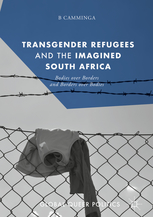
  • Book Launch: Transgender Refugees and the Imagined South Africa

    Breezeblock Café, 29 Chiswick Street, Johannesburg

    The African Centre for Migration & Society and GALA are pleased to host the Book launch of Transgender Refugees and the Imagined South Africa: Bodies over Borders and Border over Bodies. This book by B Camminga tracks the conceptual journeying of the term ‘transgender’ from the Global North—where it originated—along with the physical embodied journeying of transgender asylum seekers from countries within Africa to South Africa and considers the interrelationships between the two. The term 'transgender' transforms as it travels, taking on meaning in relation to bodies, national homes, institutional frameworks and imaginaries. This study centres on the experiences and narratives of people that can be usefully termed 'gender refugees', gathered through a series of life story interviews. It is the argument of this book that the departures, border crossings, arrivals and perceptions of South Africa for gender refugees have been both enabled and constrained by the contested meanings and politics of this emergence of transgender. This book explores, through these narratives, the radical constitutional-legal possibilities for 'transgender' in South Africa, the dissonances between the possibilities of constitutional law, and the pervasive politics/logic of binary ‘sex/gender’ within South African society. Date: Thursday 11 April 2019 Time: 18.30 for 19.00 Venue: Breezeblock Café, […]

  • Determinants of immigrants’ feeling of sense of belonging in the midst of host hostility: The experience of second-generation Nigerian immigrants in Johannesburg

    ACMS Seminar Room 2163, South East Wing, Second Floor, Solomon Mahlangu House, University of the Witwatersrand East Campus

    As part of the Lunchtime Seminar Series, the African Centre for Migration & Society invites you to a seminar titled Determinants of immigrants’ feeling of sense of belonging in the midst of host hostility: The experience of second-generation Nigerian immigrants in Johannesburg by Chioma Joyce Onukogu (African Centre for Migration & Society, University of the Witwatersrand). The assumption that immigrants will feel less sense of belonging in a host environment where they are not accepted, supported, integrated and welcomed is not out of place. However, an in-depth study of ten Nigerian second-generation children conducted in Johannesburg revealed the contrary. It was found that the children who reported experiences of discrimination, bullying, rejection and xenophobia from their peers at school and who experience discriminatory policies of the state towards them feel a sense of belonging in South Africa.  The seminar challenges conventional theories that link immigrants’ sense of belonging to the host country’s immigrant integration policies and welcoming attitudes towards immigrants.  It also rejects the notion that negative experiences reduce the feeling of sense of belonging in the host country. Looking at the overall migration context, the seminar shows that other hidden factors, such as agency, friendship networks, family and transnational networks, the church, diversity in school and membership in cultural associations, cushion […]

  • Afrophobia and the Law: How has the South African Judiciary Responded to Cases of Afrophobia?

    ACMS Seminar Room 2163, South East Wing, Second Floor, Solomon Mahlangu House, University of the Witwatersrand East Campus

    As part of the Lunchtime Seminar Series, the African Centre for Migration & Society invites you to a seminar titled Afrophobia and the Law: How has the South African Judiciary Responded to Cases of Afrophobia? by Patrick Kadima (Oliver Schreiner school of Law, University of the Witwatersrand). The rise in anti-immigrant sentiments in established democracies across the globe has undoubtedly produced very odd results. In the United States of America, the growing abhorrence of migrants led to the election of Donald trump whilst in Britain the increase in hatred of migrants has led to what we now know as Brexit and reinforced the gloomy idea that these two countries that hold democracy to heart are not cosmopolitan after all. The African Union adopted the Agenda 2063 in a bid to unite a continent that came from a painful past but this has not been an easy task. In 2008, 2015 and 2017 African migrants in South Africa experienced Afrophobic attacks that resulted in some being murdered, shops owned by African migrants being looted and burnt and many other criminal activities. South Africa is unquestionably one of the countries that has a high number of documented and non-undocumented African migrants. This seminar will first begin by seeking […]

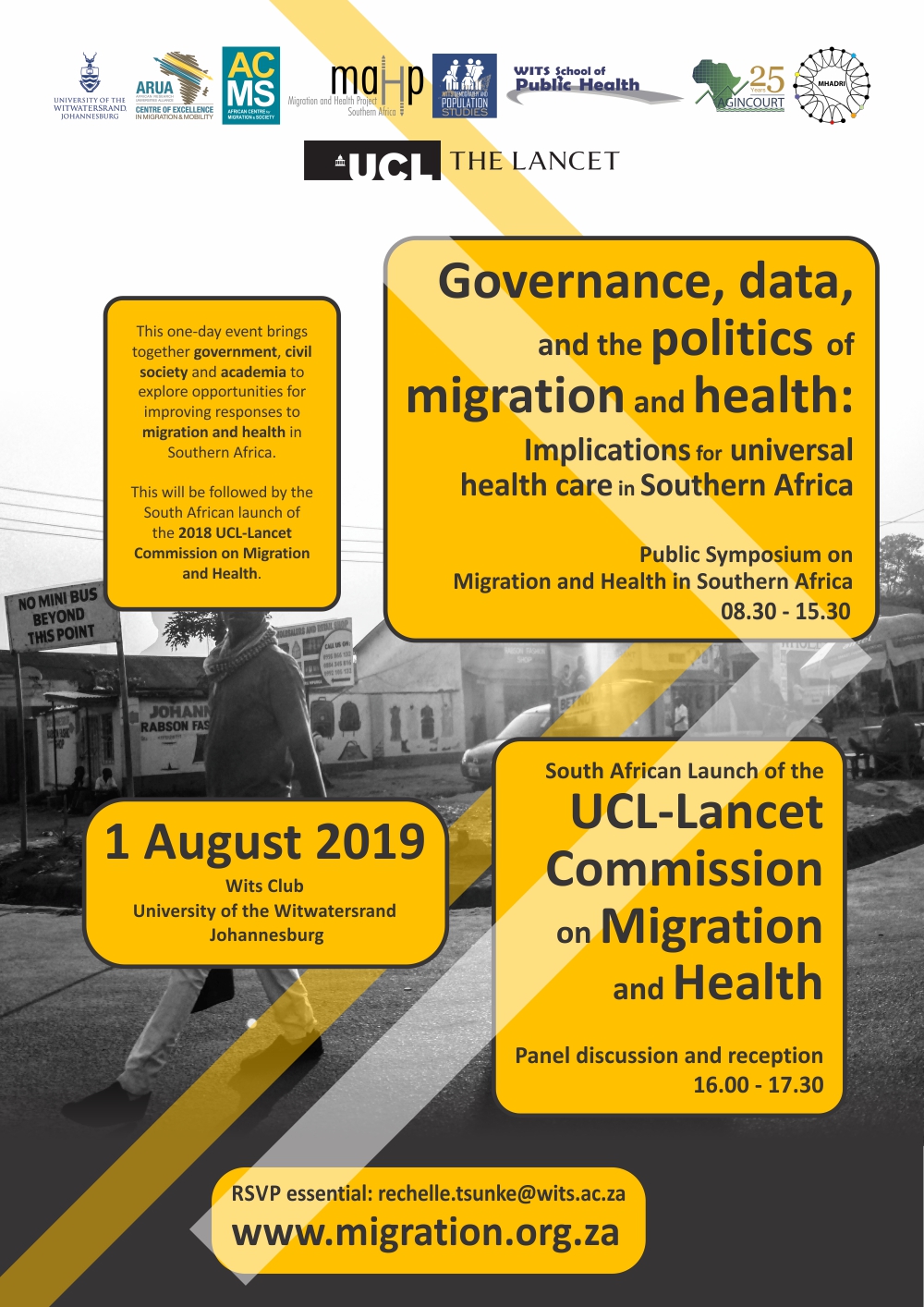
  • Public Symposium on Migration and Health in Southern Africa and The South African Launch of the UCL-Lancet Commission on Migration and Health

    Wits Club, University of the Witwatersrand, West Campus, Braamfontein, Johannesburg

    The African Centre for Migration & Society's Migration and health project Southern Africa: maHp and Security at the Margins - SeaM, in partnership with UCL-Lancet Commission on Migration and Health, Wits School of Public Health, MRC/WITS-University Rural Public Health & Agincourt Research Unit, Mhadri - the global Migration, Health and Development Research Initiative and Demography and Population Studies, University of the Witwatersrand will host a Public Symposium on Migration and Health in Southern Africa and The South African Launch of the UCL-Lancet Commission on Migration and Health . This one-day event brings together government, civil society and academia to explore opportunities for improving responses to migration and health in Southern Africa, which will be followed by the South African launch of the 2018 UCL-Lancet Commission on Migration and Health. Date: 1 August 2019 Time: 3.30-17.30 Venue: Wits Club, University of the Witwatersrand, West Campus, Braamfontein, Johannesburg RSVP to rechelle.tsunke@wits.ac.za is essential.

  • Precarious Labourers of Love: Queer Kinship, Reproductive Labour and Biopolitics

    ACMS Seminar Room 2163, South East Wing, Second Floor, Solomon Mahlangu House, University of the Witwatersrand East Campus

    As part of the Lunchtime Seminar Series, the African Centre for Migration & Society invites you to a seminar titled Precarious Labourers of Love: Queer Kinship, Reproductive Labour and Biopolitics by Ulrika Dahl (Professor of Gender Studies, Uppsala University). This seminar explores how different forms of reproductive labour create different precarities within LGBTQ parenting and kin-making in contemporary Sweden. It especially considers the precarisation of biological labour in a setting where intimate labour is the foundation for kin-making and where the necessary making, gestating and breastfeeding of a child is downplayed in relation to parenthood status. Drawing on ethnographic research, the seminar also illuminates how ‘biology’ produces strong feelings, even in a queer kinship structure that departs from the notion of intent and intimate labour as equally shared matters. Framing queer reproduction as both a biopolitical question and a question of gender labour the seminar then discusses how gendered and racialised ideas of parenthood and kinship are reproduced and reworked in imaginaries of LGBTQ parenthood. Contributing to critical whiteness studies, it argues that the (queer) nation is repeatedly recreated as white while whiteness remains invisible to those who inhabit it. Biography Ulrika Dahl is a cultural anthropologist and professor of gender studies at the Centre for […]

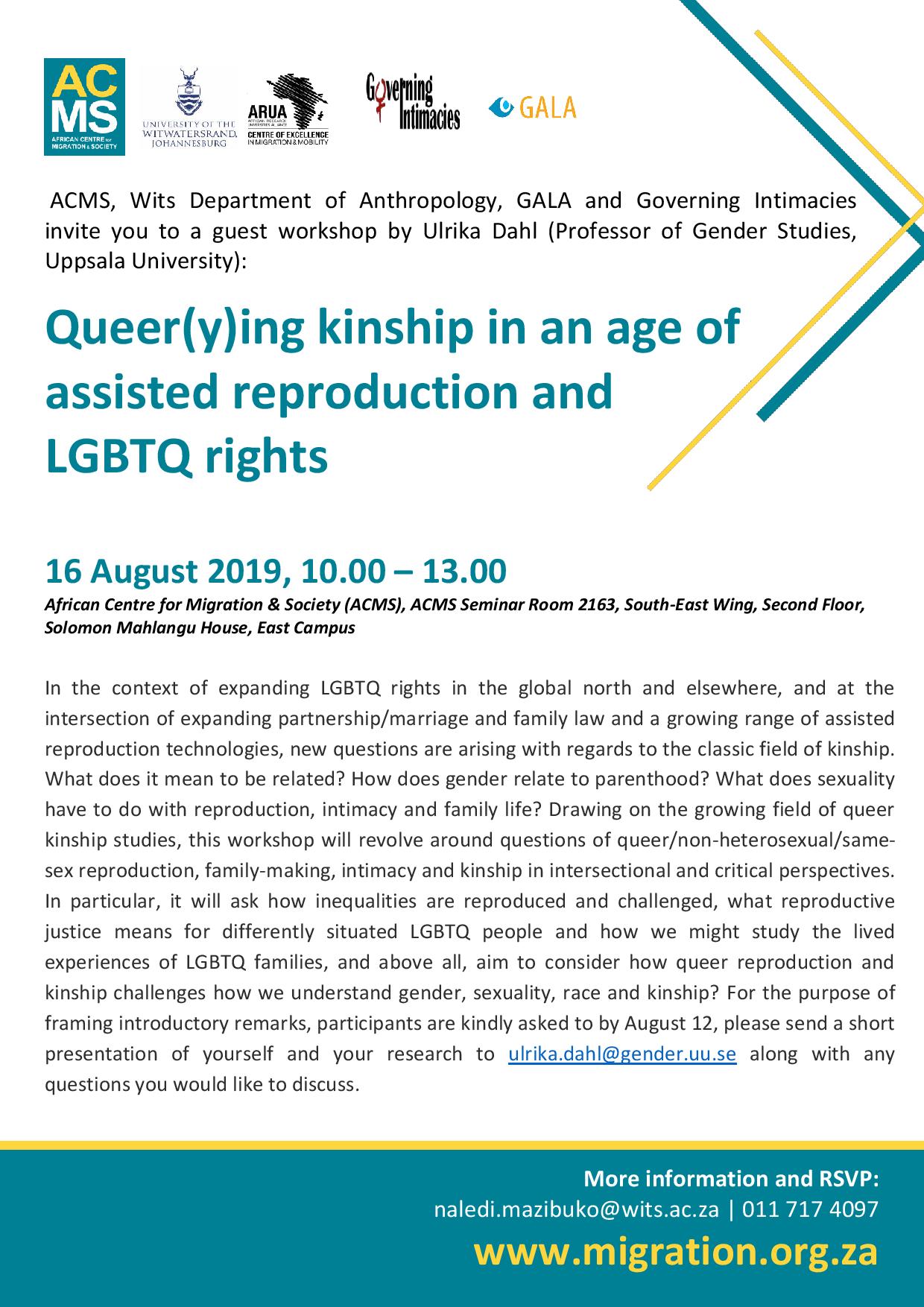
  • Queer(y)ing kinship in an age of assisted reproduction and LGBTQ rights

    ACMS Seminar Room 2163, South East Wing, Second Floor, Solomon Mahlangu House, University of the Witwatersrand East Campus

    The African Centre for Migration & Society, Wits Department of Anthropology, GALA and Governing Intimacies invite you to a guest workshop by Ulrika Dahl (Professor of Gender Studies, Uppsala University) on Queer(y)ing kinship in an age of assisted reproduction and LGBTQ rights. In the context of expanding LGBTQ rights in the global north and elsewhere, and at the intersection of expanding partnership/marriage and family law and a growing range of assisted reproduction technologies, new questions are arising with regards to the classic field of kinship. What does it mean to be related? How does gender relate to parenthood? What does sexuality have to do with reproduction, intimacy and family life? Drawing on the growing field of queer kinship studies, this workshop will revolve around questions of queer/non-heterosexual/same-sex reproduction, family-making, intimacy and kinship in intersectional and critical perspectives. In particular, it will ask how inequalities are reproduced and challenged, what reproductive justice means for differently situated LGBTQ people and how we might study the lived experiences of LGBTQ families, and above all, aim to consider how queer reproduction and kinship challenges how we understand gender, sexuality, race and kinship? Format and expectations: The workshop is open to all who are interested in […]

  • Racial borders

    ACMS Seminar Room 2163, South East Wing, Second Floor, Solomon Mahlangu House, University of the Witwatersrand East Campus

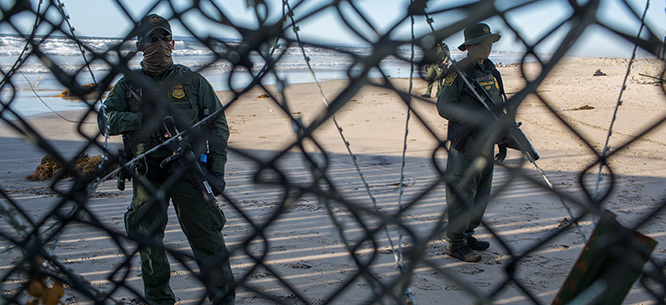
    As part of the Lunchtime Seminar Series, the African Centre for Migration & Society invites you to a seminar titled Racial borders by E. Tendayi Achiume (Professor of Law, University of California). Borders sit firmly at the center of existential national and multilateral debates, and for legal scholars the doctrine and theory of human movement across these borders calls for serious attention. The specific concern of this presentation will be the ongoing consolidation and expansion of a global migration governance regime that is deeply at odds with fundamental racial equality principles, but that nonetheless remains immune to meaningful critique within the dominant frame of liberalism, as both a legal and political project. Driven by a crisis discourse in Europe, and the United States among others, this global migration governance regime is multifaceted, comprising a broad range of techniques. At one extreme, are formal nationality-based bans on mobility and migration, border externalization and militarization, immigrant criminalization, and even punitive “deterrent” strategies such as the separation of asylum-seeking families (include child removal). But this troubling regime should also be understood to include more neutrally and even positively regarded border and migrant controls such as passports and visa restrictions, whose racialized operation remains firmly obscured by legal […]