• Queer(y)ing kinship in an age of assisted reproduction and LGBTQ rights

    ACMS Seminar Room 2163, South East Wing, Second Floor, Solomon Mahlangu House, University of the Witwatersrand East Campus

    The African Centre for Migration & Society, Wits Department of Anthropology, GALA and Governing Intimacies invite you to a guest workshop by Ulrika Dahl (Professor of Gender Studies, Uppsala University) on Queer(y)ing kinship in an age of assisted reproduction and LGBTQ rights. In the context of expanding LGBTQ rights in the global north and elsewhere, and at the intersection of expanding partnership/marriage and family law and a growing range of assisted reproduction technologies, new questions are arising with regards to the classic field of kinship. What does it mean to be related? How does gender relate to parenthood? What does sexuality have to do with reproduction, intimacy and family life? Drawing on the growing field of queer kinship studies, this workshop will revolve around questions of queer/non-heterosexual/same-sex reproduction, family-making, intimacy and kinship in intersectional and critical perspectives. In particular, it will ask how inequalities are reproduced and challenged, what reproductive justice means for differently situated LGBTQ people and how we might study the lived experiences of LGBTQ families, and above all, aim to consider how queer reproduction and kinship challenges how we understand gender, sexuality, race and kinship? Format and expectations: The workshop is open to all who are interested in […]
  • Racial borders

    ACMS Seminar Room 2163, South East Wing, Second Floor, Solomon Mahlangu House, University of the Witwatersrand East Campus

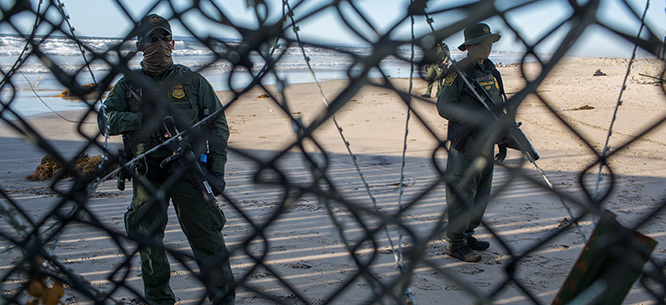
    As part of the Lunchtime Seminar Series, the African Centre for Migration & Society invites you to a seminar titled Racial borders by E. Tendayi Achiume (Professor of Law, University of California). Borders sit firmly at the center of existential national and multilateral debates, and for legal scholars the doctrine and theory of human movement across these borders calls for serious attention. The specific concern of this presentation will be the ongoing consolidation and expansion of a global migration governance regime that is deeply at odds with fundamental racial equality principles, but that nonetheless remains immune to meaningful critique within the dominant frame of liberalism, as both a legal and political project. Driven by a crisis discourse in Europe, and the United States among others, this global migration governance regime is multifaceted, comprising a broad range of techniques. At one extreme, are formal nationality-based bans on mobility and migration, border externalization and militarization, immigrant criminalization, and even punitive “deterrent” strategies such as the separation of asylum-seeking families (include child removal). But this troubling regime should also be understood to include more neutrally and even positively regarded border and migrant controls such as passports and visa restrictions, whose racialized operation remains firmly obscured by legal […]

  • Roundtable: Immigration, policing and South Africa’s future politics

    Senate Room, Second Floor East Wing, Solomon Mahlangu House, University of the Witwatersrand East Campus

    The African Centre for Migration & Society invites you to a roundtable discussion on Immigration, policing & South Africa’s future politics.  This roundtable discussion will explore the significance of the turn towards questions of immigration, borders, and sovereignty for the future of South African politics and security. Date: Wednesday 21 August 2019 Time: 16.30 -18.00 Venue: Senate Room, Second Floor East Wing, Solomon Mahlangu House, University of the Witwatersrand East Campus

  • Migrant’s remittances and living conditions of households of origin: Evidence from Kinshasa

    ACMS Seminar Room 2163, South East Wing, Second Floor, Solomon Mahlangu House, University of the Witwatersrand East Campus

    As part of the Lunchtime Seminar Series, the African Centre for Migration & Society invites you to a seminar titled Migrant’s remittances and living conditions of households of origin: Evidence from Kinshasa by José Mangalu Mobhe Agbada (Département des Sciences de la Population et du Développement, Faculté des Sciences Economiques et de Gestion, Université de Kinshasa). The aim of this seminar is to study the involvement of households of origin in the migratory process of their members as well as the participation of migrants in the economic survival of their households of origin. The main hypotheses assume a very close link between supports provided to migrants by their households of origin and migrants' remittance behaviour. Similarly, households receiving remittances are expected to enjoy better living conditions than those who do not. The data used come from the MAFE-RDC survey, conducted in Kinshasa in July/August 2007 as part of the project "Crise économique et migrations internationales en RDC ». Ce projet s’inscrivait dans le programme de recherche international dénommé FSP-74 « Migrations internationales, recompositions territoriales et développement dans les pays du Sud »,", financed by the French Ministry of Foreign Affairs through CEPED. A stratified and representative sample of 945 households was drawn. The data were analyzed using binomial […]

  • The edge economies of migration

    ACMS Seminar Room 2163, South East Wing, Second Floor, Solomon Mahlangu House, University of the Witwatersrand East Campus

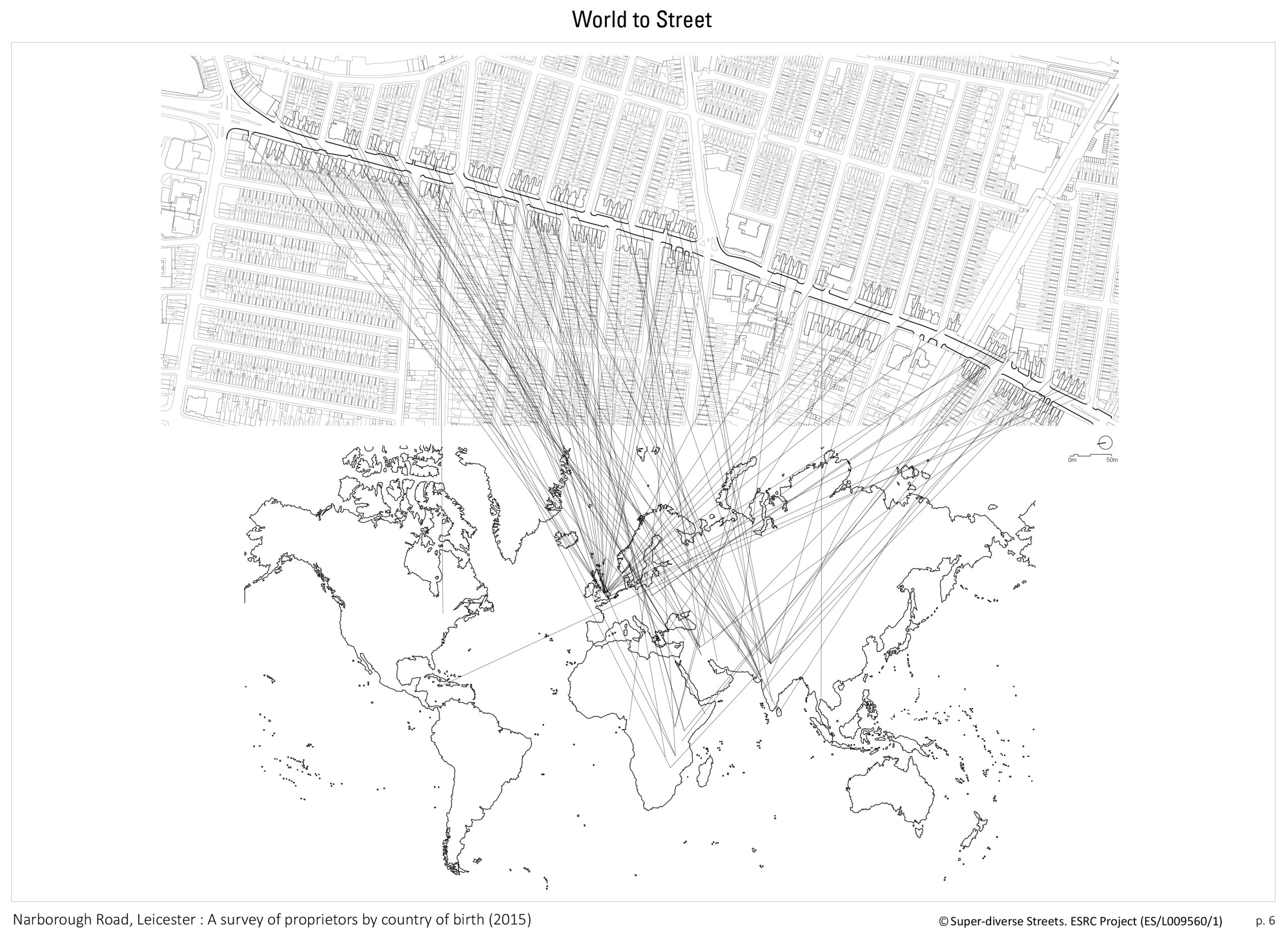
    The African Centre for Migration & Society invites you to a special public lecture titled The edge economies of migration by Professor Suzanne Hall (London School of Economics and Political Science). ‘Edge Economies’ emerge in the asymmetries of global migration and the ongoing ferocities of urban marginalisation. From the grounded perspective of street economies formed in the peripheries of post-industrial UK cities, in this special public lecture Suzzane explores the racialised frameworks of citizenship and economic inequality and their everyday contestations. She locates the global and urban formations of the edge in the European ideologies of displacement and immobility, incorporating the extended coloniality of political interventionism and human subordination. By moving between spaces of globe, state and street, she further explores the edge as a capricious space in which social sorting, cultural intermixtures and claims to difference are forged. Such combinations encourage connections between the histories and geographies of how people and places become bordered, together with practices of edge economies that are both marginal and transgressive.   Suzanne Hall is is Co-director of the Cities Programme and Associate Professor in Sociology at the LSE. Suzi’s research interests engage with the street life of brutal borders, migrant economies and urban multi-culture. Date: Thursday 12 September 2019 […]

  • No Asylum for ‘Infiltrators’: Israel’s Dysfunctional Asylum System

    ACMS Seminar Room 2163, South East Wing, Second Floor, Solomon Mahlangu House, University of the Witwatersrand East Campus

    As part of the Lunchtime Seminar Series, the African Centre for Migration & Society invites you to a seminar titled No asylum for 'infiltrators': Israel's dysfunctional asylum system by Ruvi Ziegler (Associate Professor in International Refugee Law, University of Reading, School of Law). This talk explores the precarious status of Eritrean and Sudanese asylum seekers in Israel. Having crossed the Israeli-Egyptian border without authorisation and not through an official border crossing, Israeli law defines such individuals as ‘infiltrators’, a charged term which dates back to border-crossings into Israel by Palestinian Fedayeen in the 1950s. Eritreans and Sudanese nationals constitute over 90 percent of ‘infiltrators’ in Israel. Their livelihood is curtailed through a hostile political discourse, financial sanctions, and detention. While Israel refrains from deporting them to their respective countries of origin, recognising that such forced removal could expose them to risks to their lives and/or freedom, it refrains from granting them protection status, seeking instead to reach 'third country' agreement with sub-Saharan African states. The talk argues that the regularisation of asylum in Israel, including legal recognition of ‘refugee’, ‘asylum seeker’ and subsidiary or complementary protraction statuses, is long due. Biography Dr. Reuven (Ruvi) Ziegler is Associate Professor in International Refugee Law at the University of Reading, School of Law, where he is the Director of Postgraduate Taught Programmes.  Ruvi is an […]

  • Black Markets: Transatlantic Architectures of Care

    ACMS Seminar Room 2163, South East Wing, Second Floor, Solomon Mahlangu House, University of the Witwatersrand East Campus

    As part of the Lunchtime Seminar Series, the African Centre for Migration & Society invites you to a seminar titled Black markets: Transatlantic architectures of care by Huda Tayob (History & Theory Programme Convener, Graduate School of Architecture, University of Johannesburg). South Africa has hosted a large number of refugees and asylum seekers since the end of apartheid in the early 1990s. In Cape Town, this led to a burgeoning of pan-African mixed-use markets, known as “Somali malls.” These arcades have been constituted of multiple small shops, along with educational, religious, and social spaces, which primarily cater to Somalis and other East Africans. The majority of the stores within these markets have been owned and run by women. This ethnographic research and study of oral histories has shown that these seemingly local establishments have been elements in a wider global network of markets. These buildings have occupied urban margins, but performed the circulation of transnational spatial stories, spatial practices, people, and goods. This seminar traces the emergence and relationship between such markets in Cape Town, Minneapolis, and Nairobi, from the 1980s to the present. Huda Tayob argue that these markets produce spatial intimacy within contested realms, as well as networks of support and possibility within displacement contexts. […]

  • Present and imminent: Crises and complexity in Mexico and South Africa

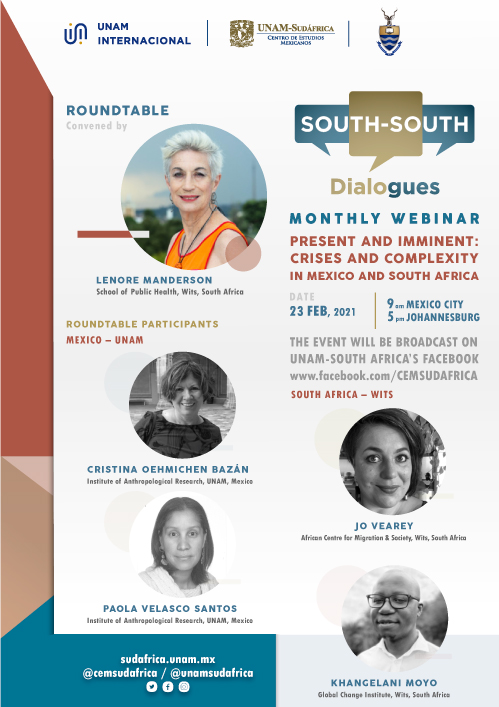
    Convened by Prof Lenore Manderson, the roundtable Present and Imminent: Crises and Complexity in Mexico and South Africa will focus on contemporary and emerging crises in the two countries. Both Mexico and South Africa face multiple ecological and economic problems, as reflected by biodiversity loss, water, food and energy crises, the increasing burden of non-communicable diseases, and new infections including COVID-19. Pressures from continued urbanisation, migration, and unemployment, partly due to such challenges, contribute to local anxiety, violence and systemic inequality. In this panel, we use this mix of problems as portals to examine the interrelationship of physical, social and biological worlds, as studied by members of the two universities. We will focus on the twin challenges in urban Mexico and South Africa of climate change and migration, both of which present escalating challenges of scope and intensity. We will explore the bidirectional relationships of different crises, and will reflect on the challenges for improved governance and in implementing policies and programs. We will conclude by considering how these problems are common in LMIC, and the role of G-24 countries like Mexico and South Africa in addressing these questions, and in responding to them as a model of new global […]

  • Old and New African Diaspora Networks: Before and After COVID-19

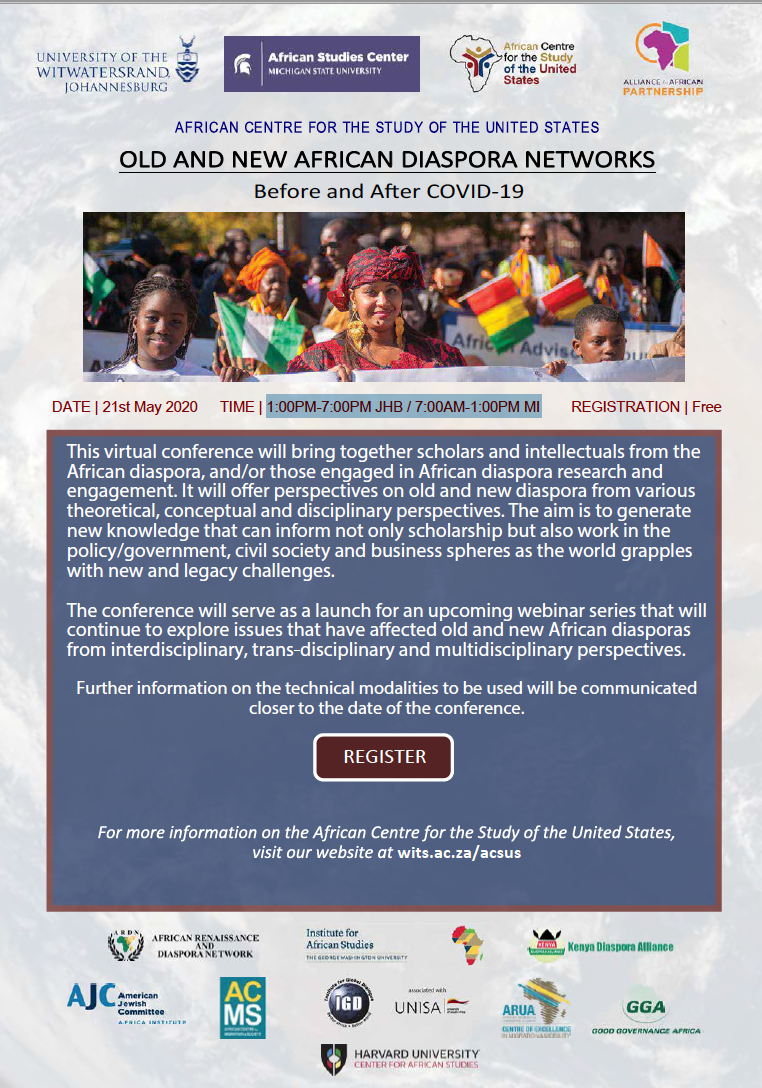
    This virtual conference will bring together scholars and intellectuals from the African diaspora, and/or those engaged in African diaspora research and engagement. It will offer perspectives on old and new diaspora from various theoretical, conceptual and disciplinary perspectives. The aim is to generate new knowledge that can inform not only scholarship but also work in the policy/government, civil society and business spheres as the world grapples with new and legacy challenges. The conference will serve as a launch for an upcoming webinar series that will continue to explore issues that have affected old and new African diasporas from interdisciplinary, trans disciplinary and multidisciplinary perspectives. Further information on the technical modalities to be used will be communicated closer to the date of the conference. Date: 21 May 2020 Time: 1:00PM-7:00PM JHB / 7:00AM-1:00PM MI To participate, register for free here.

  • Migration to South Africa – Perspectives from Civil Society and Current Challenges in Times of COVID-19

    In times of crisis like the current one, inequality and injustice are magnified. Combined efforts are crucial to support vulnerable people in continuing to secure their livelihoods and access essential services. Especially when taking into account the situation of people on the move (migrants, refugees, asylum seekers, paperless people) the circumstances in South Africa have not turned to the better. Their struggle to make a living in a country with one of the most progressive constitutions gets more severe by the day. A newly published study by the African Centre for Migration & Society (ACMS) of the University of the Witwatersrand in Johannesburg/South Africa and Bread for the World outlines the manifold challenges and circumstances for people on the move in South Africa and shows different aspects of the work of civil society actors with them. The study also reflects on several parallels to the German situation while pointing out some important differences. During the upcoming Webinar, key points and conclusions of the study will be presented by the authors, Iriann Freemantle and Rebecca Walker. Four Bread for the World Partner Organisations based in South Africa will then share their perspectives on the study and will make strong links to current challenges in their work with […]