• Present and imminent: Crises and complexity in Mexico and South Africa

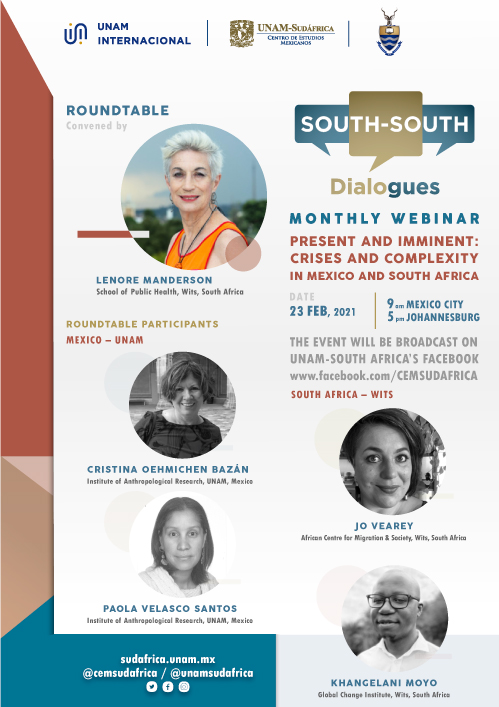
    Convened by Prof Lenore Manderson, the roundtable Present and Imminent: Crises and Complexity in Mexico and South Africa will focus on contemporary and emerging crises in the two countries. Both Mexico and South Africa face multiple ecological and economic problems, as reflected by biodiversity loss, water, food and energy crises, the increasing burden of non-communicable diseases, and new infections including COVID-19. Pressures from continued urbanisation, migration, and unemployment, partly due to such challenges, contribute to local anxiety, violence and systemic inequality. In this panel, we use this mix of problems as portals to examine the interrelationship of physical, social and biological worlds, as studied by members of the two universities. We will focus on the twin challenges in urban Mexico and South Africa of climate change and migration, both of which present escalating challenges of scope and intensity. We will explore the bidirectional relationships of different crises, and will reflect on the challenges for improved governance and in implementing policies and programs. We will conclude by considering how these problems are common in LMIC, and the role of G-24 countries like Mexico and South Africa in addressing these questions, and in responding to them as a model of new global […]
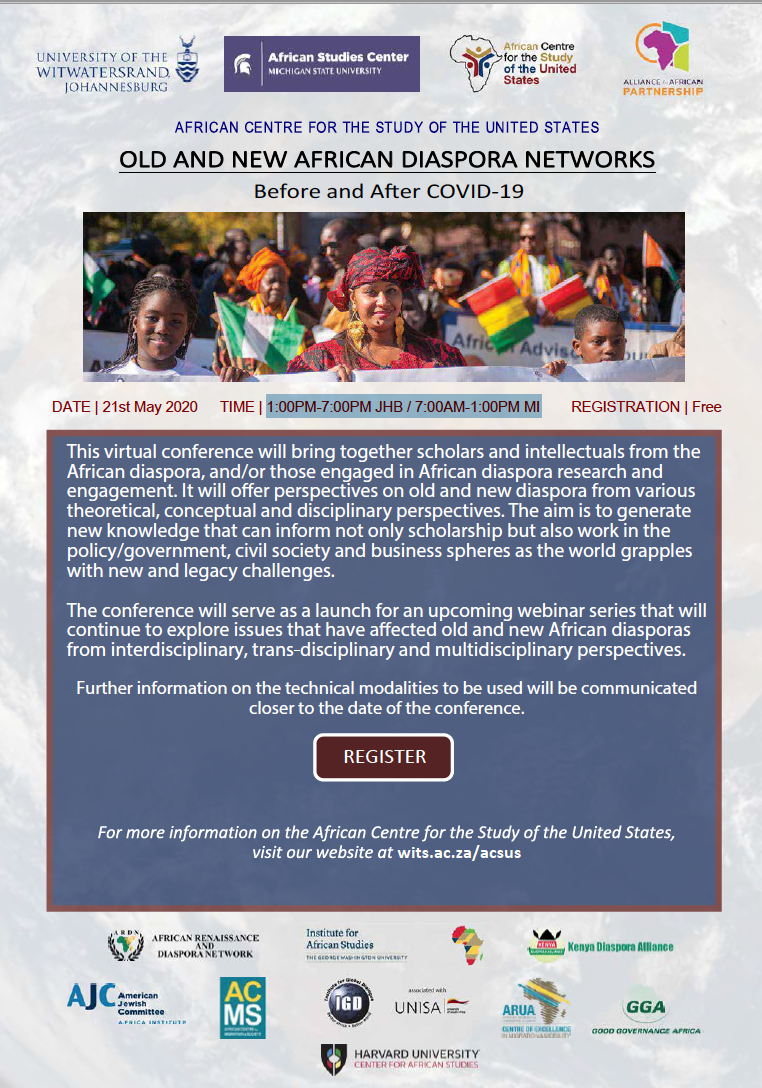
  • Old and New African Diaspora Networks: Before and After COVID-19

    This virtual conference will bring together scholars and intellectuals from the African diaspora, and/or those engaged in African diaspora research and engagement. It will offer perspectives on old and new diaspora from various theoretical, conceptual and disciplinary perspectives. The aim is to generate new knowledge that can inform not only scholarship but also work in the policy/government, civil society and business spheres as the world grapples with new and legacy challenges. The conference will serve as a launch for an upcoming webinar series that will continue to explore issues that have affected old and new African diasporas from interdisciplinary, trans disciplinary and multidisciplinary perspectives. Further information on the technical modalities to be used will be communicated closer to the date of the conference. Date: 21 May 2020 Time: 1:00PM-7:00PM JHB / 7:00AM-1:00PM MI To participate, register for free here.

  • Migration to South Africa – Perspectives from Civil Society and Current Challenges in Times of COVID-19

    In times of crisis like the current one, inequality and injustice are magnified. Combined efforts are crucial to support vulnerable people in continuing to secure their livelihoods and access essential services. Especially when taking into account the situation of people on the move (migrants, refugees, asylum seekers, paperless people) the circumstances in South Africa have not turned to the better. Their struggle to make a living in a country with one of the most progressive constitutions gets more severe by the day. A newly published study by the African Centre for Migration & Society (ACMS) of the University of the Witwatersrand in Johannesburg/South Africa and Bread for the World outlines the manifold challenges and circumstances for people on the move in South Africa and shows different aspects of the work of civil society actors with them. The study also reflects on several parallels to the German situation while pointing out some important differences. During the upcoming Webinar, key points and conclusions of the study will be presented by the authors, Iriann Freemantle and Rebecca Walker. Four Bread for the World Partner Organisations based in South Africa will then share their perspectives on the study and will make strong links to current challenges in their work with […]

  • Alternatives to Detention: Advocacy, Challenges, and Opportunities in Southern Africa

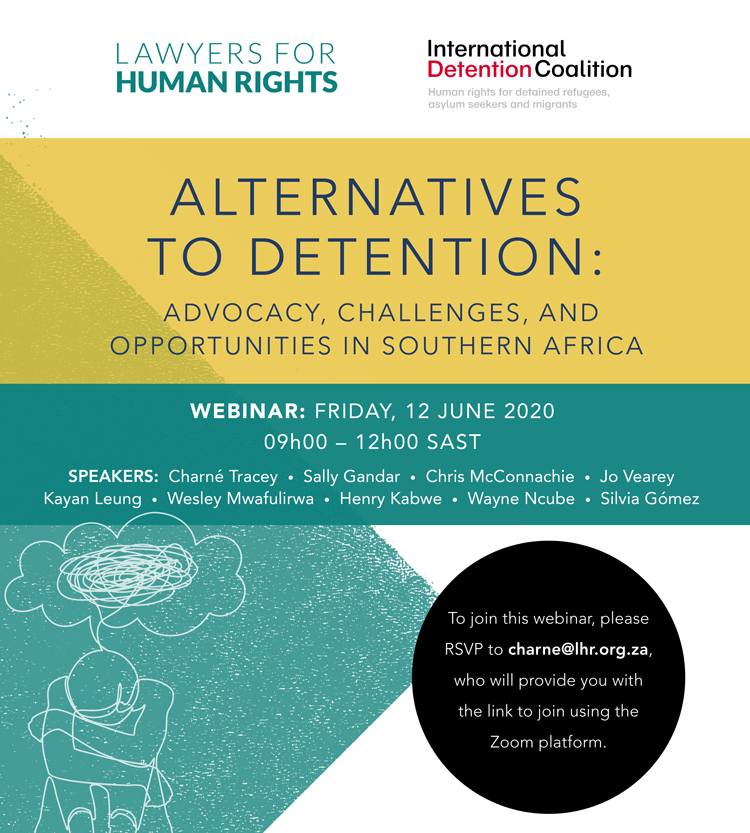
    The detention system within Southern Africa has long been riddled with gaping wounds. To this end, the rise in the use of immigration detention as a migration management tool has unfortunately been accompanied by an accelerated deprivation of basic human rights. In the case of South Africa, this has particularly taken the form of zeroing in on migrants, asylum-seekers and refugees with widespread disregard of legal protections or various court orders in place aimed at securing their rights. Straying away from utilitarian and retributive theories of justice, detention has ultimately become a pretext for perpetuating and preserving long-held inequalities in society. In light of Covid-19, Lawyers for Human Rights (“LHR”) seeks to strengthen regional collaboration with its African neighbours in order to promote the use of ATDs by highlighting the disproportionate impact of the criminalisation of the Disaster Management Regulations (GN 43107 GG 657) of 18 March 2020 (“Lockdown Regulations”) as amended by law enforcement on migrants. The event seeks to bring together legal experts, African partners, and civil society in order to share perspectives and strategies. Background In the wake of Covid-19, rigid lockdown orders have heightened overarching concerns surrounding the use of immigration detention as a tool to […]

  • Public Positions: The Politics of the Pandemic

    WiSER and the African Centre for Migration & Society warmly invite you to the next Public Positions session The Politics of the Pandemic by Professor Simukai Chigudu (St Antony's College, Oxford Department of International Development at the University of Oxford). Every epidemic is always a public health crisis - and more. In the global South in particular, epidemics are always shaped and reshaped by prior "existing conditions", as many commentators have been pointing out: political, economic, institutional or cultural.  As a result, the life of an epidemic is always multi-perspectival. In turn, pathways of disease response can never be linear. The challenges of dealing with epidemics and diseases which involve highly dynamic viral-social-political and ecological determinants are always particularly complex. In this PUBLIC POSITIONS Session, Professor Chigudu will discuss several of the key arguments in his book The Political Life of an Epidemic: Cholera, Crisis and Citizenship in Zimbabwe and thereafter offer remarks on the COVID-19 pandemic. He will during the course of the discussion highlight some of the most important themes that mark the politics of epidemics in Africa and globally, from the historical origins of various pandemics to the social patterns of their unfolding and impact; and from the competing interpretations of social experiences of the […]

  • Building Solidarity in the time of COVID-19 Webinar Series: Access to Health Care – A Regional Approach

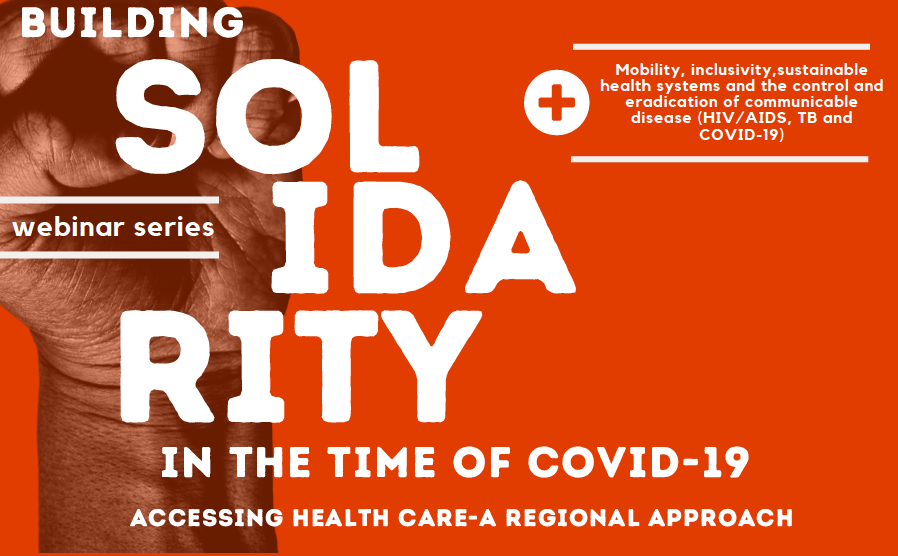
    You are invited to participate in the first of five webinar series under the theme: Building Solidarity in the time of COVID-19. This weeks discussion will be on: Access to Health Care- a regional approach: Mobility, inclusivity,sustainable health systems and the control and eradication of communicable disease (HIV/AIDS, TB and COVID-19).  The panellists for this week are Sibongile Tshabalala, Eric Goemaere and Jo Vearey. Date: 17 July 2020 Time: 9:00-11:00 RSVP Email: bea@totem-media.net to receive the zoom link Please find attached the poster invitation, framing document and info-graphic giving background to the webinar discussion and panellists.If you have questions or comments you would like to make in preparation or during the webinar please post them in the comments section of the zoom meeting to be engaged by panellists. We look forward to your attendance.

  • Workshop Invitation: Getting the Future Write: Early Career Publishing Series

    ‘the world continues to be divided between those who are heard and those who are not, those who get to print and those limited to reading the ideas of others’ Publishing and academic writing are important facets of any academic career and yet they are rarely part of the curriculum or openly discussed. The aim of this workshop series is to create an interdisciplinary space for junior scholars to (a) build a personal publication strategy and (b) develop a peer support network for academic writing and publishing. The workshop is aimed primarily at humanities and social science scholars on the African continent or of African descent. Our three-part series will be held on Zoom. Each two-hour workshop will cover a different theme: October: Developing a publication strategy: how, where and why to write? November: Publishing articles from your PhD November: Turning your PhD into a book Each workshop will feature presentations from early career scholars who have experience of publishing, as well as input from publishers. At the end of each day, participants will have time to develop and discuss their publication strategy as it evolves. Those interested in participating should fill in this form https://forms.gle/kHcKhcmTERdewU1M9 by 23 October 2020. […]

  • The Two UN Compacts – Refugees and Migrants: Challenges and Implementation in Europe

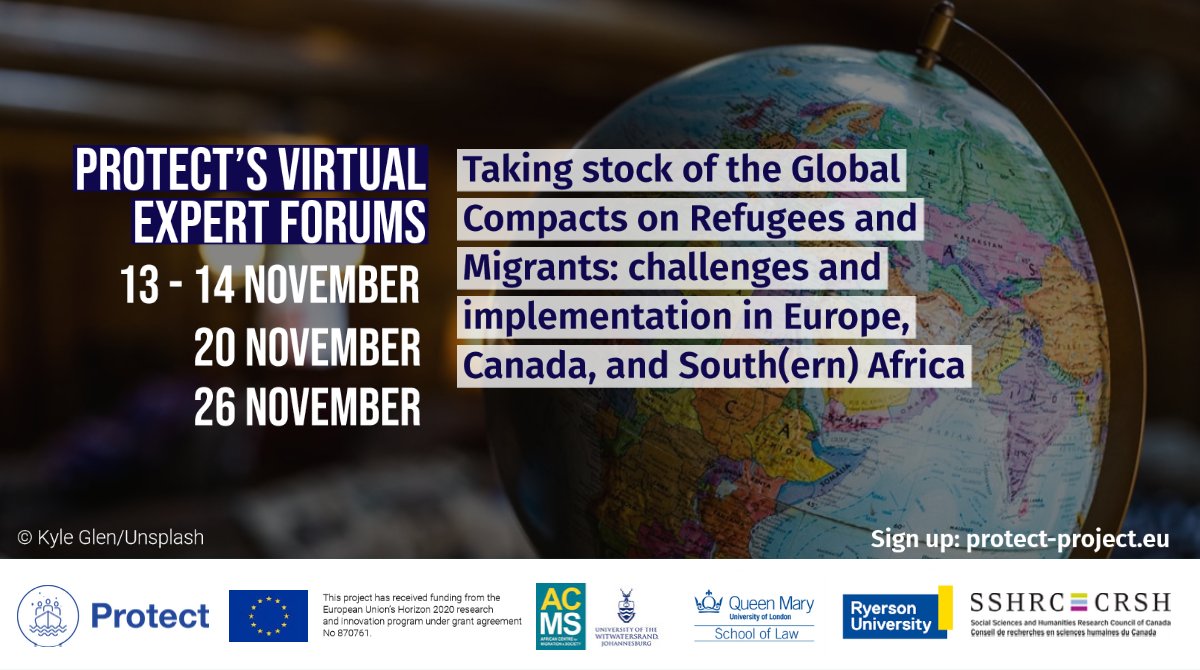
    When: Friday, November 13, 2020 (05:00 PM GMT / 06:00 PM CET/ 07:00 PM SAST) – Saturday, November 14, 2020, (09:00 AM GMT / 10:00 AM CET/ 11:00 AM SAST) Where: Online, The PROTECT Expert Forum 2020 will discuss ‘The Two UN Compacts – Refugees and Migrants: Challenges and Implementation in Europe’. The event is hosted by Professor Elspeth Guild (Queen Mary University of London) and Professor Sandra Lavenex (University of Geneva). This Expert Forum, organised as part of the PROTECT project, engages with the Global Compacts on Refugees and Migrants from the perspective of their added value to existing international norms which also cover migrants. We hypothesise that there is added value from these instruments in providing a reinforced commitment to existing human rights standards, bringing migration firmly within the scope of other UN instruments. About the Expert Forum Against this background, the Expert Panel (13th November 2020) brings together legal scholars, migration experts, and representatives from organisations such as UNHCR, ECRE, and EASO, to explore contemporary issues faced in the Mediterranean region in light of the EU states’ commitments to the two UN Compacts and the role and policy of EU institutions. The panellists include Professor Hakan Gurcan Sicakkan (PI, […]

  • International protection and the Global Compacts in the time of Covid-19: lessons and challenges from South(ern) Africa

    This Expert Forum has been convened to take stock of the role of the Global Compact on Refugees (GCR) and the Global Compact for Safe, Orderly and Regular Migration (GCM) in South(ern) Africa, two years after their adoption. It will examine the extent to which the GCR and GCM are influencing the implementation of South Africa’s legal and institutional frameworks surrounding refugee and migrant protection in cities such as Johannesburg and Cape Town. The Forum will also explore the unique challenges the global COVID-19 pandemic has created in terms of implementation of the two Compacts at the city, national, and regional levels. Equally, looking forward, the Forum will ask if the pandemic may offer some opportunities to utilize the Compacts further to improve international protection structures for refugees and migrants. For example, by developing more inclusive ‘whole of society’ approaches to healthcare systems at the local and municipality level. The Forum is part of “PROTECT The Right to International Protection. A Pendulum between Globalization and Nativization?” PROTECT is an EU funded research project which studies the impact of the UN’s Global Compacts on Refugees and Migration on refugees’ right to international protection. The vision of PROTECT is to discover ways […]

  • Healthcare in transit: Quantifying the health needs of migrants across the Limpopo

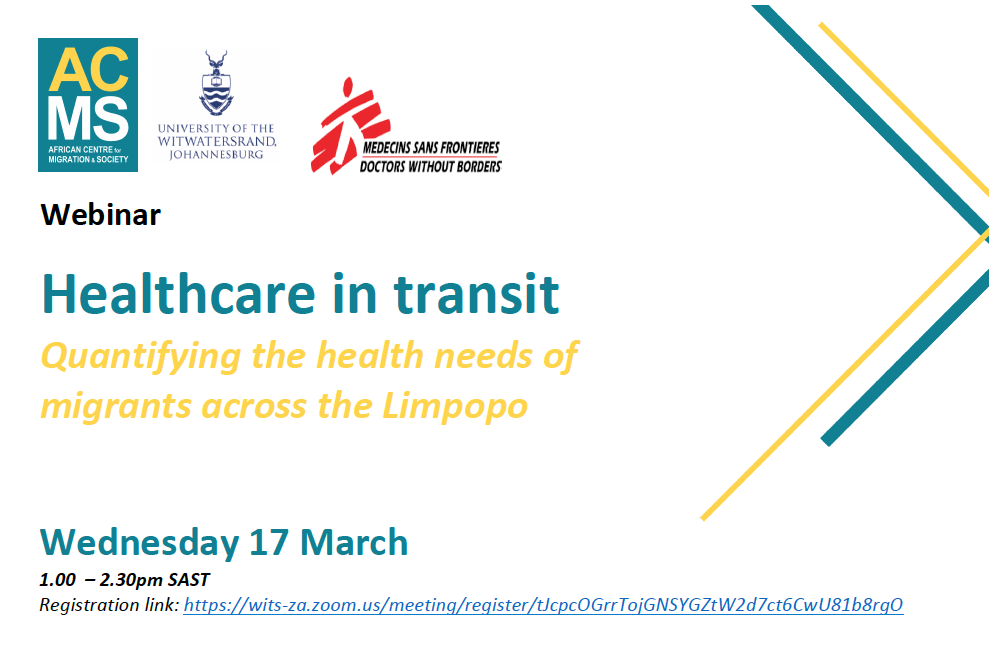
    Beginning in late 2019, Doctors Without Borders (MSF) in partnership with the African Centre for Migration & Society (ACMS), conducted over 1,375 detailed interviews with migrants and asylum-seekers across Beitbridge and Musina, documenting the health challenges they faced. Participants included: Zimbabwean deportees coming through Beitbridge Reception, migrants and asylum seekers of several nationalities staying in Musina, Malawians using Beitbridge as a waiting area, the cross-border population living in rural Beitbridge, and different groups heading to South Africa via Beitbridge crossing points. The results of that survey show that the significant waiting period for asylum-seeker application outcomes often exacerbates health challenges that migrants experience. While the report does not point to an acute health crisis at the border, it outlines the risks of the current process, which often requires migrants and asylum-seekers to travel from the rest of the country to Musina, as their office of first application, in order to renew their permits. Many of those whose papers expire before they are able to renew them must endure inhumane and often illegal conditions of arrest and detention prior to deportation, heightening the risks of contagion during the COVID-19 pandemic. Implications of the report – beyond addressing medical needs – extend to the need for […]