10 events found.
Events
-
-
-
-
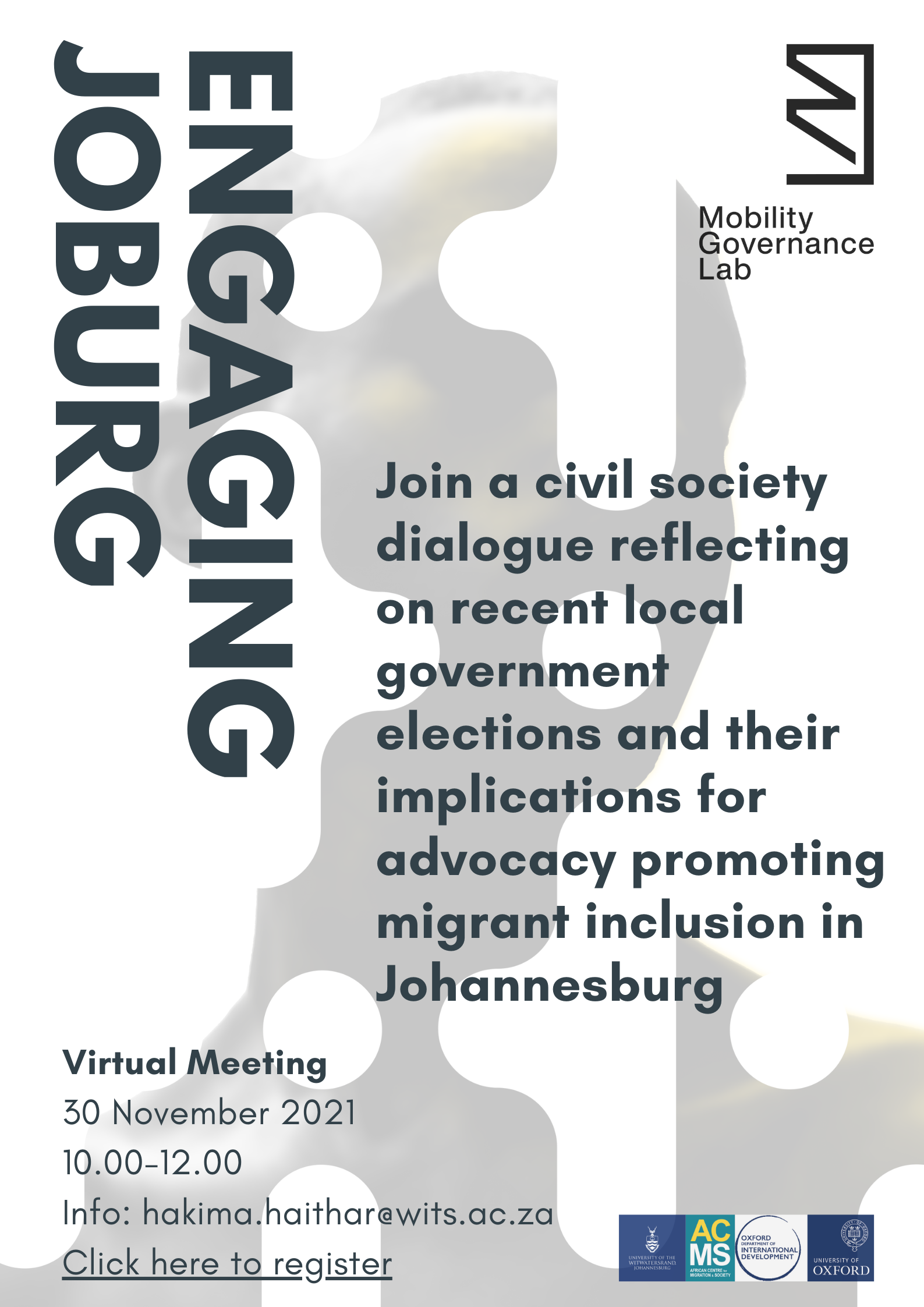
Civil Society Consultative Meeting: Governing for Migrant Inclusion in Post-Election Johannesburg
OnlineSouth Africa’s recent elections mean coalitions local governments and increasingly competitive local politics. An already weakened bureaucracy and a near empty public purse offer few resources to politicians and parties jockeying for position and electoral advantage. To divert attention from their shortcomings, elected officials are ever more likely to scapegoat immigrants and migrants. Community leaders – elected, selected, or self-appointed – will similarly capitalise on xenophobia to their own advantage. Past experience of xenophobic violence across the country tells us this. Past experience tells us this will be deadly, destructive and further denude our country’s already faltering public institutions. As a municipality now managed by a coalition government and the city most affected by xenophobic violence, Johannesburg will not be spared. But what is to be done? There is now need to publicly recognise the acute dangers lying ahead and find ways to navigate a fragmented and perilous political landscape. To this end, the African Centre for Migration & Society (ACMS) and the Wits-Oxford Mobility Governance Lab is organising a civil society consultative meeting to discuss and prepare strategies for engagement with the incoming administration post recent local government elections. A new administration demands new and different forms of engagement. […]
-
-
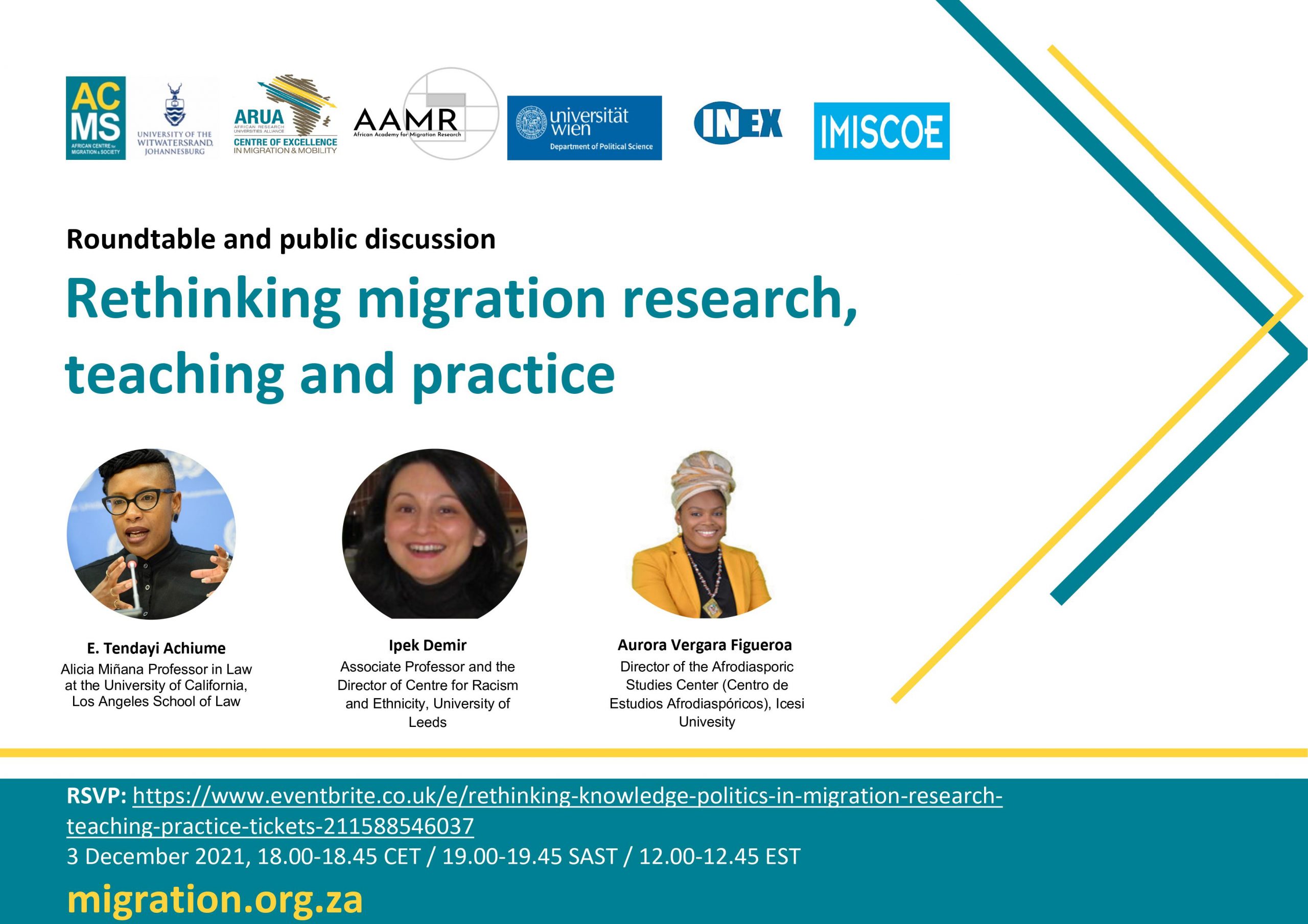
Roundtable & Public Discussion: Rethinking Knowledge Politics in Migration Research, Teaching & Practice
The African Centre for Migration & Society (ACMS) at the University of the Witwatersrand and Department of Political Science at the University of Vienna in partnership with the African Research Universities Alliance (ARUA) and the Anti- Racism Working Group of the IMISCOE International Migration Research Network cordially invite you to a roundtable and public discussion on Rethinking Migration Research, Teaching and Practice. An ongoing gap in genuine perspectives that are the outcome of robust engagement of scholars and practitioners across the Global North and the Global South runs the risk of reducing decolonisation to a normative and at times arbitrary framework, silencing certain perspectives and/or side-lining existing work. What does decolonisation have to offer to migration researchers and practitioners that differs or is inimitable from pre-existing notions of reflexivity in the field, and what, if any, are its potential pitfalls? Centred on three themes (rethinking the migration research agenda and practice; reflecting on fieldworks and methods; changing the way we teach), this roundtable and public discussion aims to engage with the question if decolonisation as an analytical and reflexive tool can provide new or critical knowledge about more productive, inclusive and transformative approaches, language and categories of doing migration research, […]
-
-
Applying Behavioral Science in Programming to Address Xenophobia & Promote Social Cohesion
Background Globally, as well as in the Southern Africa region, a recent rise in anti-migrant attitudes, including an increase in violent acts against migrants, has drawn increasing attention from political actors as well as civil society. While many initiatives to promote social cohesion have been implemented over the years, there is a dearth of research or evidence to understand the impact of such activities. Are media campaigns effective? If so, with which types of audience and what types of messaging have the greatest impact? Can integrating migrants into sports leagues and cultural events help reduce anxiety and promote a more positive image of migrants among the host community? Recent advances in brain and behavioral science (BBS) are now providing policymakers and practitioners with new tools to design, implement and measure more impactful social cohesion and peacebuilding programs to reduce xenophobia and violent conflict, and promote cooperation across various social divides. In this webinar, the International Organization for Migration (IOM), the African Centre for Migration & Society (ACMS), Prof. Linda Tropp of the University of Massachusetts – Amherst, and Beyond Conflict (a USbased NGO with over 30 years of experience collaborating with local actors and behavioral scientists in building social cohesion […]
-
Call for Papers & Panels: African Queer & Trans Displacements
African Queer & Trans Displacements is a two-day conference bringing together scholars, policymakers, practitioners, advocates and activists working on the forced or voluntary migration of lesbian, gay, bisexual, transgender, queer and intersex (LGBTQI+) Africans. The intersection of sexuality, gender and displacement remains understudied, especially in Global South contexts, despite the fact that the vast majority of the world’s queer migrants, refugees and asylum seekers live in these countries. At the same time, the social, legal, political and economic needs of LGBTQI+ migrants, refugees and asylum seekers remain overlooked by both queer rights movements and migrant/refugee rights movements, resulting in inadequate support services and poorly developed policies. This conference aims to foster dialogue across these divides, while also providing space to engage with migration scholarship centred on Africa and its peoples. Existing scholarship tends to elide the cultural, linguistic and social differences of LGBTQI+ individuals seeking asylum, homogenising disparate experiences and backgrounds under the broad category of ‘queer asylum seeker’. Countries of birth are largely presented as inconsequential, or as narrative elements rather than critical considerations. This provides little clarity of the specificities of leaving any one place, and even less of an understanding about the relationship between places left behind […]
-
-
The UK-Rwanda Asylum Deal: What does it mean for refugees and the global refugee regime?
This special seminar is being hosted by the Refugee Law Initiative (RLI) in London, the African Centre for Migration and Society (ACMS) in Johannesburg, and the East African Centre for Forced Migration and Displacement (ACFMD) in Nairobi. The seminar will discuss the recent Asylum Partnership Arrangement signed between the UK and Rwanda, under which certain asylum-seekers can be relocated to Rwanda from the UK for possible permanent settlement. The seminar draws on a range of perspectives from researchers and practitioners engaging with this issue. The event facilitates topical debate about the legality and feasibility of this agreement and the likely impact it will have on affected populations: What does this agreement mean for refugees and asylum seekers? What does the agreement signal for the global refugee regime at large? What are the major legal and practical obstacles likely to be encountered? What are the alternatives to such an approach for the UK? Will it have wider ramifications for refugees seeking protection within the EU? Discussants include: Allan Munyao Mukuki, East African Centre for Forced Migration Dr Nikolas Feith Tan, PhD Fellow at the Danish Institute for Human Rights and Aarhus University in international refugee law Zoe Bantleman, Immigration Law Practitioners' […]
-
-
BOOK LAUNCH: “The Blinded City: Ten Years in Inner-City Johannesburg” by Dr Matthew Wilhelm-Solomon
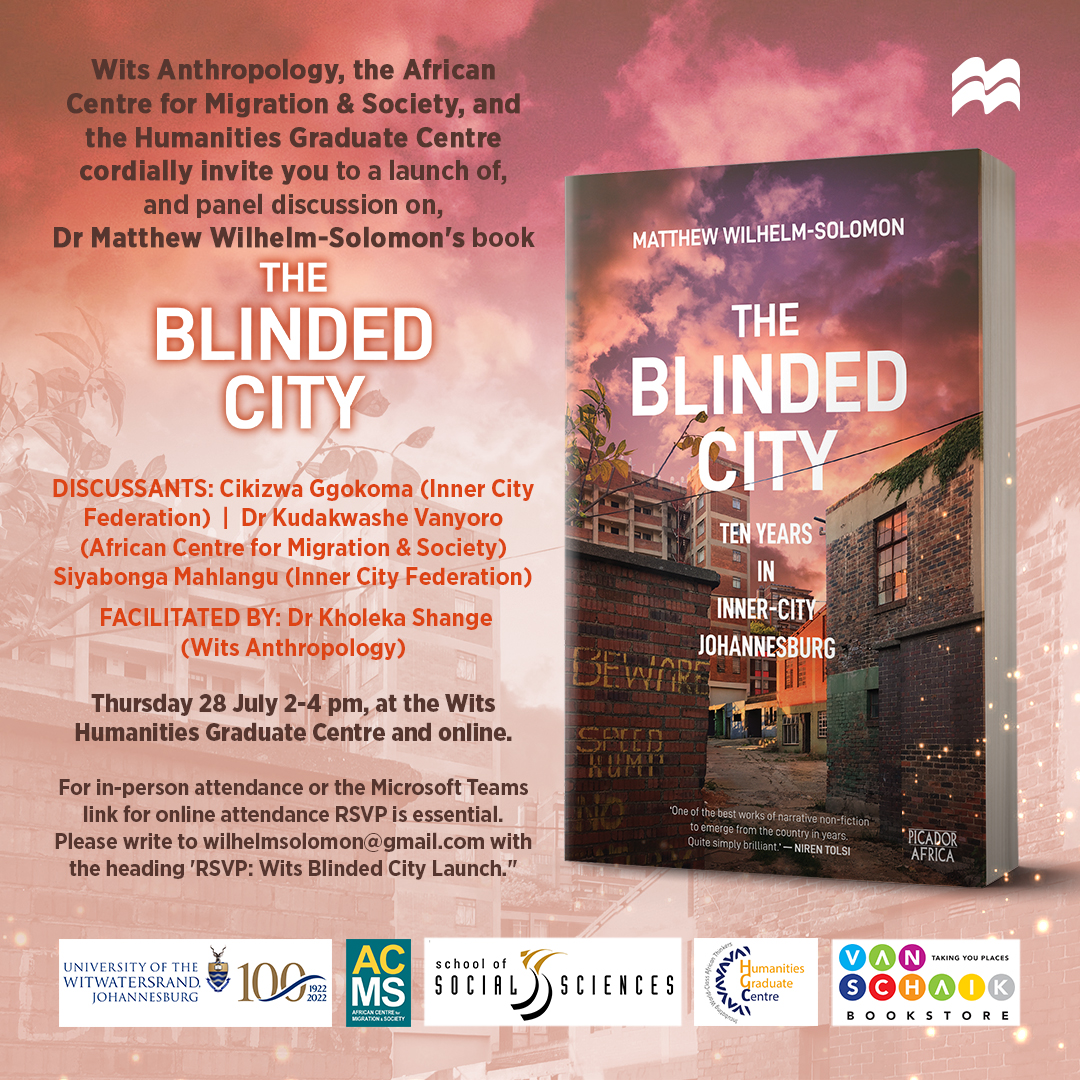
Wits Anthropology, the African Centre for Migration & Society, and the Humanities Graduate Centre cordially invite you to a launch of, and panel discussion on, Dr Matthew Wilhelm-Solomon's book "The Blinded City: Ten Years in Inner-CityJohannesburg" (Pan Macmillan SA, 2022), Thursday 25 August 11:30 am -1 pm, at the Atrium, Wits Humanities Graduate Centre and online. DISCUSSANTS: Cikizwa Ggokoma (Inner City Federation) Dr Kudakwashe Vanyoro (African Centre for Migration & Society) Siyabonga Mahlangu (Inner City Federation) FACILITATED BY: Dr Kholeka Shange (Wits Anthropology) For in-person attendance RSVP is essential. Please write to wilhelmsolomon@gmail.com with the heading 'RSVP: Wits Blinded CityLaunch." SYNOPSIS: ‘One of the best works of narrative non-fiction to emerge from the country in years. Quite simply brilliant.’ – NIREN TOLSI Amid evictions, raids, killings, the drug trade, and fire, inner-city Johannesburg residents seek safety and a home. A grandmother struggles to keep her granddaughter as she is torn away from her. A mother seeks healing in the wake of her son’s murder. And displaced by the city’s drive for urban regeneration, a group of blind migrants try to carve out an existence. The Blinded City recounts the history of inner-city Johannesburg from 2010 to 2019, primarily from the perspectives of the unlawful occupiers of spaces […]
-
-
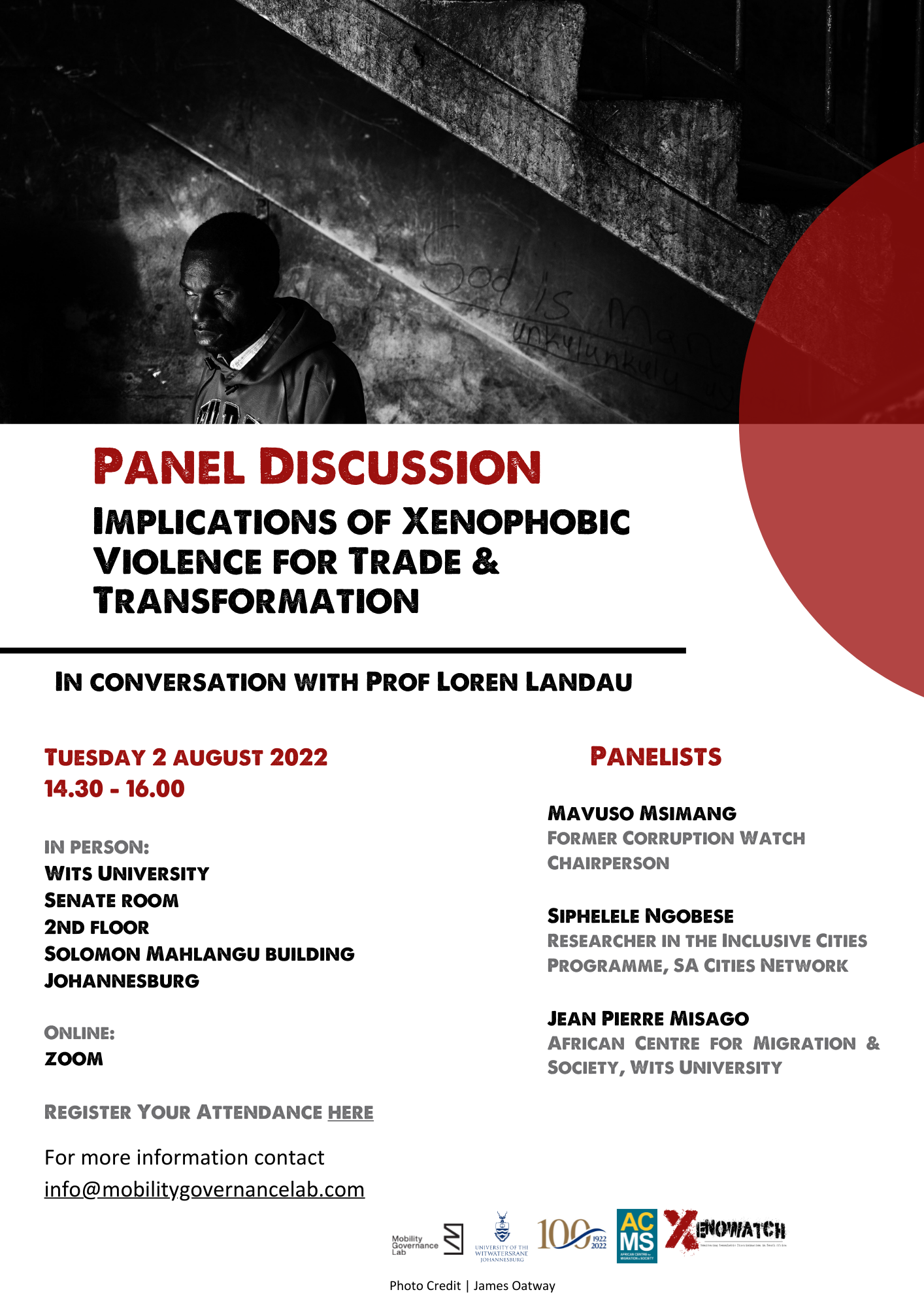
Panel Discussion: Implications of Xenophobic Violence for Trade & Transformation
Senate Room, Second Floor East Wing, Solomon Mahlangu House, University of the Witwatersrand East CampusWits University’s African Centre for Migration & Society and the Wits-Oxford Mobility Governance Lab, invite you to a panel discussion reflecting on the meaning and implications of xenophobic violence for South Africa’s economic and political future. The discussion stems from a newly released Xenowatch report: Xenophobic Violence in South Africa: An Analysis of Trends, Causal Factors and Responses. Drawing on more than a decade of original research across South Africa, the report describes xenophobic violence as an increasingly integral part of the country’s socio-economic and political landscape. Abetted by anti-immigrant attitudes, xenophobic violence is rooted in democratic deficits: threats to rule of law and constitutional credibility. It highlights that violence is distinctly spatialised, often occurring repeatedly in specific localities where economic and political competition is acute. It demonstrates that while inequality fuels popular dissatisfaction, political opportunists and entrepreneurs scapegoat and victimise immigrants and other outsiders for their own advantage. The consequences of South Africa’s anti-outsider violence extend far beyond the immediate victims but affect lives across many townships and informal settlements. Yet while violence has long been a local matter, the forthcoming national leadership contest has seen xenophobic rhetoric and mobilisation become increasingly well-organised and national. Together these reflect a […]
-
-
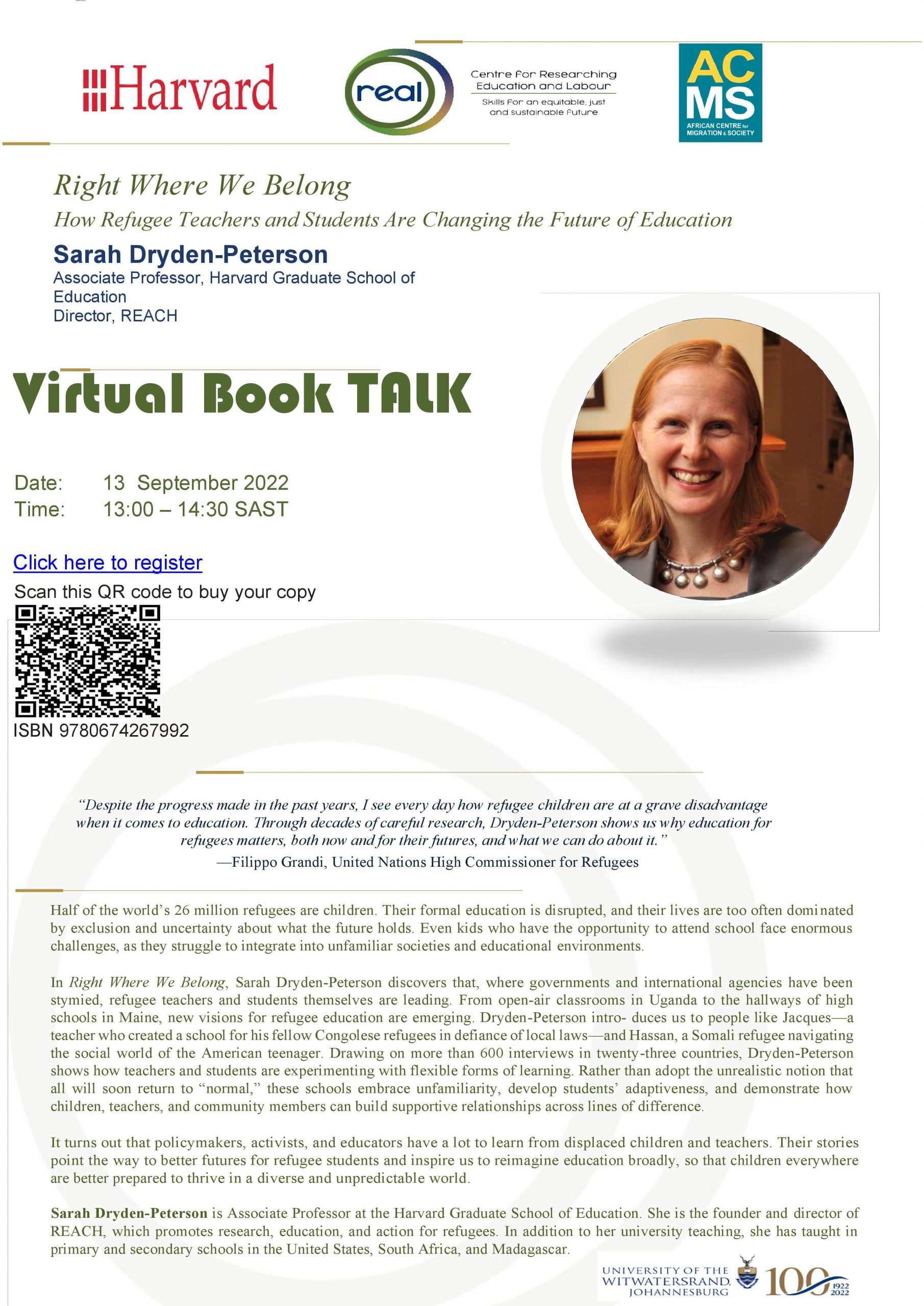
Virtual Book Talk: Right Where We Belong: How Refugee Teachers and Students Are Changing the Future of Education
Half of the world’s 26 million refugees are children. Their formal education is disrupted, and their lives are too often dominated by exclusion and uncertainty about what the future holds. Even kids who have the opportunity to attend school face enormous challenges, as they struggle to integrate into unfamiliar societies and educational environments. In Right Where We Belong, Sarah Dryden-Peterson discovers that, where governments and international agencies have been stymied, refugee teachers and students themselves are leading. From open-air classrooms in Uganda to the hallways of high schools in Maine, new visions for refugee education are emerging. Dryden-Peterson introduces us to people like Jacques—a teacher who created a school for his fellow Congolese refugees in defiance of local laws—and Hassan, a Somali refugee navigating the social world of the American teenager. Drawing on more than 600 interviews in twenty-three countries, Dryden-Peterson shows how teachers and students are experimenting with flexible forms of learning. Rather than adopt the unrealistic notion that all will soon return to “normal,” these schools embrace unfamiliarity, develop students’ adaptiveness, and demonstrate how children, teachers, and community members can build supportive relationships across lines of difference. It turns out that policymakers, activists, and educators have a lot to […]
-
-
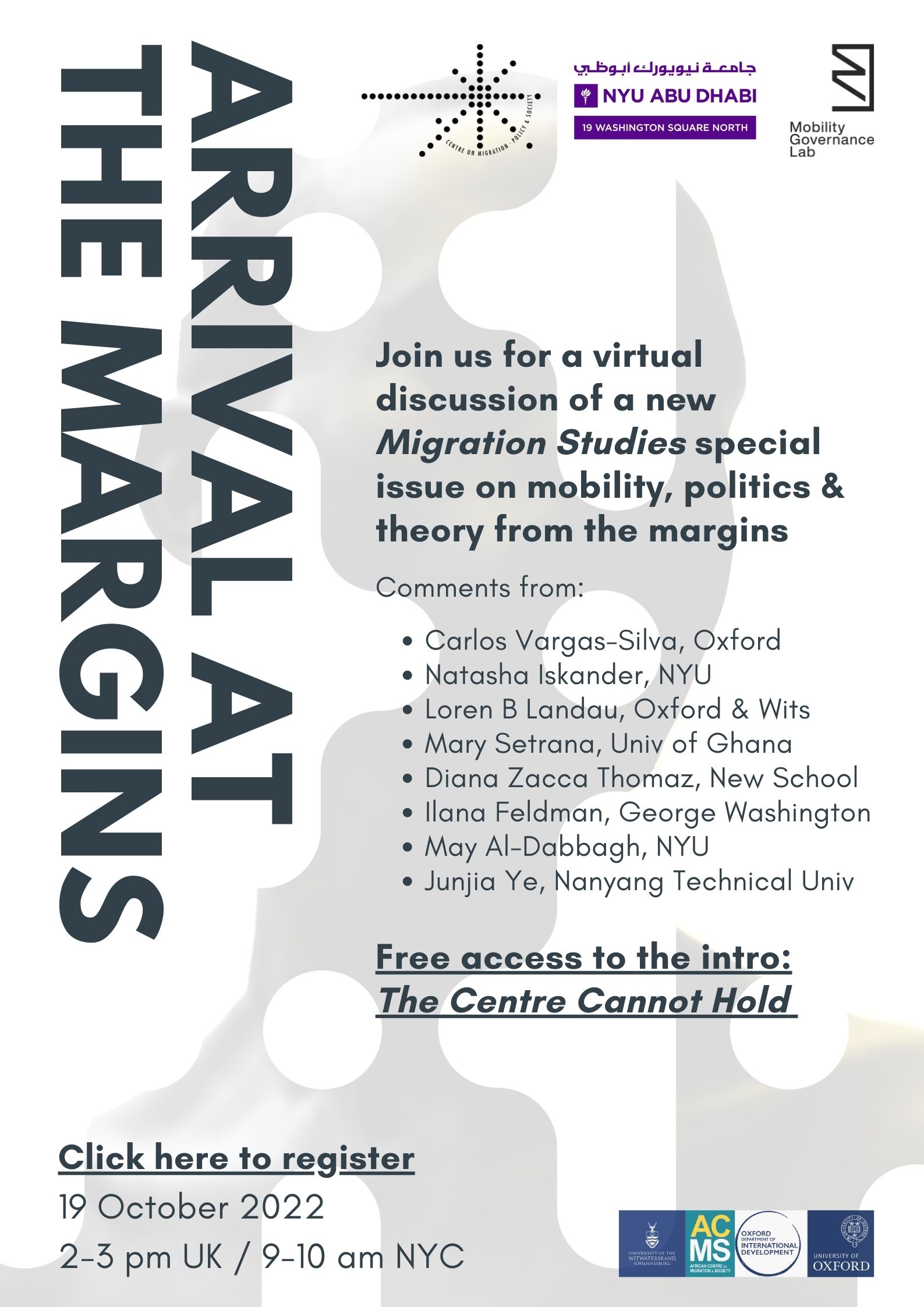
Virtual Discussion: Arrival at the Margins
The editors and contributors of ‘Arrival at the Margins,’ invite you to attend a virtual discussion of their new special issue of Migration Studies. With interdisciplinary contributions from five continents, the issue calls on scholars to simultaneously centre and unsettle the margin: to recognise the multiplicity of margins as politically generative spaces, frequently contoured by sustained and varied forms of mobility. It helps to recalibrate the study of human mobility, drawing attention to approaches, spaces, and transformative process underrecognised in contemporary scholarship. Date: 19 October 2022 Time: 2-3 pm UK / 9-10 am NYC Registration: Click here to register Click here for a free download of the introduction by Natasha Iskander and Loren B Landau