• International protection and the Global Compacts in the time of Covid-19: lessons and challenges from South(ern) Africa

    This Expert Forum has been convened to take stock of the role of the Global Compact on Refugees (GCR) and the Global Compact for Safe, Orderly and Regular Migration (GCM) in South(ern) Africa, two years after their adoption. It will examine the extent to which the GCR and GCM are influencing the implementation of South Africa’s legal and institutional frameworks surrounding refugee and migrant protection in cities such as Johannesburg and Cape Town. The Forum will also explore the unique challenges the global COVID-19 pandemic has created in terms of implementation of the two Compacts at the city, national, and regional levels. Equally, looking forward, the Forum will ask if the pandemic may offer some opportunities to utilize the Compacts further to improve international protection structures for refugees and migrants. For example, by developing more inclusive ‘whole of society’ approaches to healthcare systems at the local and municipality level. The Forum is part of “PROTECT The Right to International Protection. A Pendulum between Globalization and Nativization?” PROTECT is an EU funded research project which studies the impact of the UN’s Global Compacts on Refugees and Migration on refugees’ right to international protection. The vision of PROTECT is to discover ways […]
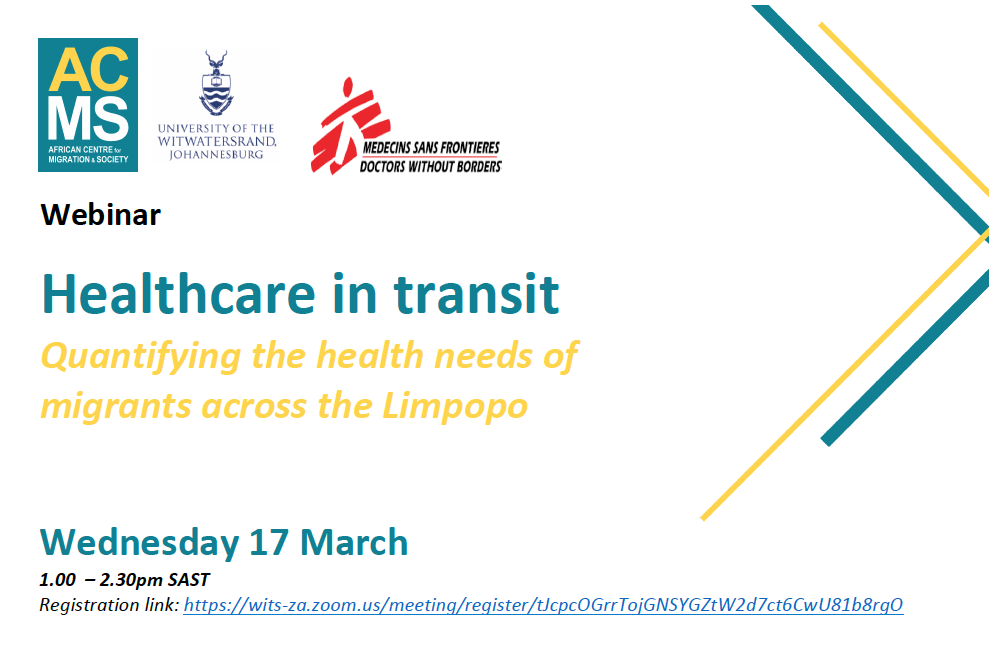
  • Healthcare in transit: Quantifying the health needs of migrants across the Limpopo

    Beginning in late 2019, Doctors Without Borders (MSF) in partnership with the African Centre for Migration & Society (ACMS), conducted over 1,375 detailed interviews with migrants and asylum-seekers across Beitbridge and Musina, documenting the health challenges they faced. Participants included: Zimbabwean deportees coming through Beitbridge Reception, migrants and asylum seekers of several nationalities staying in Musina, Malawians using Beitbridge as a waiting area, the cross-border population living in rural Beitbridge, and different groups heading to South Africa via Beitbridge crossing points. The results of that survey show that the significant waiting period for asylum-seeker application outcomes often exacerbates health challenges that migrants experience. While the report does not point to an acute health crisis at the border, it outlines the risks of the current process, which often requires migrants and asylum-seekers to travel from the rest of the country to Musina, as their office of first application, in order to renew their permits. Many of those whose papers expire before they are able to renew them must endure inhumane and often illegal conditions of arrest and detention prior to deportation, heightening the risks of contagion during the COVID-19 pandemic. Implications of the report – beyond addressing medical needs – extend to the need for […]

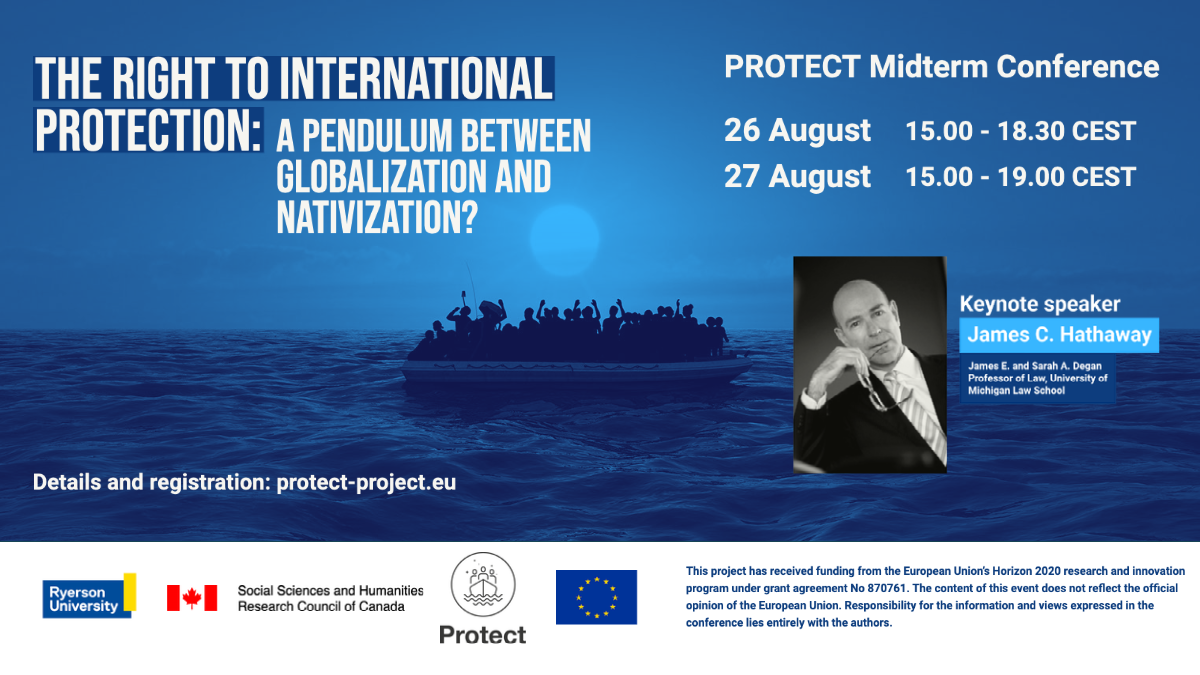
  • PROTECT Midterm Conference

    At PROTECT’s virtual conference on 26 – 27 August, we will present our midterm findings and discuss their policy relevance. On day one (26 August), our researchers will give bite-sized presentations of our Work Package findings, which are all dedicated to studying the impacts of the Global Compact on Refugees (GCR) and the Global Compact for Migration (GCM) in different manners. The conference will feature a keynote address by Professor James C. Hathaway, University of Michigan Law School Day two (27 August) is dedicated to two plenary panels; a Policy Forum and an Academic Forum. While the Policy Forum gathers significant national and international actors involved in the global governance of international protection, the Academic Forum is specially devised to communicate with top scholars in the field in order to have their evaluations of the quality and validity of our research results. On both days we invite guests to ask questions and participate in our online facilitated discussion spaces. Full video talks where we present our findings in detail will be sent out to all attendees in advance. Access the short programme here. Register here for virtual participation

  • Exploring the Boundaries of Protection and Human Rights for International Migrants in South Africa: A Facilitated Conversation

    Invited Panel at the 1st Migration & Urbanisation Conference organised by the South African National Department of Social Development and Statistics South Africa About the conference: Migration and urbanisation have been described as major issues impacting on the world’s economic, political and social landscape. Migration has emerged as a dominant theme in global political discourse and international relations. Similarly, patterns of internal migration and urbanisation have significant implications on origin and destination areas within countries. Thus migration is an area of significant focus in policymaking and administration at all levels of governance. The 2030 Agenda for Sustainable Development recognizes for the first time the contribution of migration to sustainable development. Migration is a crosscutting issue, relevant to all of the Sustainable Development Goals. Eleven out of seventeen goals contain targets and indicators that are relevant to migration or mobility. The Agenda's core principle to "leave no one behind", including migrants, requires data disaggregation by migratory status, opening up significant migration data needs but also the opportunity to improve migration data. Panel discussion This facilitated panel conversation will bring together the perspectives of academics, government, and international organizations working in the field of international protection. Inputs will consider the applicability of […]

  • PROTECT Expert Forum: Protection Issues and Solutions for LGBTIQ+ People in Contexts of Forced Displacement

    The African Centre for Migration & Society (ACMS) is running a series of interventions (including public workshops) to unpack the role of international protection and the reality of human rights-based protection claims on the ground in Southern Africa today. Special attention will be given to the influence and impact of both the Global Compact on Refugees (GCR) and Global Compact for Safe, Orderly and Regular Migration (GCM) in the current context of Covid-19. These events are part of PROTECT's Expert Forums series, all of which seek to explore the legal potential and impacts of the Global Compacts on Refugees and Migration. The events are organized by PROTECT's South Africa-based researchers, Jo Vearey, Nicholas Maple, and Kudakwashe Vanyoro. Key topics and issues to be covered in this series: • Protection claims of refugees in South Africa • The stretching and shrinking of international protection via state and local practices • Ground-level approaches to protection for marginalised groups The impact of Covid-19 on: • International protection and localised forms and norms of protection •State approaches to health security and the international securitisation agenda • Regional responses to forced displacement, crisis and instability Program 15 September Protection Issues and Solutions for LGBTIQ+ People in […]

  • Call to Participate in a Workshop on Rethinking Knowledge Politics in Migration Research, Teaching & Practice

    Recently, there has been a proliferation of representations of refugees, asylum seekers and irregular migrants waiting at land, sea as well as air border crossings headed towards Europe. These groups are often framed in highly emotive language that associates them with threats, or portrayed as either tragic or miserable, or as the exemplary citizen. There has also been an increase in emphasis on normative concepts such as ‘safe, orderly and regular migration’ in contemporary migration debates and policies; over and above already established ones such as ‘integration’. Often, we also find inherent presumptions that structural disparities between Europe and Africa can be resolved by addressing the root causes of migration and displacement via research and practice without necessarily addressing the causes of oppression. Conversations about African migrants tend to portray Europe as the main host continent for the majority of African migrants in spite of the greater numerical significance of internal and cross-border migration within and across the countries of the global South. All these developments point to the need for ongoing reflection and in particular the need to address northern-centric views in social science and public debate. This call invites abstract submissions to participate in an online workshop as […]

  • PROTECT Expert Forum: Exploring the Boundaries of International Protection and Human Rights Instruments in South(ern) Africa

    The African Centre for Migration & Society (ACMS) is running a series of interventions (including public workshops) to unpack the role of international protection and the reality of human rights-based protection claims on the ground in Southern Africa today. Special attention will be given to the influence and impact of both the Global Compact on Refugees (GCR) and Global Compact for Safe, Orderly and Regular Migration (GCM) in the current context of Covid-19. These events are part of PROTECT's Expert Forums series, all of which seek to explore the legal potential and impacts of the Global Compacts on Refugees and Migration. The events are organized by PROTECT's South Africa-based researchers, Jo Vearey, Nicholas Maple, and Kudakwashe Vanyoro. Key topics and issues to be covered in this series: • Protection claims of refugees in South Africa • The stretching and shrinking of international protection via state and local practices • Ground-level approaches to protection for marginalised groups The impact of Covid-19 on: • International protection and localised forms and norms of protection •State approaches to health security and the international securitisation agenda • Regional responses to forced displacement, crisis and instability Program 22 September Exploring the Boundaries of International Protection and Human […]

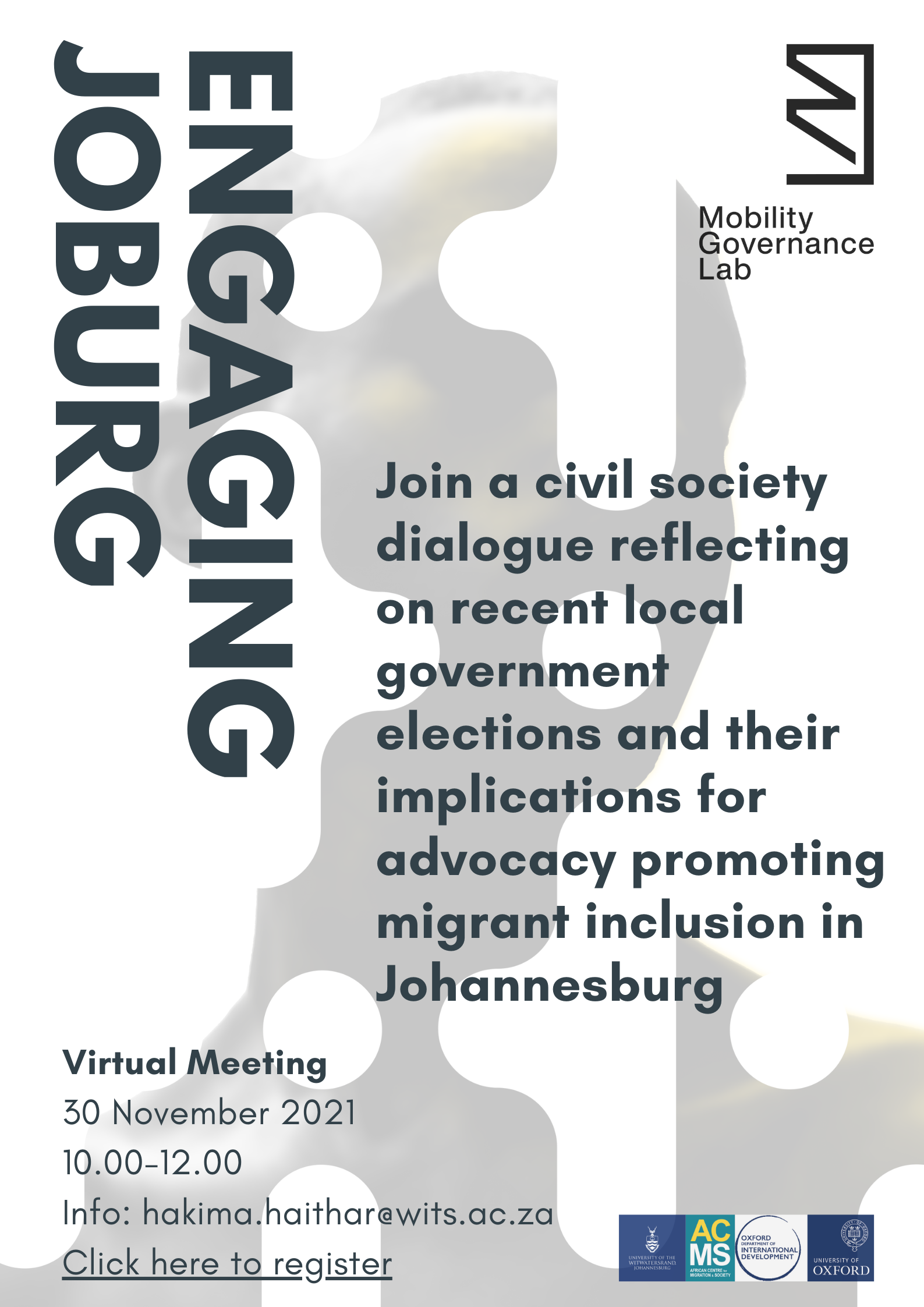
  • Civil Society Consultative Meeting: Governing for Migrant Inclusion in Post-Election Johannesburg

    Online

    South Africa’s recent elections mean coalitions local governments and increasingly competitive local politics. An already weakened bureaucracy and a near empty public purse offer few resources to politicians and parties jockeying for position and electoral advantage. To divert attention from their shortcomings, elected officials are ever more likely to scapegoat immigrants and migrants. Community leaders – elected, selected, or self-appointed – will similarly capitalise on xenophobia to their own advantage. Past experience of xenophobic violence across the country tells us this. Past experience tells us this will be deadly, destructive and further denude our country’s already faltering public institutions.  As a municipality now managed by a coalition government and the city most affected by xenophobic violence, Johannesburg will not be spared. But what is to be done? There is now need to publicly recognise the acute dangers lying ahead and find ways to navigate a fragmented and perilous political landscape. To this end, the African Centre for Migration & Society (ACMS) and the Wits-Oxford Mobility Governance Lab is organising a civil society consultative meeting to discuss and prepare strategies for engagement with the incoming administration post recent local government elections. A new administration demands new and different forms of engagement. […]

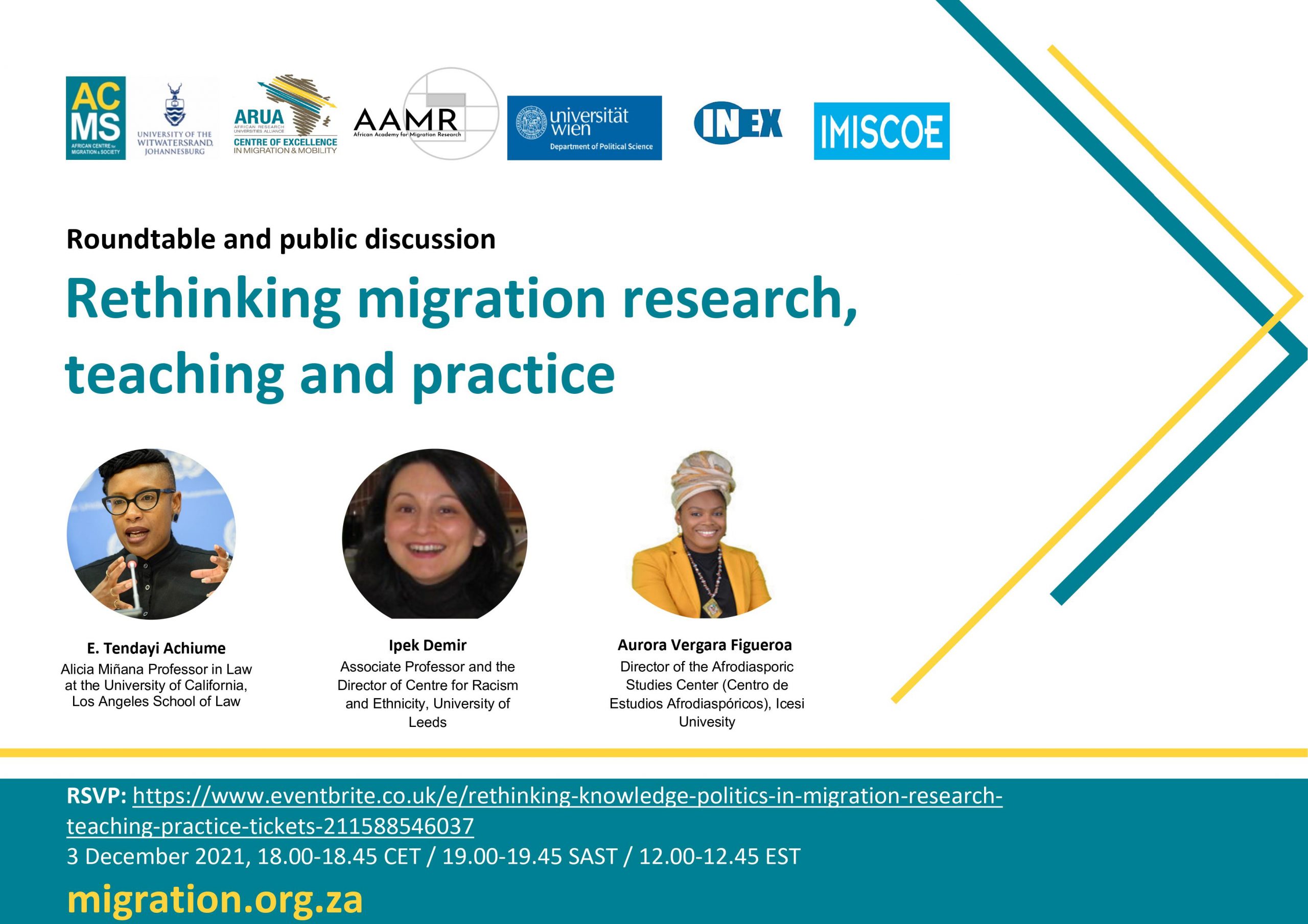
  • Roundtable & Public Discussion: Rethinking Knowledge Politics in Migration Research, Teaching & Practice

    The African Centre for Migration & Society (ACMS) at the University of the Witwatersrand and Department of Political Science at the University of Vienna in partnership with the African Research Universities Alliance (ARUA) and the Anti- Racism Working Group of the IMISCOE International Migration Research Network cordially invite you to a roundtable and public discussion on Rethinking Migration Research, Teaching and Practice. An ongoing gap in genuine perspectives that are the outcome of robust engagement of scholars and practitioners across the Global North and the Global South runs the risk of reducing decolonisation to a normative and at times arbitrary framework, silencing certain perspectives and/or side-lining existing work. What does decolonisation have to offer to migration researchers and practitioners that differs or is inimitable from pre-existing notions of reflexivity in the field, and what, if any, are its potential pitfalls? Centred on three themes (rethinking the migration research agenda and practice; reflecting on fieldworks and methods; changing the way we teach), this roundtable and public discussion aims to engage with the question if decolonisation as an analytical and reflexive tool can provide new or critical knowledge about more productive, inclusive and transformative approaches, language and categories of doing migration research, […]