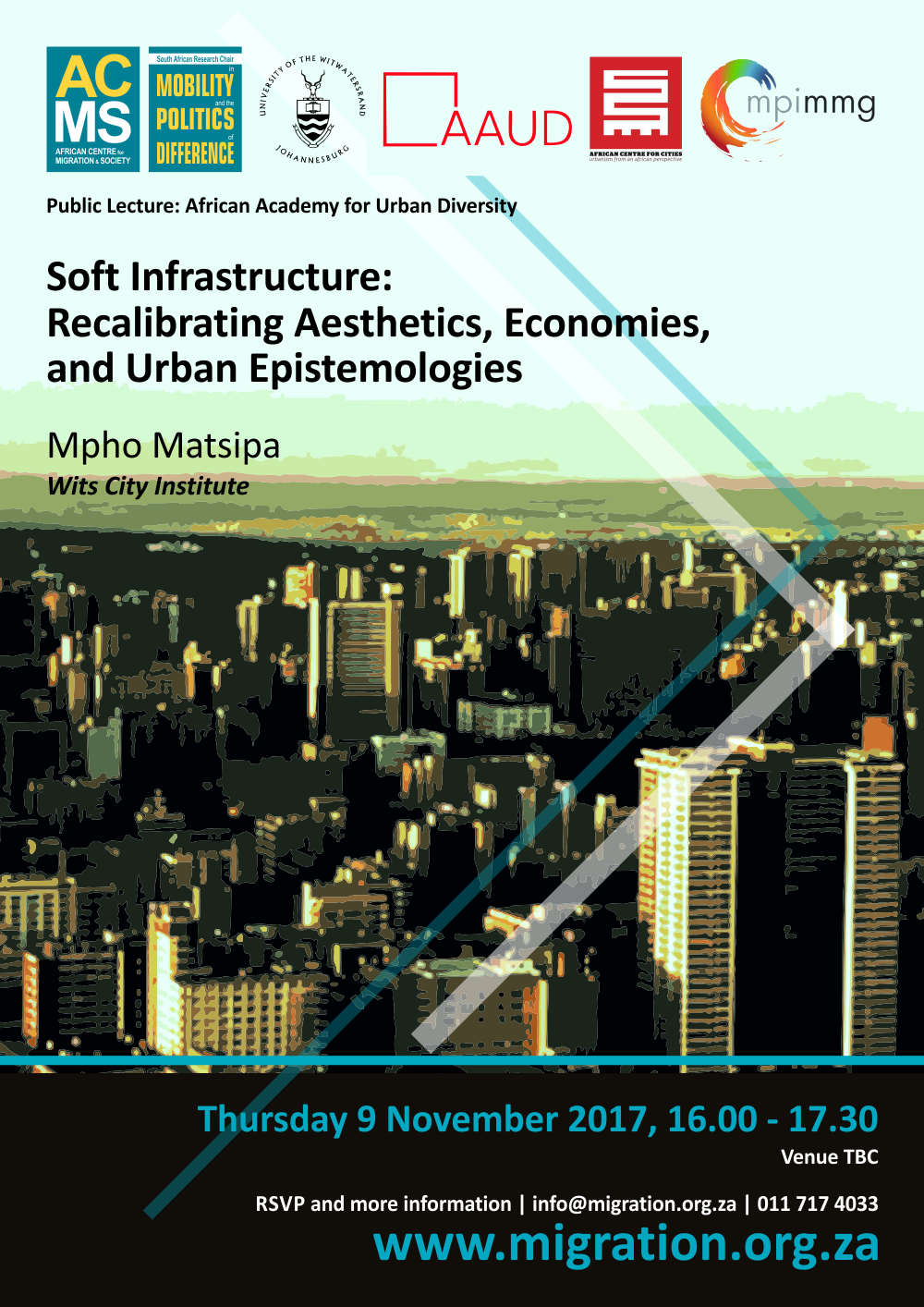
• Soft infrastructure: Recalibrating aesthetics, economies, and urban epistemologies

    Humanities Graduate Centre Seminar Room, South West Engineering Building, University of the Witwatersrand East Campus

    The Academy for African Urban Diversity; a joint initiative of the African Centre for Migration & Society; the African Centre for Cities; and the Max Planck Institute for the Study of Religious and Ethnic Diversity invites you to a special public lecture by Dr Mpho Matsipa (Wits City Institute, University of the Witwatersrand, Johannesburg). A city like Johannesburg offers a glimpse into how immigration, black female sexuality and shifts in urban retail economies provide important economic and cultural resources to urban residents and users. By exploring black cultural practices, like braiding, as both ontology and epistemology, the lecture will explore how such practices recalibrate local economies, infrastructures, and aesthetic codes, and thus might co-constitute emergent urban identities and a way of knowing the city. The intimate, networked, and fractal nature of black hair braiding spaces disrupts the rigid colonial spatial orders of the city and its architecture. However, can such soft infrastructures sufficiently disrupt the grand narrative of African cities in ‘crisis’, while also disrupting colonial and colonizing cartographies of African urban environment? Biography Dr Mpho Matsipa is a researcher at the Wits City Institute. After completing her professional degree in Architecture at the University of Cape Town, with a distinction in design, Mpho […]
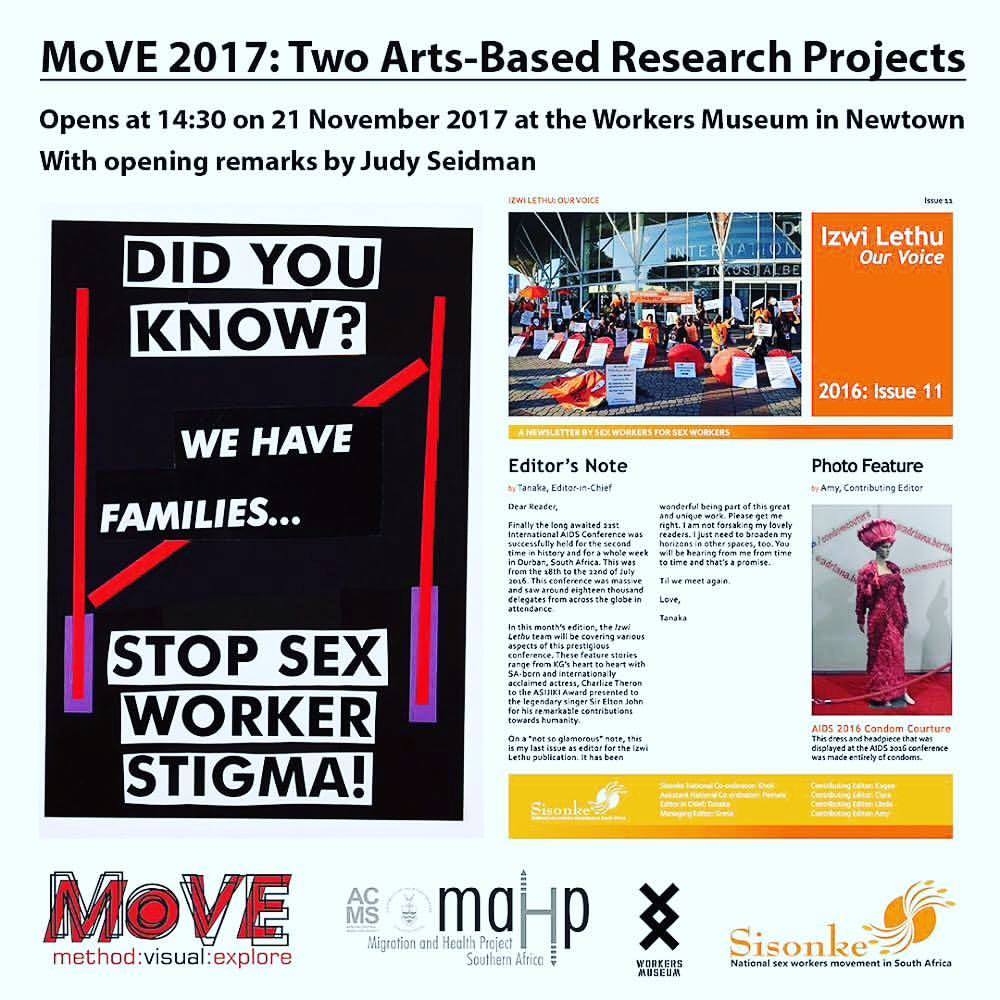
  • MoVE 2017: Two Arts-based Research Projects

    Workers' Museum, Jeppe Street, Newtown, Johannesburg

    The MoVE project of the African Centre for Migration & Society is holding an exhibition that showcases two visual and narrative research projects conducted in 2016 and 2017.  Both projects involved collaboration with the MoVE Project and the Sisonke Sex Worker Movement. We feature an exhibition of The Sex Worker Poster Project: a poster conducted with persons who sell sex in Mpumalanga, and an exhibition of the sex worker newsletter project entitled, Izwi Lethu: Our Voices. Opening remarks: Judy Seidman on the history of posters in activism in South Africa Judy Seidman is a cultural worker and visual artist. Between 1980 and 1985, Judy worked with the Medu Art Ensemble in Gaborone, Botswana, to make posters for the liberation struggle in South Africa. Since then she has worked as a curator, facilitator and freelance designer, for various social movements, including the trade unions, AIDS campaigns, Curriculum Development Project, Khulumani Support Group,  the 1in9 Campaign and the Sex Workers Education and Advocacy Taskforce. Date:    Tuesday 21 November 2017 Time:    14:30 Venue:  Workers Museum, Newtown, Johannesburg The exhibition will run until 20 December 2017.

  • Social cohesion and violence prevention symposium

    Humanities Graduate Centre Seminar Room, South West Engineering Building, University of the Witwatersrand East Campus

    South Africa is a place of many contradictions, conflicts, and tensions, including but not limited to racism, sexism, and xenophobia. Since the 2000s, the term “social cohesion” has been used as something of a catchall ideal, to which these are all an affront. As common as the term is, it does not rest on a clear analysis of why social tensions exist, or what is to be done about those that do. So far, social cohesion has proved both elusive and resistant to official encouragement. The GCRO and the South African Research Chair in Mobility and the Politics of Difference at ACMS, in partnership, are undertaking a programme of research into the empirics of violence prevention, based on previous work on social cohesion. As part of the preparation for this programme a ‘State of Knowledge Symposium’ will bring together academics and practitioners working on problems of social tension, and particularly those that manifest as violence, in an academic setting. The interest of this workshop is to interrogate the kinds of interventions that are being deployed to address this field of social problems, with a particular focus on anti-violence work. Some initial questions include: ● To what extent do those who […]

  • The Meanings of Women’s Mobilities: Gender Ideals and Female Mobility in West Africa

    ACMS Seminar Room 2163, South East Wing, Second Floor, Solomon Mahlangu House, University of the Witwatersrand East Campus

    As part of the Lunchtime Seminar Series, the African Centre for Migration & Society invites you to a seminar titled The Meanings of Women’s Mobilities: Gender Ideals and Female Mobility in West Africa presented by Dr Gunvor Jónsson (Departmental Lecturer, Oxford Department of International Development, University of Oxford). Despite increasing global attention to women’s involvement in migration in recent decades, very little research has looked at Malian women’s different forms of mobility, beyond the “rural exodus” from the countryside into towns. Gunvor's fieldwork in Dakar, the capital of Senegal, focused on both mobile and settled female traders from Mali, the neighbouring country. Many of these women were heads of their own households; many were single – unmarried, divorced, widowed. In this presentation she will look at the various mobilities that these and other Malian women were engaged in, to examine the kinds of meanings and experiences they were associated with. She will start by discussing the role of local Islamic, patriarchal and Mande ideals in relation to women’s mobilities. Gunvor then moves on to examine the kinds of mobilities that were associated with womanhood, focusing specifically on how conceptions of womanhood were linked to liminal or perpetual conditions of strangerhood. By looking […]

  • Lagos Budding 50: Storytelling project on Migration and Resilience

    ACMS Seminar Room 2163, South East Wing, Second Floor, Solomon Mahlangu House, University of the Witwatersrand East Campus

    The African Centre for Migration & Society invites you to a seminar titled Lagos Budding 50: Storytelling project on Migration and Resilience presented by Helen Gebregiorgis (Project Manager, African Photo Stories). Inspired by the May 2017 'Lagos @ 50 Celebrations' highlighting prominent and influential Lagosians, Lagos: Budding 50  is a visual storytelling project that honours and recognises the contributions of young, everyday Lagosians in the development of the megacity. Different storytelling methods were utilized throughout the interviews with participants, such as photography, videography, and audio recording. Through exploration of identity, migration and resilience, Lagos: Budding 50 celebrates the stories of diverse, ambitious and resilient young Lagosians as they strive to better themselves and their communities. The project is inspired by and dedicated to the people of Lagos. Striving to contribute towards a balanced perspective of Africa, the Africa Photo Stories website is an initiative to build bridges of connection between the global community and the African community through storytelling methods, one story at a time. Biography Helen Gebregiorgis is a visual storyteller, passionate about Africa, peace-building, and human connection. It wasn’t until her first trip to the continent, that she truly understood that Africa was more than just a handful of stories. It was […]

  • The Safe Country Concept in International Agreements: Past, Present and Future of State Practice

    ACMS Seminar Room 2163, South East Wing, Second Floor, Solomon Mahlangu House, University of the Witwatersrand East Campus

    As part of the Lunchtime Seminar Series, the African Centre for Migration & Society invites you to a seminar titled The Safe Country Concept in International Agreements: Past, Present and Future of State Practice presented by María-Teresa Gil-Bazo (Senior Lecturer in Law and Convenor of Newcastle University Research Group on International Studies in Forced Migration). One of the expressions of international cooperation among States in the field of refugee protection is the adoption of international agreements that implement the “safe country” concept. This presentation examines the legal background to these concepts and State practice by considering three select case studies: South Africa, Spain and the US. The presentation analyses the legal implications and significance of issues arising and provides a critique of the system and its premises. In particular, the presentation considers whether a multilateral arrangement – such as the Dublin III Regulation or the Canada-US Agreement – has the potential to become a model for the development of an inter-State agreement whereby one of the State Parties effectively delivers all relevant international obligations (including the right to asylum) on behalf of all States bound by such system. The dual nature of the system is analysed, as an operational instrument creating obligations between […]

  • The Regional Protection of Internally Displaced Persons in Africa

    ACMS Seminar Room 2163, South East Wing, Second Floor, Solomon Mahlangu House, University of the Witwatersrand East Campus

    As part of the Lunchtime Seminar Series, the African Centre for Migration & Society invites you to a seminar titled The Regional Protection of Internally Displaced Persons in Africa presented by Dr Romola Adeola (Postdoctoral Researcher, African Centre for Migration & Society, University of the Witwatersrand). Internal displacement has emerged as a pertinent challenge in Africa. Yearly, millions of people are internally displaced on the continent due to conflict and other factors.  With the reality that more than half of the continent was internally displaced in the early 2000s, African leaders developed the Convention for the Protection and Assistance of Internally Displaced Persons in Africa in 2009. This presentation examines the content of this framework, regional developments towards its realization and some key challenges that must be addressed in fostering compliance of states with the legal framework. Biography Dr Romola Adeola is a lawyer with expertise in international law specifically in areas of migration, refugee protection, development and human rights law and policy. She has lectured and presented at various conferences on the protection of refugees, internally displaced persons and migrants at various Universities. She has served extensively as a consultant for governments and international institutions on issues of migration. She has a Doctorate in […]

  • Youth on the move: Reframing and representing youth migration

    Today, youth migration is becoming an increasingly important phenomenon in the field of transnational migration studies. Yet, migration scholarship and immigration law continue to presume that migrants are first and foremost adult actors making relatively autonomous consensual decisions to become mobile. When youth migration is discussed, it is often normatively assumed that parental neglect or a breakdown in parental care are the cause. Adults are frequently seen as the primarydecision-makers and providers for children and, thus, are often responsible—or culpable—for a young person’s migration. The corresponding position of the child as inferior or somehow exclusively dependent on parents stands in marked contrast to the integral roles children often assume in familial decision-making processes, as well as to the decisions they make as social actors and migrants in their own right. This interdisciplinary conference seeks to disrupt the adult bias in migration literature by uniting emerging and established scholars and practitioners to investigate both the conceptual and territorial migration of children and youth across diverse international contexts. Hosted by the African Centre for Migration and Society (ACMS) at the University of the Witwatersrand in Johannesburg, South Africa, and co-sponsored by the Migration and Health Project (maHp) and the American Anthropological Association’s Anthropology of Children and Youth Interest Group (ACYIG), this conference promises to engage a […]

  • Do Migrants matter? A Comparative Analysis of the Causes of Death Among Sub-Saharan Immigrants and Local South Africans, 2009-2015

    ACMS Seminar Room 2163, South East Wing, Second Floor, Solomon Mahlangu House, University of the Witwatersrand East Campus

    As part of the Lunchtime Seminar Series, the African Centre for Migration & Society invites you to a seminar titled Do Migrants Matter? A Comparative Analysis of the Causes of Death Among Sub-Saharan Immigrants and Local South Africans, 2009-2015 by Lorena Nunez Carrasco (Department of Sociology, University of the Witwatersrand); Abha Jaiswal (Research and Information System for Developing Countries); Michel K. Muteba (School of Public Health, University of the Witwatersrand) and Jairo Arrow (Statistics South Africa). Migrants form an integral part of South Africa. In line with South Africa’s status as a signatory of the Refugees Act, migrants have been included in the population that will receive basic health care services under the National Health Insurance (NHI). Understanding the burden of disease of migrants will play a significant role in the sustainability of NHI. Against this backdrop, this presentation analyses the causes of death registered by Statistics South Africa  (Stats SA) for the years 2009 to 2015 and compares African migrants from four countries with the largest population in the country (Lesotho, Malawi, Mozambique and Zimbabwe,) and local South Africans. Initial findings show a much higher percentage of unnatural deaths among foreign nationals from these countries when compared with the local population. Using the CDC10 coding and […]

  • Immigration and the labor market outcomes of natives in developing countries: A case study of South Africa

    ACMS Seminar Room 2163, South East Wing, Second Floor, Solomon Mahlangu House, University of the Witwatersrand East Campus

    As part of the Lunchtime Seminar Series, the African Centre for Migration & Society invites you to a seminar titled Immigration and the Labor Market Outcomes of Natives in Developing Countries: A Case Study of South Africa by Nzinga Broussard (Millennium Challenge Corporation). Using South African census data from 2001, 2007, and 2011, Nzinga examines the effect that immigration had on labor market outcomes of native-born black South Africans. Using instrumental variables to control for the potential endogenous location choices of immigrants to South Africa, the results show that immigrant inflows decreased the employment-to- population ratios and total annual income of black native-born South Africans. Additionally, results suggest a negative effect of immigrant inflows on the employment ratio and total annual income of black native-born South Africans employed in the formal sector. Results show that immigration caused an intersectoral employment shift. For black male South Africans, the composition of the employed labor force shifted to the formal sector, and for black female South Africans, the composition of the employed labor force shifted to the informal sector. Biography  Dr. Nzinga Broussard is an applied micro-economist with over nine years of experience in the areas of development, labor, and agricultural economics. She has several publications in peer-reviewed […]