• Media portrayal of immigration in the South African media, 2011-2015

    ACMS Seminar Room 2163, South East Wing, Second Floor, Solomon Mahlangu House, University of the Witwatersrand East Campus

    As part of the Lunchtime Seminar Series, the African Centre for Migration & Society invites you to a seminar titled Media portrayal of immigration in the South African media, 2011-2015 presented by Nixon Kariithi (Tangaza Africa Media). The issue of media representation of immigrants is particularly pertinent today, given the current anti-immigrant sentiment in parts of Europe and the United States. In South Africa, negative attitudes towards foreigners are common and media discursive descriptions of immigrants as illegal, undocumented or a dangerous threat is typical. This study utilises quantitative tools of analysis to explore the media coverage of immigration adopting the RASIM Corpus Linguistics (CL) approach. The rubric – REFUGEE, ASYLUM-SEEKER, IMMIGRANT, MIGRANT is adjusted to RASFIM – REFUGEE, ASYLUM-SEEKER, FOREIGNER, IMMIGRANT, MIGRANT – to more appropriately account for the specific nuances of representations of immigrants in the South African media. The data, comprising of over 5,000 relevant media articles, was drawn in annual tranches for the period 2011–2015. The findings identify significant patterns that are consistent with extant literature on media constructions of foreigners as “illegal immigrants.” Other findings relating to “shop” and “trade” references offer evidence of the complex and at times contradictory nature of public discourses on immigration. Media narratives go as far as to suggest that foreign-owned shops are […]
  • Mystic motives: Re-evaluating clandestine migration out of Senegal

    ACMS Seminar Room 2163, South East Wing, Second Floor, Solomon Mahlangu House, University of the Witwatersrand East Campus

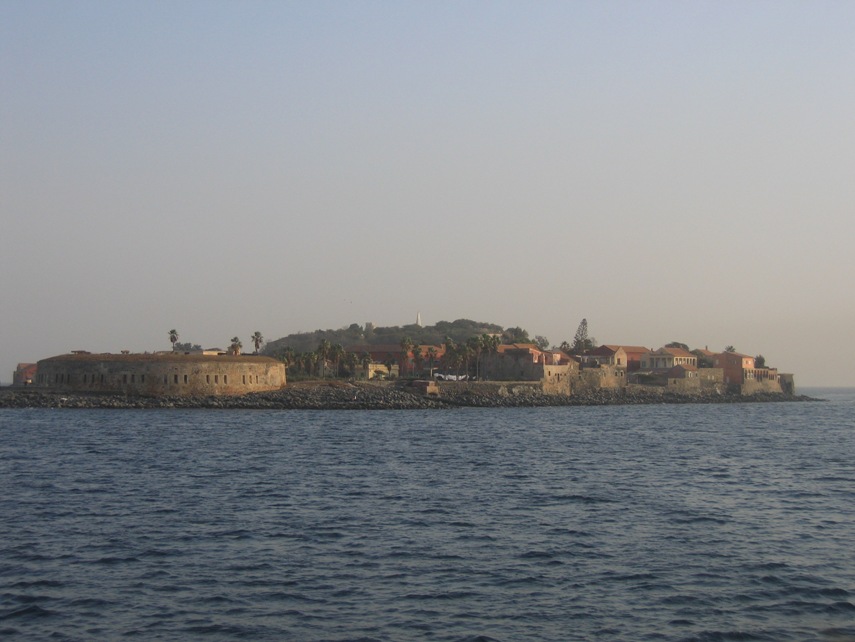
    As part of the Lunchtime Seminar Series, the African Centre for Migration & Society invites you to a seminar titled Mystic motives: Re-evaluating clandestine migration out of Senegal presented by Stephanie Maher (African Centre for Migration & Society, University of the Witwatersrand). Between 2006 and 2008, tens of thousands of young predominantly male boat migrants left the shores of West Africa in the hopes of reaching the Spanish Canary Islands. At the time, policy analysts explained the exodus as being motivated primarily by ‘brute poverty’. Since then, anthropologists have nuanced this strictly fiscal interpretation by exploring how other social factors contributed to clandestine departures, such as the inability of youth in Africa to achieve ‘social adulthood’. While such scholarship complicates the broad strokes approach of policy analysis by attending to the difficulties of obtaining upward social mobility in climates of austerity and volatility, it remains largely centered on the economics of individual status and neglects the reality of fulfilling spiritual obligations in a world of increasingly restricted borders. This presentation offers another reading of the motivating factors by arguing that economic motives, though profound, cannot be divorced from their socio-religious milieu. Rather, migration is often a mode of aspiring to piety and striving […]

  • Routes And Rites To The City: Mobility, Diversity And Religious Space In Johannesburg

    Humanities Graduate Centre Seminar Room, South West Engineering Building, University of the Witwatersrand East Campus

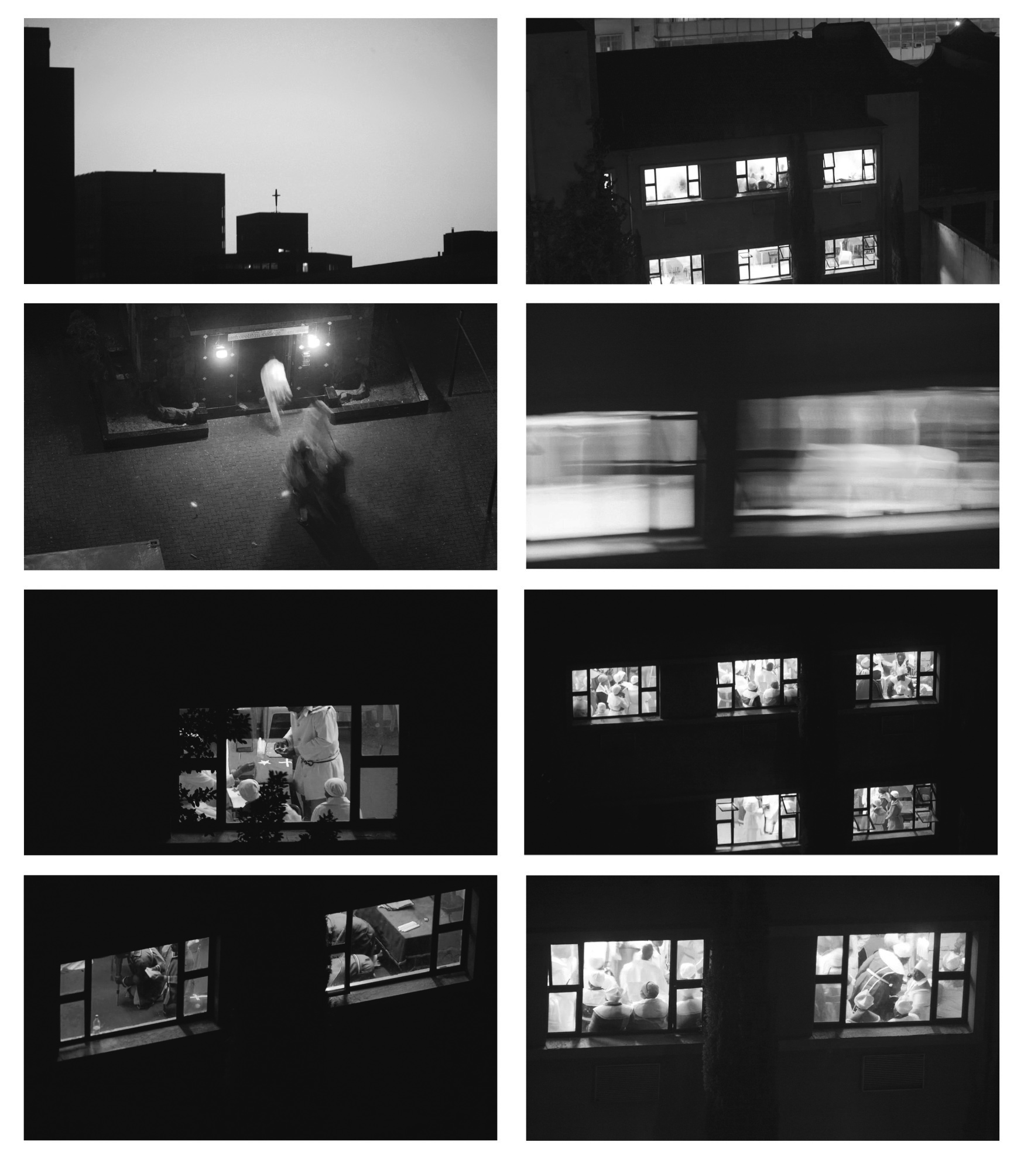
    The Wits Department of Sociology and African Centre for Migration & Society are pleased to host a book launch and panel discussion of Routes and Rites to the City: Mobility, Diversity and Religious Space in Johannesburg. Routes and Rites is an exploration of the ways religion and diverse forms of mobility have shaped post-apartheid Johannesburg, South Africa. The project has two inter-related publications: the first is a full length, multi-authored polygraph (Palgrave Macmillan, 2016) edited by Matthew Wilhelm-Solomon, Lorena Núñez, Peter Kankonde Bukasa and Bettina Malcomess;  the second is a freely available visual supplement curated by Bettina Malcomess. Both include multiple authors and photographers. The project analyses transnational and local migration in contemporary and historical perspective, along with movements of commodities, ideas, sounds and colours within the city. It re-theorizes urban ‘super-diversity’ as a plurality of religious, ethnic, national and racial groups but also as the diverse processes through which religion produces urban space. The authors argue that while religion facilitates movement, belonging and aspiration in the city, it is complicit in establishing new forms of enclosure, moral order and spatial and gendered control. Multi-authored and interdisciplinary, this edited collection and visual supplement deals with a wide variety of sites and religions, including Christianity, Islam, Hinduism and […]

  • Urban Refugees: Resilience, social networks and policy implications lessons from Nairobi

    ACMS Seminar Room 2163, South East Wing, Second Floor, Solomon Mahlangu House, University of the Witwatersrand East Campus

    As part of the Lunchtime Seminar Series, the African Centre for Migration & Society invites you to a seminar titled Urban refugees: Resilience, social networks and policy implications lessons from Nairobi, Peshawar and Gaziantep presented by Caroline Wanjiku-Kihato (Associate Professor, Graduate School of Architecture, University of Johannesburg). This is part of a three-country study that explores the role of social capital and social networks in urban refugees’ quest for self-reliance in Nairobi (Kenya), Peshawar (Pakistan) and Gaziantep (Turkey). Using survey data and in-depth interviews conducted with refugees in Nairobi, this paper outlines the nature of social relationships in refugees’ home and host countries and examines the ways in which social relationships shape their socio-economic capabilities. The study used both quantitative and qualitative research methods. Our survey comprised of 1074 interviews with refugees from twelve countries, now living in Nairobi. In addition to the survey, we held one-on-one interviews with twenty-two respondents (with an equal number of male and female respondents) from Eritrea, Ethiopia, Somali, the Democratic Republic of Congo (DRC), South Sudan, Uganda and Burundi. Urban refugees in Nairobi are income and asset poor, living mostly from hand to mouth. With few income generating opportunities, low and irregular remittance transfers, less than half are able to […]

  • Staying with complexity: Narratives of arriving and living in Durban

    ACMS Seminar Room 2163, South East Wing, Second Floor, Solomon Mahlangu House, University of the Witwatersrand East Campus

    As part of the Lunchtime Seminar Series, the African Centre for Migration & Society invites you to a seminar titled Staying with complexity: narratives of arriving and living in Durban presented by Kira Erwin (Senior Researcher, Urban Futures Centre, Durban University of Technology). This seminar offers initial insights from a project on Migration and Inclusivity in the city of Durban. The project collected 30 oral histories; from women applying for asylum permits, from women who are in South Africa on study permits and spousal visas, and from South African women who have come to stay in a single-sex hostel in Durban from rural areas in the province. Themes from the narratives highlight how storytelling is used as a survival strategy, how precariousness in the city is shaped by entangled variables (some which are brought with migrants from their home spaces), and the role of religion and gender in determining agency. These diverse stories of migration and arrival in Durban offer complex and contradictory narratives. Complicating and nuancing our understanding of migrancy is critical if we are to create city spaces that make for a more dignified life for all. Yet the richness, fractures and commonalities in these narratives also present a challenge for researchers; […]

  • Addressing the issues behind the European refugee crisis: Towards new global solidarities and solutions

    ACMS Seminar Room (2163), Solomon Mahlangu House (2nd floor), East Campus, University of the Witwatersrand

    The African Centre for Migration & Society's South African Research Chair in Mobility and the Politics of Difference invites you to a special public lecture by Liv Tørres (Executive Director, Nobel Peace Center, Oslo). In the beginning of 2015, large numbers of refugees and migrants started arriving in Europe. The so-called "European refugee crisis" had developed slowly since 2010, but evolved into a mass movement of people, with record-numbers of refugees passing the doorstep of Europe. Altogether 1,3 million people arrived with relative high numbers settling in Germany, Sweden and France, with Italy and Greece as frontline states which carry most of the practical and political “burdens”. Two years and an agreement with Turkey later, thousands of people are still stuck in holding camps in Greece; Italy is overwhelmed; large parts of Europe refuse to help; right-wing political parties and far-right groups capitalize on fears, at the same time as regular Islamist attacks contribute to growing tensions, mounting radicalization, the closing of borders and a divided and more nationalistic Europe. Putting this into a larger perspective though, the numbers of refugees arriving in Europe are low compared to the larger migration and refugee flows internationally where it is countries in the south taking most […]

  • Academy for African Urban Diversity launched at the African Centre for Migration & Society

    The Academy for African Urban Diversity (AAUD) was launched at the African Centre for Migration & Society (ACMS) on 6 November 2017. AAUD is a joint initiative of ACMS; the African Centre for Cities; and the Max Planck Institute for the Study of Religious and Ethnic Diversity. It brings together a cohort of post-fieldwork doctoral students exploring diversity in African cities to debate and theorize the political, social and economic processes surrounding Africa’s growing and diversifying cities. The initiative creates interdisciplinary engagement among young and senior scholars working on urban studies on the African continent. The AAUD launch began with a welcome note from Wits Dean of Humanities Professor Ruksana Osman. Osman highlighted the importance of AAUD in aligning with the University of the Witwatersrand’s vision to nurture young, talented, academic African researchers. Wits Dean of Humanities Professor Ruksana Osman welcoming AAUD fellows Other top South African and global academics also welcomed the initiative. “The AAUD is a key and very important opportunity for scholars to advance their understanding of diversity in African cities, and to generate new ways of understanding urban processes on the continent”, said Professor Edgar Pieterse, Director of the African Centre for Cities at the University of […]

  • Soft infrastructure: Recalibrating aesthetics, economies, and urban epistemologies

    Humanities Graduate Centre Seminar Room, South West Engineering Building, University of the Witwatersrand East Campus

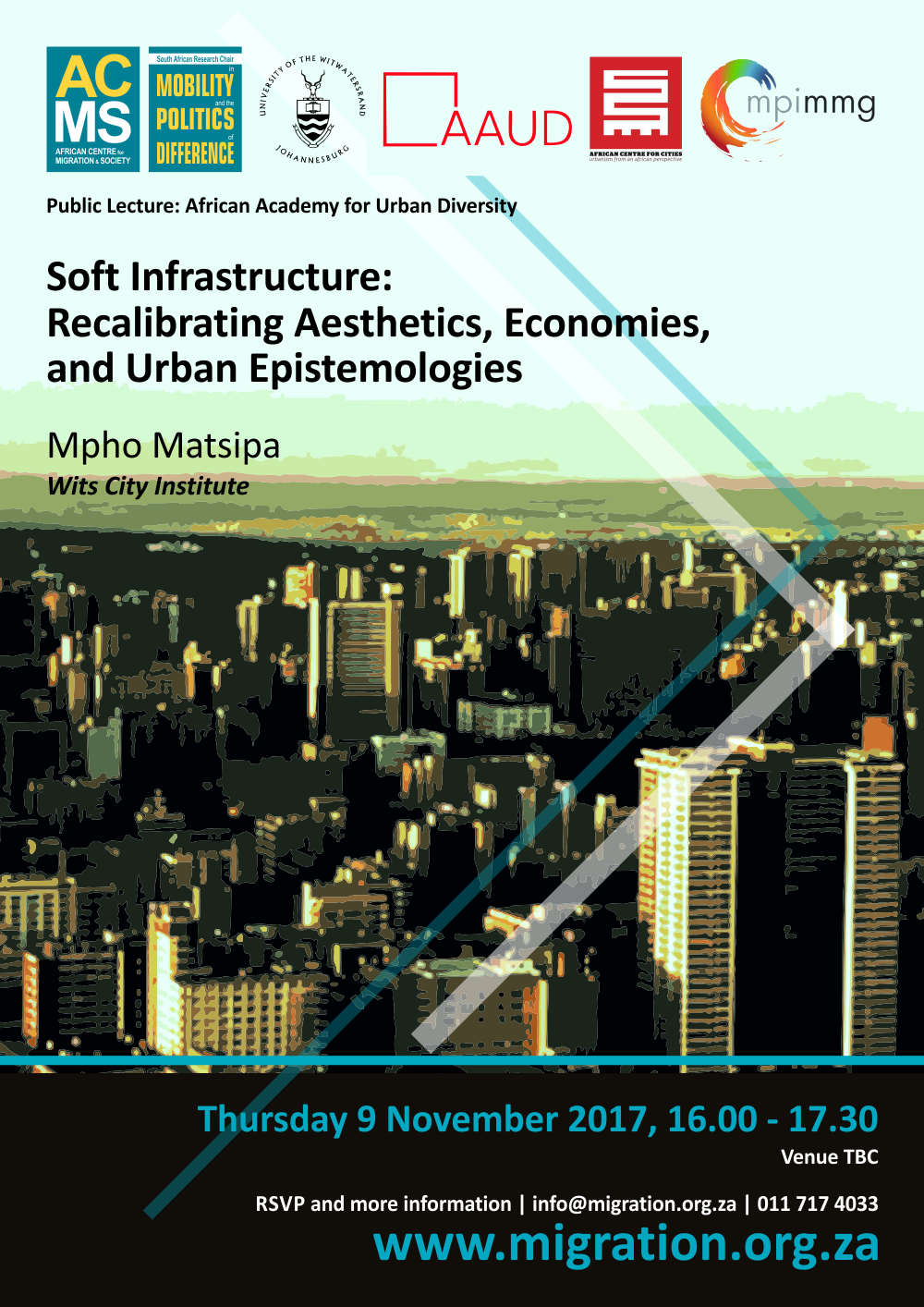
    The Academy for African Urban Diversity; a joint initiative of the African Centre for Migration & Society; the African Centre for Cities; and the Max Planck Institute for the Study of Religious and Ethnic Diversity invites you to a special public lecture by Dr Mpho Matsipa (Wits City Institute, University of the Witwatersrand, Johannesburg). A city like Johannesburg offers a glimpse into how immigration, black female sexuality and shifts in urban retail economies provide important economic and cultural resources to urban residents and users. By exploring black cultural practices, like braiding, as both ontology and epistemology, the lecture will explore how such practices recalibrate local economies, infrastructures, and aesthetic codes, and thus might co-constitute emergent urban identities and a way of knowing the city. The intimate, networked, and fractal nature of black hair braiding spaces disrupts the rigid colonial spatial orders of the city and its architecture. However, can such soft infrastructures sufficiently disrupt the grand narrative of African cities in ‘crisis’, while also disrupting colonial and colonizing cartographies of African urban environment? Biography Dr Mpho Matsipa is a researcher at the Wits City Institute. After completing her professional degree in Architecture at the University of Cape Town, with a distinction in design, Mpho […]

  • MoVE 2017: Two Arts-based Research Projects

    Workers' Museum, Jeppe Street, Newtown, Johannesburg

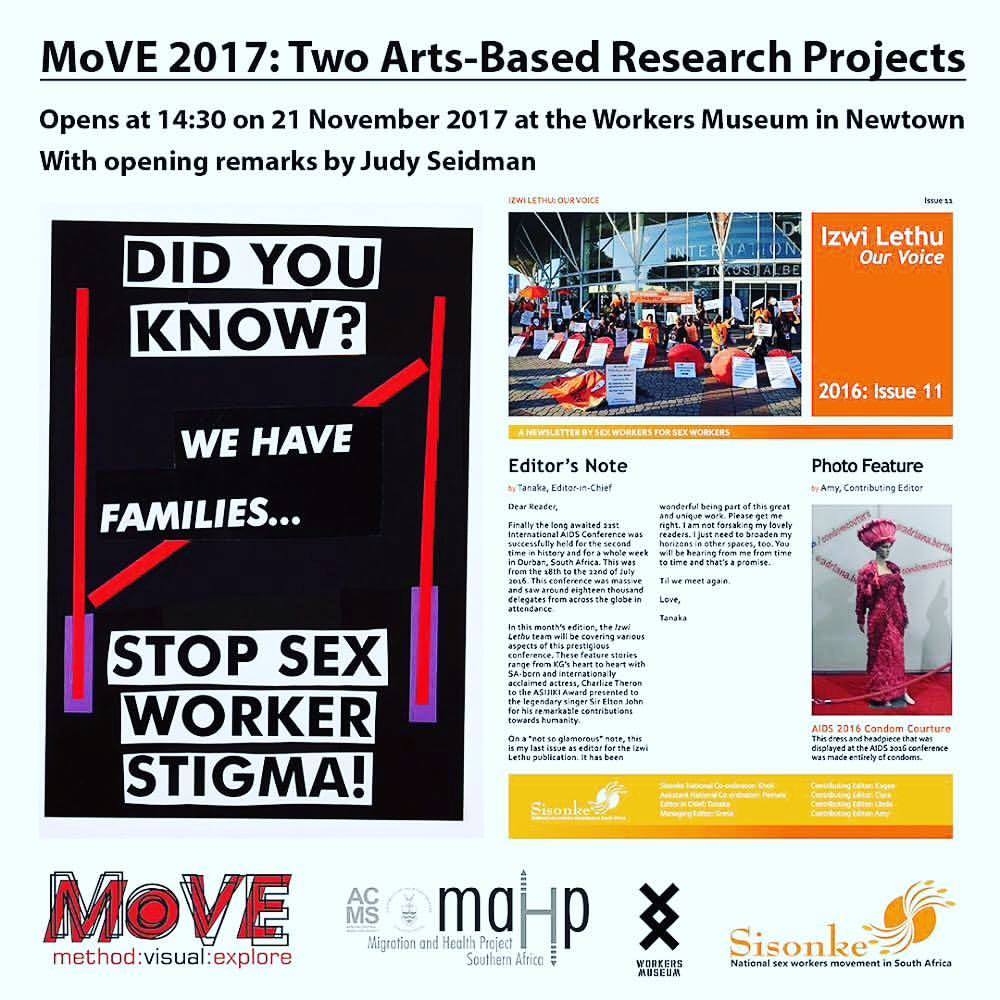
    The MoVE project of the African Centre for Migration & Society is holding an exhibition that showcases two visual and narrative research projects conducted in 2016 and 2017.  Both projects involved collaboration with the MoVE Project and the Sisonke Sex Worker Movement. We feature an exhibition of The Sex Worker Poster Project: a poster conducted with persons who sell sex in Mpumalanga, and an exhibition of the sex worker newsletter project entitled, Izwi Lethu: Our Voices. Opening remarks: Judy Seidman on the history of posters in activism in South Africa Judy Seidman is a cultural worker and visual artist. Between 1980 and 1985, Judy worked with the Medu Art Ensemble in Gaborone, Botswana, to make posters for the liberation struggle in South Africa. Since then she has worked as a curator, facilitator and freelance designer, for various social movements, including the trade unions, AIDS campaigns, Curriculum Development Project, Khulumani Support Group,  the 1in9 Campaign and the Sex Workers Education and Advocacy Taskforce. Date:    Tuesday 21 November 2017 Time:    14:30 Venue:  Workers Museum, Newtown, Johannesburg The exhibition will run until 20 December 2017.

  • Social cohesion and violence prevention symposium

    Humanities Graduate Centre Seminar Room, South West Engineering Building, University of the Witwatersrand East Campus

    South Africa is a place of many contradictions, conflicts, and tensions, including but not limited to racism, sexism, and xenophobia. Since the 2000s, the term “social cohesion” has been used as something of a catchall ideal, to which these are all an affront. As common as the term is, it does not rest on a clear analysis of why social tensions exist, or what is to be done about those that do. So far, social cohesion has proved both elusive and resistant to official encouragement. The GCRO and the South African Research Chair in Mobility and the Politics of Difference at ACMS, in partnership, are undertaking a programme of research into the empirics of violence prevention, based on previous work on social cohesion. As part of the preparation for this programme a ‘State of Knowledge Symposium’ will bring together academics and practitioners working on problems of social tension, and particularly those that manifest as violence, in an academic setting. The interest of this workshop is to interrogate the kinds of interventions that are being deployed to address this field of social problems, with a particular focus on anti-violence work. Some initial questions include: ● To what extent do those who […]