• EXHIBITION: The project that’s remapping migration in urban Africa

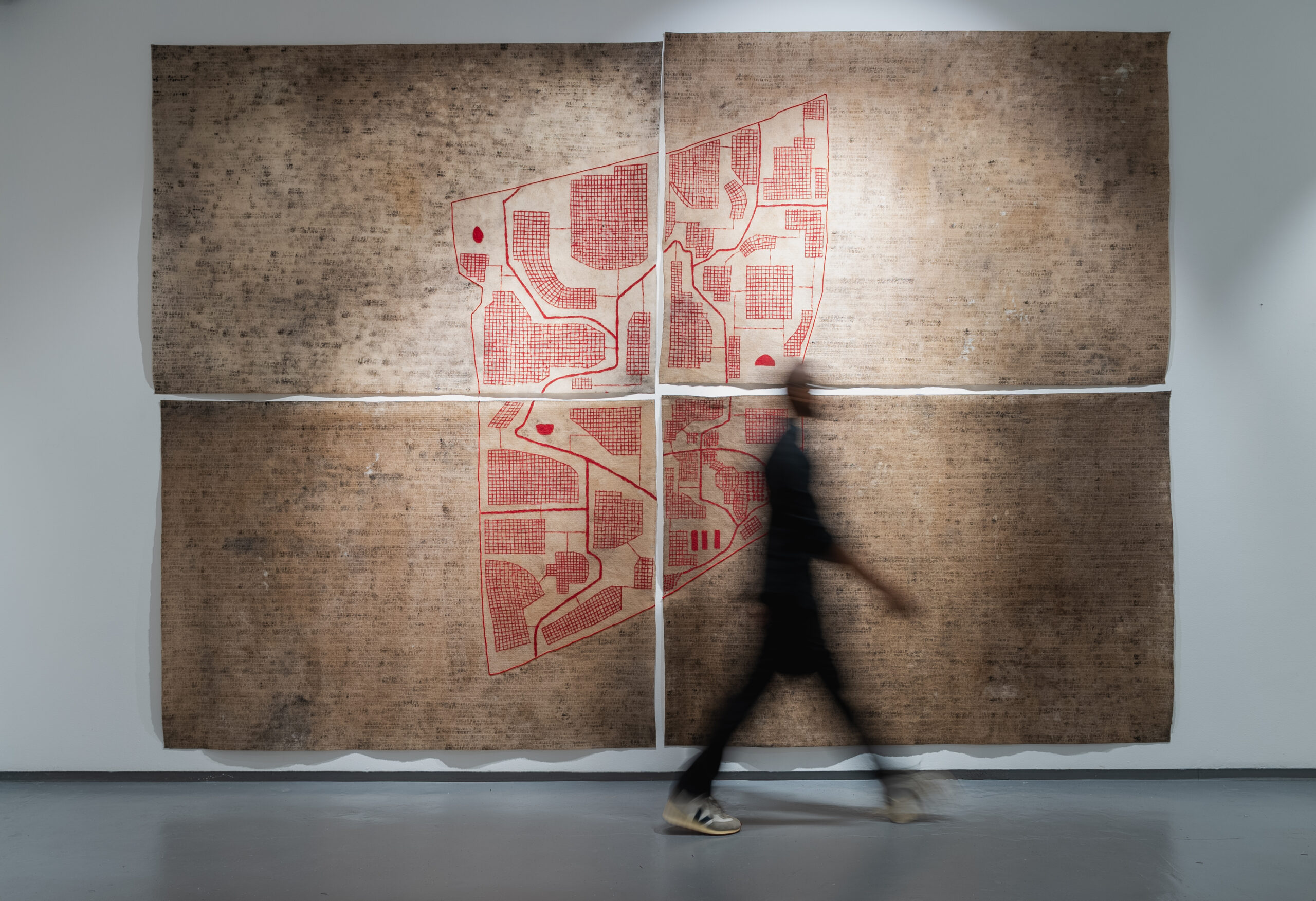
    This post has been adapted from an article that was originally published by Wits University, under the same title, on 3 March 2026. Above featured image, 'When we travel, where do we settle?', by Wezile Harmans (photo credit: Lehlohonolo Ndlovu). In-text image, 'Madini', by Daniel Muchina. And with it, a glimpse into the world's future cities. The population of African cities is expected to double to 1.4 billion people by 2050, with much of this growth being driven by those ​​arriving from elsewhere. Yet the way planners and policy-makers talk about these spaces — using words like failure, ungoverned, and problematic — is unfit for this era of global political, economic and environmental instability. The Atlas of Uncertainty asks: What if African cities aren't behind the curve, but ahead of it? Launching at the Origins Centre at Wits University on 18 April, the Atlas of Uncertainty is a collaborative, interdisciplinary knowledge project — part book, part interactive website, part travelling exhibition — that challenges how we understand and interpret migration and African cities. Built on surveys from gateway neighbourhoods in Accra, Nairobi, and Johannesburg, it braids hard data with essay, poetry, soundscape, artwork, and new forms of cartography to convey what statistics alone cannot — […]

  • ACMS SEMINAR: Exclusionary Cohesion? Rethinking the Nexus between Social Cohesion and Xenophobic Violence in South Africa

    ACMS Seminar Room 2163, South East Wing, Second Floor, Solomon Mahlangu House, University of the Witwatersrand East Campus

    Presenter: Dr Jean Pierre Misago Date: Wednesday, 25 March 2026 Time: 12:30 – 13:45 Venue: ACMS Seminar Room (2163), Solomon Mahlangu House (2nd floor), East Campus, Wits University (directions) Zoom link: https://tinyurl.com/3dwkccpp, Meeting ID: 957 8662 4514, Passcode: 012731 RSVP: Email ntokozo.yingwana@wits.ac.za Abstract: Drawing on nearly two decades of multi-case and comparative qualitative research, this article examines the relationship between social cohesion and xenophobic violence in South Africa. Echoing emerging scholarship, it challenges the conventional wisdom that social cohesion is inherently a solution to violence. It demonstrates that under certain conditions, social cohesion is linked to xenophobic violence, not as a solution but as a driver. It indeed argues that intersections between i) migration-induced diversity; ii) severe socio-economic deprivation; and iii) local governance deficits turn already pervasive bonding cohesion into ‘exclusionary cohesion’, thereby rendering aspects of social cohesion (i.e. social cohesion itself) a driver of xenophobic violence. The article makes three scholarly contributions. First, it introduces two concepts – ‘exclusionary cohesion’ and ‘deprivation-induced cohesion’ (an extension of social closure) - that capture the essence of aspects of social cohesion making it a driver of xenophobic violence in South Africa. Second, it lends voice to calls for reconceptualising social cohesion by […]

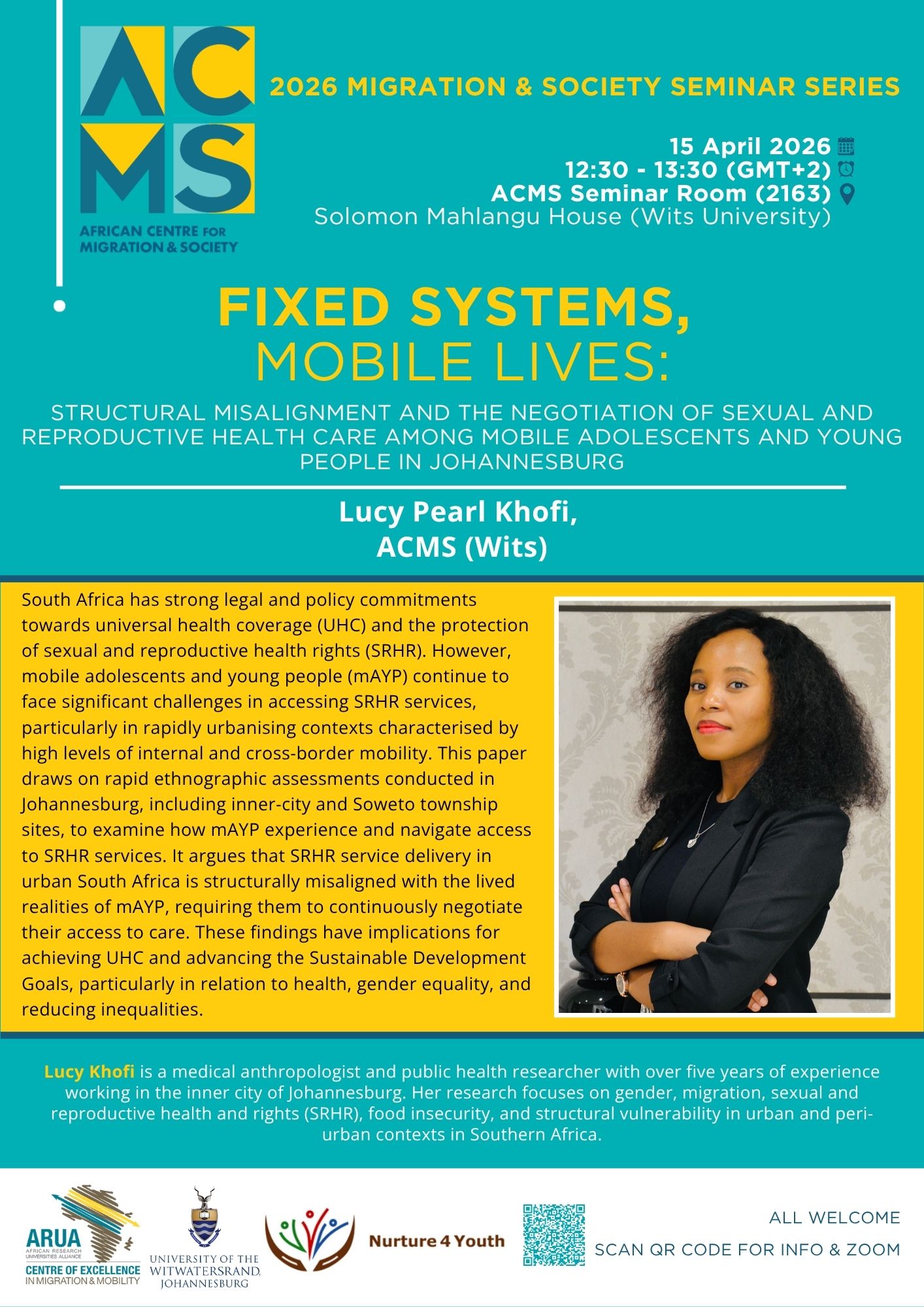
  • ACMS SEMINAR: Fixed Systems, Mobile Lives

    ACMS Seminar Room 2163, South East Wing, Second Floor, Solomon Mahlangu House, University of the Witwatersrand East Campus

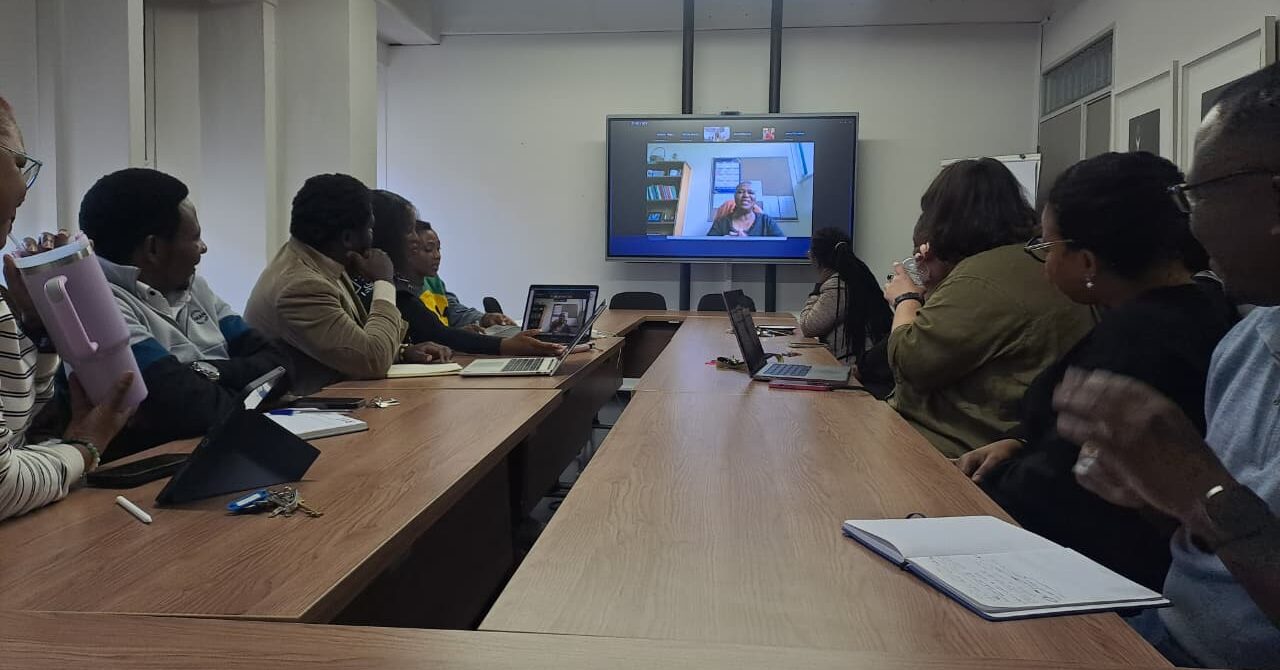
    Presenter: Dr Lucy Pearl Khofi Discussant: Professor Busisiwe Nkala-Dlamini (Wits University, Department of Social Work) Title: Fixed Systems, Mobile Lives: Structural Misalignment and the Negotiation of Sexual and Reproductive Health Care among Mobile Adolescents and Young People in Johannesburg Date: Wednesday, 15 April 2026 Time: 12:30 – 13:30 Venue: ACMS Seminar Room (2163), Solomon Mahlangu House (2nd floor), East Campus, Wits University (directions) Zoom link: https://tinyurl.com/3dwkccpp, Meeting ID: 957 8662 4514, Passcode: 012731 RSVP: Email ntokozo.yingwana@wits.ac.za Abstract: South Africa has strong legal and policy commitments towards universal health coverage (UHC) and the protection of sexual and reproductive health rights (SRHR). However, mobile adolescents and young people (mAYP) continue to face significant challenges in accessing SRHR services, particularly in rapidly urbanising contexts characterised by high levels of internal and cross-border mobility. Nurture4Youth aims to support mAYP’s health and wellbeing by strengthening their capacity to navigate access to SRHR services in new and often precarious environments. This paper draws on rapid ethnographic assessments conducted in Johannesburg, including inner-city and Soweto township sites, to examine how mAYP experience and navigate access to SRHR services. The rapid ethnographic assessment approach included participatory methods such as transect walks, structured observations of key spaces, community engagements, and in-depth […]

  • VIDEO: Fixed Systems, Mobile Lives

    By Reabetswe Maputla South Africa has strong legal and policy commitments toward Universal Health Coverage (UHC) and the protection of sexual and reproductive health and rights (SRHR). However, findings from a rapid ethnographic assessment in Johannesburg, across inner-city and Soweto, highlight a clear gap between policy and lived reality. On 15 April, ACMS post-doctoral fellow Dr Lucy Pearl Khofi presented at the ACMS Migration & Society Seminar Series a paper on: 'Fixed Systems, Mobile Lives: Structural Misalignment and the Negotiation of Sexual and Reproductive Health Care among Mobile Adolescents and Young People in Johannesburg.’ Professor Busisiwe Nkala-Dlamini of the Wits University, Department of Social Work, was the discussant. Mobile adolescents and young people (mAYP), particularly in rapidly urbanising settings shaped by internal and cross-border mobility, face significant barriers to accessing SRHR services. Long waiting times, overburdened facilities, and rigid administrative systems often make access difficult. Many are forced to choose between seeking healthcare and meeting immediate economic or family responsibilities. Dr Khofi argues that SRHR service delivery is structurally misaligned with the lived realities of mAYP. While health systems assume stability and continuity, young people’s lives are often mobile, uncertain, and economically constrained. As a result, access to care is […]

  • BOOK LAUNCH: East African Queer and Trans Displacements

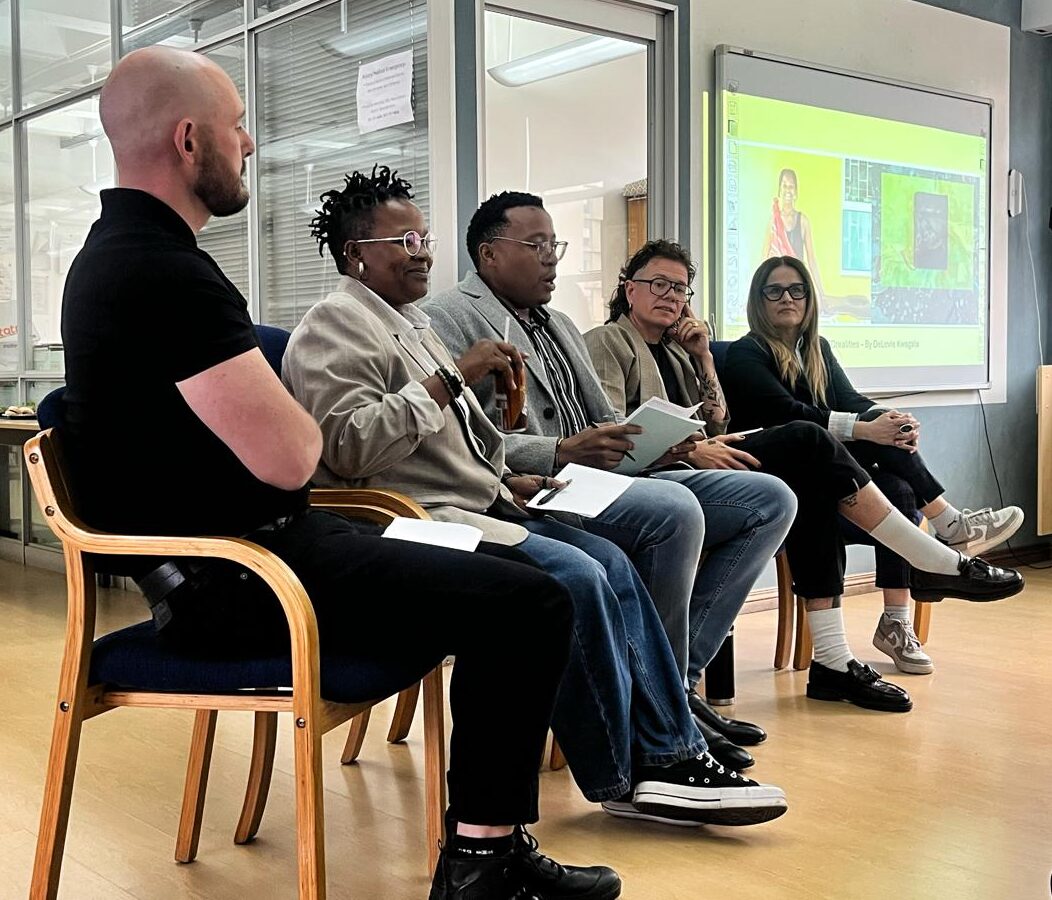
    Over the past decade, East Africa has become synonymous with state-sponsored homo/ transphobia, marked by draconian legislation and recurring moral panics. These escalating dynamics have forced many LGBTQI East Africans to flee their homes. Yet it would be wrong to characterise East Africa solely as a producer or host of LGBTQI refugees. It is also a site of activism and community, of belonging and enterprise, where the limits of protection mechanisms are tested and redefined. Bringing together diverse case studies and interdisciplinary perspectives, this collection features original creative works by queer and trans diasporic writers and artists to explore the drivers, impacts and meanings of queer and trans displacement in and from the region. East African Queer and Trans Displacements is an open access collection that offers the first in-depth examination of queer and trans displacement in the region. The latest book launch was held on 13 April 2026 at the Wits Centre for Diversity Studies (WiCDS). It brought together three of the editors—Dr. B. Camminga (University of Bristol), Dr Barbara Bompani (University of Parma) and Dr John Marnell (Wits University)—in conversation with Dr Kudzaiishe Vanyoro (Wits University) and Shinta Jennifer Ayebazibwe (University of Johannesburg).  Speaking about his book chapter, titled: […]

  • ACMS SEMINAR: The Adversity Grid – Beyond Epistemological Traps

    ACMS Seminar Room 2163, South East Wing, Second Floor, Solomon Mahlangu House, University of the Witwatersrand East Campus

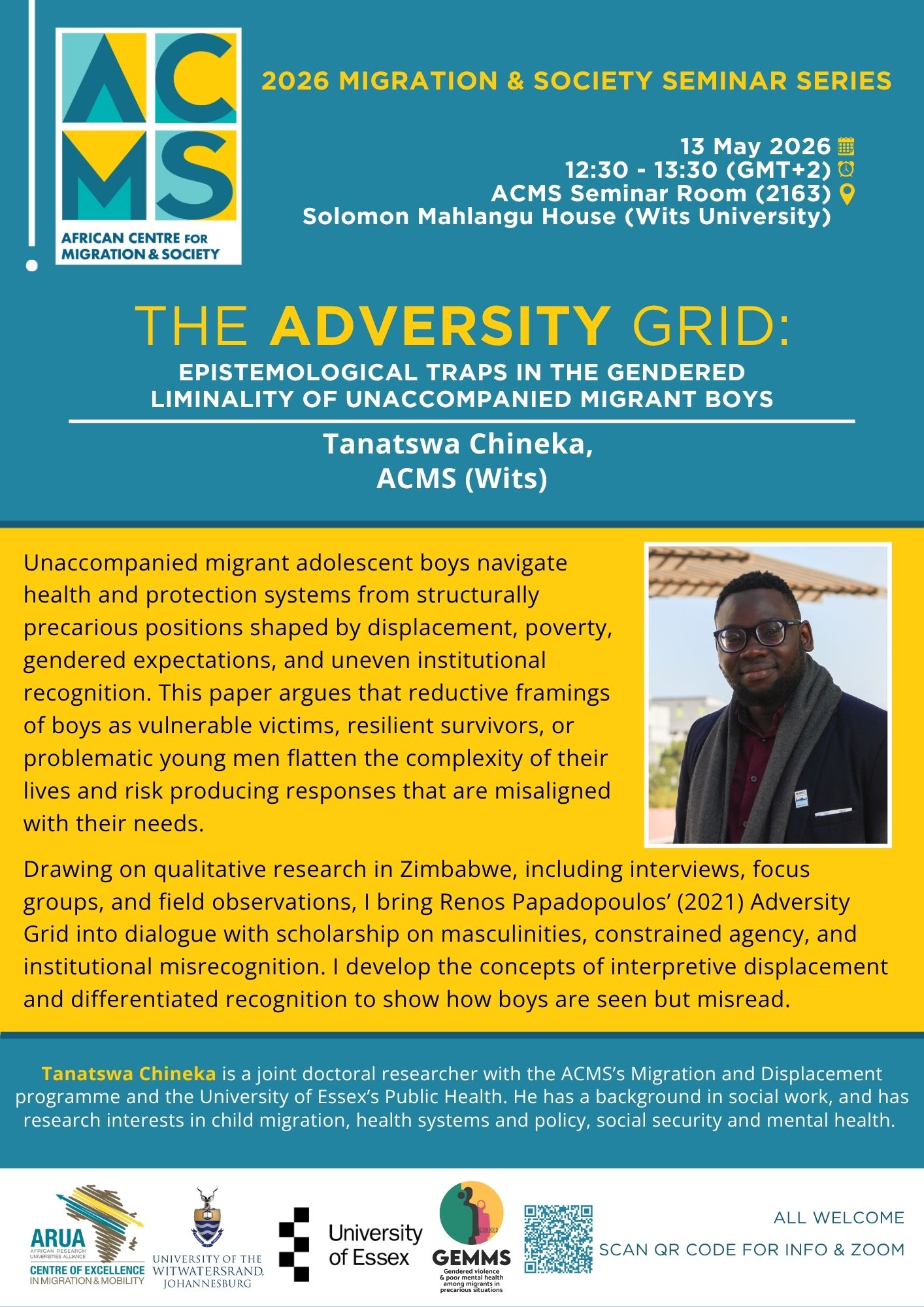
    Presenter: Tanatswa Chineka Title: The Adversity Grid: Beyond Epistemological Traps in the Gendered Liminality of Unaccompanied Migrant Boys Respondent: Prof. Edmos Mtetwa (Department of Social Work, University of Zimbabwe)  Date: Wednesday, 13 May 2026 Time: 12:30 – 13:30 Venue: ACMS Seminar Room (2163), Solomon Mahlangu House (2nd floor), East Campus, Wits University (directions) Zoom link: https://tinyurl.com/3dwkccpp, Meeting ID: 957 8662 4514, Passcode: 012731 RSVP: Email ntokozo.yingwana@wits.ac.za Abstract: Unaccompanied migrant adolescent boys navigate health and protection systems from structurally precarious positions shaped by displacement, poverty, gendered expectations, and uneven institutional recognition. This paper argues that reductive framings of boys as vulnerable victims, resilient survivors, or problematic young men flatten the complexity of their lives and risk producing responses that are misaligned with their needs. Drawing on qualitative research in Zimbabwe, including interviews, focus groups, and field observations, I bring Renos Papadopoulos’ (2021) Adversity Grid into dialogue with scholarship on masculinities, constrained agency, and institutional misrecognition. Findings show that boys occupy a condition of gendered liminality and are subject to a girl-centred triage, achieving only partial recognition through the figure of the “good migrant boy.” I develop the concepts of interpretive displacement and differentiated recognition to show how boys are seen but […]

  • ACMS SEMINAR: Growing Up Across Borders

    ACMS Seminar Room 2163, South East Wing, Second Floor, Solomon Mahlangu House, University of the Witwatersrand East Campus

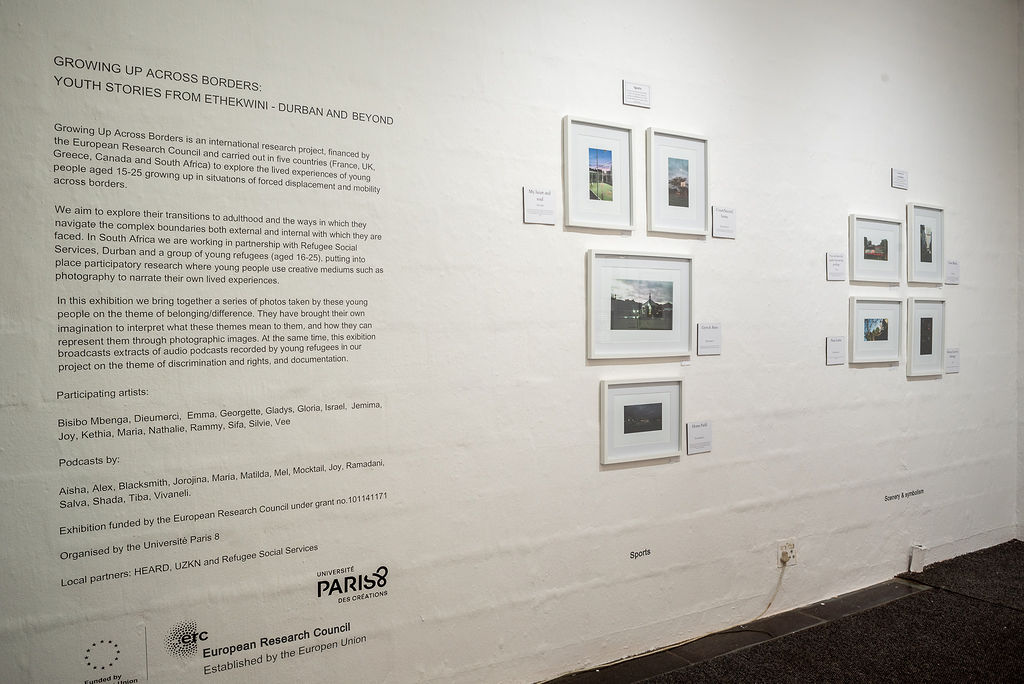
    Presenters: Prof. Jane Freedman and Dr Aron Hagos Tesfai Title: Growing Up Across Borders Date: Wednesday, 20 May 2026 Time: 12:30 – 13:30 Venue: ACMS Seminar Room (2163), Solomon Mahlangu House (2nd floor), East Campus, Wits University (directions) Zoom link: https://tinyurl.com/3dwkccpp, Meeting ID: 957 8662 4514, Passcode: 012731 RSVP: Email ntokozo.yingwana@wits.ac.za Abstract: Growing Up Across Borders (GRABS) is a project at the Université Paris 8 that explores how migration, mobility, and urban life shape the health, wellbeing, and everyday experiences of young people across Southern Africa. Bringing together research, dialogue, and community engagement, the project focuses particularly on the ways mobile and migrant youth navigate access to healthcare, social support, education, and opportunities within contexts of inequality and precarity. By centring young people’s lived experiences across borders, the project aims to generate evidence that informs more inclusive policies, responsive health systems, and youth-centred approaches to social justice and development. About the presenters: Prof. Jane Freedman is the leader of the European Research Council (ERC) funded Growing Up Across Borders (GRABS) project. She is a professor at the Université Paris 8 and a member of the Paris Centre for Social and Political Research (CRESPPA). Her research has focused for many years […]

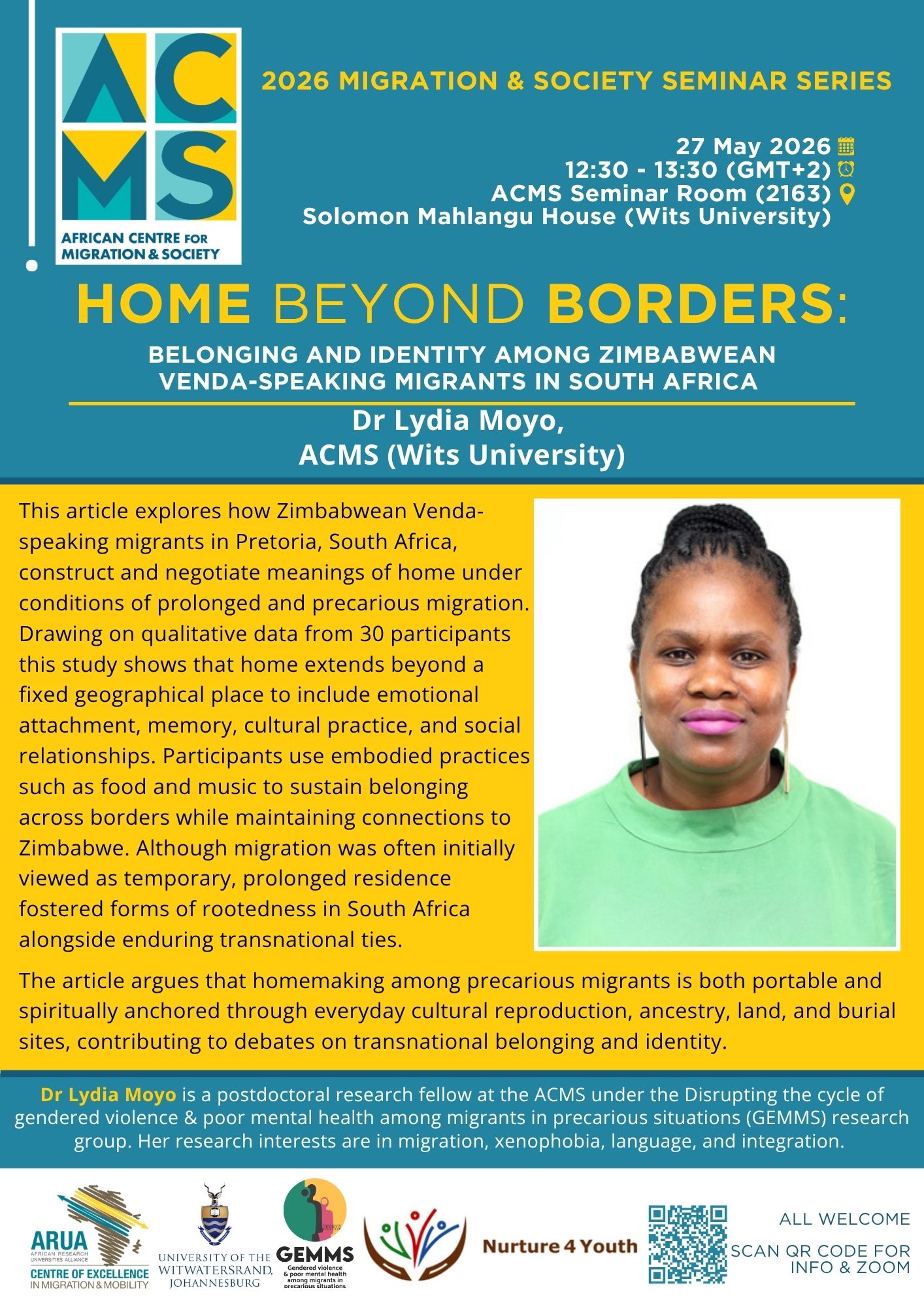
  • ACMS SEMINAR: Home Beyond Borders

    ACMS Seminar Room 2163, South East Wing, Second Floor, Solomon Mahlangu House, University of the Witwatersrand East Campus

    Presenter: Dr Lydia Moyo Title: Home Beyond Borders: Belonging and Identity among Zimbabwean Venda-Speaking Migrants in South Africa Discussant: Dr Paddington Mutekwe Date: Wednesday, 27 May 2026 Time: 12:30 – 13:30 (GMT+2) Venue: ACMS Seminar Room (2163), Solomon Mahlangu House (2nd floor), East Campus, Wits University (directions) Zoom link: https://tinyurl.com/3dwkccpp, Meeting ID: 957 8662 4514, Passcode: 012731 RSVP: Email ntokozo.yingwana@wits.ac.za Abstract: This article explores how Zimbabwean Venda-speaking migrants in Pretoria, South Africa, construct and negotiate meanings of home under conditions of prolonged and precarious migration. Drawing on qualitative data from 30 participants collected through semi-structured interviews and analysed thematically using Atlas.ti, the study shows that home extends beyond a fixed geographical place to include emotional attachment, memory, cultural practice, and social relationships. Participants use embodied practices such as food and music to sustain belonging across borders while maintaining connections to Zimbabwe. Although migration was often initially viewed as temporary, prolonged residence fostered forms of rootedness in South Africa alongside enduring transnational ties. The article argues that homemaking among precarious migrants is both portable and spiritually anchored through everyday cultural reproduction, ancestry, land, and burial sites, contributing to debates on transnational belonging and identity. About the researcher/presenter: Lydia Moyo is a […]

  • ACMS SEMINAR: Hearing the City

    ACMS Seminar Room 2163, South East Wing, Second Floor, Solomon Mahlangu House, University of the Witwatersrand East Campus

    Presenter: Dr Brian Murahwa Title: Hearing the City: Pentecostalism, Urban Soundscapes and the Politics of Audibility in Johannesburg's Inner City Discussant: Carina Tenewaa Kanbi Date: Wednesday, 17 June 2026 Time: 12:30 – 13:30 (GMT+2) Venue: ACMS Seminar Room (2163), Solomon Mahlangu House (2nd floor), East Campus, Wits University (directions) Zoom link: https://tinyurl.com/3dwkccpp, Meeting ID: 957 8662 4514, Passcode: 012731 RSVP: Email Jaclyn.Modise@wits.ac.za Abstract: This article examines Johannesburg’s inner city as a complex auditory landscape where religious actors, informal economies, transport systems, and street life intersect, creating overlapping acoustic territories. Sound influences spatial order, social interactions, and belonging. Over the past two decades, the city has integrated new 'sounds' from Pentecostal Churches, whose growth has surged amid rising urban insecurity and uncertainty. The use of high-powered sound systems in Pentecostal churches has elicited mixed reactions – joyous for Pentecostals and an affront to other urban actors. Based on extensive ethnographic fieldwork, this article argues that the use of boisterous sound systems by Pentecostal Churches should not be dismissed as mere nuisances or ‘noise’, but rather, should be understood as forms of spatial production embedded within broader urban struggles over visibility, audibility, legitimacy, and survival. This study proposes ‘sonic justice’ as an alternative framework […]

  • EVENT: Parliamentary Symposium On Migration and Social Cohesion

    Wits School of Governance, 2 St David's Place, Parktown, Johannesburg, 2050

    ACMS migration expert and co-director Prof. Jo Vearey will be making inputs at the South Africa National Migration Symposium (SAN-MIS) tomorrow. SAN-MIS is a landmark initiative led by the Portfolio Committee on International Relations and Cooperation in partnership with the Wits School of Governance (WSG) and the International Organization for Migration (IOM). Established as an annual platform for inclusive, evidence-based dialogue, SAN-MIS brings together policymakers, academics, civil society, migrant and host communities, diplomatic missions, and international partners to engage on one of the most pressing issues shaping South Africa and the African continent. The symposium seeks to promote informed public discourse, strengthen social cohesion, and generate practical policy recommendations that support safe, regular and humane migration while addressing the challenges associated with irregular migration. The inaugural symposium focuses on the theme, “Social Cohesion between Nationals and Migrants in South Africa”, reflecting the urgent need to address growing social tensions and their implications for community stability, regional relations and South Africa’s position within Africa. Through constructive dialogue, research-informed discussions and the sharing of lived experiences, the symposium aims to identify practical interventions that foster coexistence, counter misinformation, and strengthen social inclusion. By creating a trusted platform for engagement, SAN-MIS contributes to […]